


‘Shall these bones live?’: The Criterion in Crisis
At the beginning of 1928, Eliot was busy writing a new life. In fact, he was writing a new new life: ‘Ash-Wednesday […] was merely an attempt to do the verse of the Vita Nuova in English’, the poet would later write. In ‘merely’, Eliot disguises his own serious aspirations for the poem: to relineate Dante’s text of radical love for a world between wars and a spirit undergoing conversion’s anacoluthon. Nonetheless, what would become the second part of Ash-Wednesday appeared for the first time in The Criterion in January 1928, as a poem called ‘Salutation’:
Lady, three white leopards sat under a juniper-tree
In the cool of the day, having fed to satiety
On my legs on my heart my liver and that which had been contained
In the hollow round of my skull. And God said
Shall these bones live? shall these bones
Live?
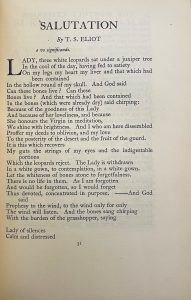
The poem here speaks as and with and to (and perhaps for) the God of Ezekial 37, posing a question – twice, differently – on the edge of resurrection: ‘Shall these bones live? shall these bones / Live?’ At around the same time, a more worldly question of life and death had come to The Criterion, with the voice of God reconstituted as Lady Rothermere, who had, at the end of 1927, withdrawn her funding for the magazine. Lady Rothermere and The Criterion had always had an uneasy relationship – despite its distinguished contributors, which included Paul Valéry, Marcel Proust, Ezra Pound, Virginia Woolf, I. A. Richards, Hart Crane and various other modernist dignitaries – and now she decided to pull the plug. The Criterion, whose influence far exceeded its readership, found itself on the brink of extinction – and in need of its own new life.
Most letters gathered here pertain in some way to this uncertainty around the publication’s future. ‘Everything has been so kaleidoscopic’, Eliot writes to Roger Hinks in January 1928; by March of that year, it is still ‘in a tottering state’ (to Mark Wardle). Even Thomas Hardy’s death is subsumed by the magazine’s immediate solvency: ‘I should have written to you immediately on hearing of Hardy’s death but had many other things on my mind. The fact is that the survival of The Criterion is at present uncertain and we cannot look forward any further than March’ (to Jean-Jacques Mayoux, 25 January 1928). Elsewhere, there are several apologies for delays: ‘I am ashamed to say that in the doubtful state of Criterion affairs […] I have not read a single manuscript of anybody’s’ (to Alan Porter, 4 April 1928); for missed lunches (with, for instance, Herbert Reed (17 February 1928); and for having to reject submissions and suggested reviews (for example, to Atherton Mercer, 24 January 1928). Much is written in haste and with little space for saying more than what is necessary – though there are glimmers of Eliot’s comic gravity: ‘All that I can say at the moment is that we have gone a good way toward getting the guarantees that we need; not that a few more millionaires could not be helpful if you know of any’ (to R. E. Gordon George, 20 February 1928). In the end The Criterion survived as a quarterly, and Eliot began the business of dealing with the backlog of contributors: ‘Therefore I cling tenaciously to your Milton’, he writes to H. J. C. Grierson on 14 June, lest the review should have slipped away in the ‘period of extreme confusion’.
Counterpointing the crisis are whispers of Eliot’s literary immortality. There are letters to his usual coterie – Orlo Williams, Herbert Reed, John Gould Fletcher, Thomas McGreevy, Wyndham Lewis – alongside tantalising glimpses of rising stars, such as a young Louis Zukofsky (whose contributor’s cheque got lost in the post – August 1929). There are the invitations to speak at various university literary societies, with names such as The Hesperides (Ronald J. Politzer, 24 January 1928), Imperial College Literary Society (Geoffrey F. Carter, 11 September 1928 ), King’s College Literary Society (W. A. Simpson, 30 August 1928) and The Heretics (G. F. Williams, 20 March 1928), where he was asked to repeat his introduction to the Clark Lectures to an audience keen for a closer listen: ‘many who attended your lectures [in 1926] would be very pleased to hear you on the same subject in a smaller room’. Most are graciously rejected or gracefully postponed. Nonetheless, such an increase in attention might lead a poet to consider his self-image:
Thank you very much for the photographs. I think they are excellent – especially of Marion and John: the only faults in mind are the Charlie Chaplin moustache (due, I suppose, to the lighting) and my not having bathed my eyes – and the next time you photograph your male guests at 11 p.m. or so you ought [to] give them a rub over first with your electric razor, that is, if you use such a powerful lens.

This is a letter, written in February 1929, to E. McKnight Kauffer, a well-revered artist and lifelong collaborator of Eliot’s. Under the conditions of increased fame, and public scrutiny, the potentially comic – ‘Charlie Chaplin moustache’ – must be carefully controlled, and stylish blur is preferred to a clear lens revealing tired eyes. In a peculiar twist, Kauffer was also a known Eliot lookalike, and the latter would one day write a profile for his artistic counterpart: ‘I cannot venture to say much about his appearance, because there is said to be a facial resemblance between Kauffer and myself.’ Indeed, there is a certain Eliot-esque surreality in being photographed by your own doppelgänger.
The two letters that pertain most directly to Eliot’s poetic practice come from August 1928 and October 1929. The first, to Bonamy Dobrée, gives abbreviated advice on his latest poem ‘Thuriger’, sent to Eliot for feedback, some choice lines of which run:
And the blood of Thuriger flowed evenly, steadily,
But no tears came,
Not a cry for a hard sword in the silence,
Only the flurry of bats
Over the stone where the body gleamed no longer.
[…]
The clouds passed evenly; the grass stood still in the valley;
And Thuriger remembered the dead limbs shining in the cave.
[…]
Then Thuriger rose and went to the stream,
To the rock by the pool where the waters ruined in froth;
Where the sun struck down on his head, and up from the rock,
And the shadows of eagles swept the rock.
Eliot’s advice offers a valuable – if glimmering – insight into that exacting imprecision that spells the line between good and bad verse: ‘Italics are bad in poetry. Abused by M. Arnold’; ‘Do Bats rustle or what?’; Why SHOULD NOT the grass Stand Still?’; ‘RECOMMENDATION: Study the Poetical Works of Conrad Aiken and Know what to Avoid. RECOMMENDATION: Make up Your Mind on Theological Questions’; ‘Dont like toc toc’. These suggestions constitute a judicious combination of general feeling and close reading. Curiously, Dobrée’s poem bears certain – but striking – rhythmic semantic resemblances to Eliot’s own writing. It is hard not to hear, for instance, in its acoustic repetitiousness, the ‘red rock’ of The Waste Land (not to mention its ‘shadow’), as well as murmurs of Ash-Wednesday: (‘Why should the agèd eagle stretch its wings?’) It is perhaps this slightly uncomfortable proximity that provokes comments such as ‘Thuriger is too much like Ernest Thesiger’, and his advice on further reading: ‘Consider the Major Heresies’. Certain intimacies can be jarring – like being snapped by another lookalike.
The second letter is to Jean de Menasce and is (as ever) written ‘suddenly and in haste’: ‘I have recently [sent] Madame de Bassiano a new poem for Commerce, with a word that if you would care to translate it, I had rather you did [it] than anybody’. A trusted translator is a different kind of intimacy. The poem in question is the third part of Ash-Wednesday, which indeed appeared in Commerce under the title ‘SOM DE L’ESCALINA’, with de Menasce’s translation on the facing page. The Vita nuova becomes, at this point, the Purgatorio: ‘Ara vos prec, per aquella valor / que vos guida al some de l’escalina, / sovenha vos a temps de ma dolor!’ [‘Now I pray you, by that Goodness which guideth you to the summit of the stairway, be mindful in due time of my pain’]. All of which speaks not only of Ash-Wednesday’s polyvocal existence and interest in translational and allusive knowingness, but also to the editorial pains taken by the poet in that these letters tell of Eliot’s patient mindfulness – even at the point of various crises – in his reading of and dealing with others. A poetic development is always in balance against the magazine’s financial struggles, the increasing strangeness of fame and a veritable mountain of material to read: short stories by Gerald Sykes (11 September 1928) and H. A. Manhood (3 October 1928), articles by Ethel Robert Wheeler on Thomas Chatterton (11 September 1928), poetry by Dudley Fitts (12 September 1928). Through Eliot’s unfailing diligence, The Criterion weathered its crisis, and in these letters we see the difficulty by which a great poem somehow takes new life while facing the needs of earthly survival.
DR JACK BARRON