


To mark the centenary of Valerie Eliot’s birth, on 17 August 1926, we reproduce here John Haffenden’s essay on Valerie, featured in volume five of The Letters of T. S. Eliot.
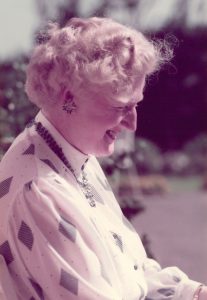
Valerie Eliot: Editing the Letters
The Letters of T. S. Eliot owes everything to Valerie Eliot (1926-2012). She had been Eliot’s greatest fan ever since, aged fourteen, she listened to a recording of ‘Journey of the Magi’ played to the class by her English teacher at St Anne’s School, Reading. From that moment Valerie Fletcher (as she then was) felt a spiritual connection. ‘I was overwhelmed by it,’ she wrote. ‘I remember intense excitement, as though a bomb had exploded under me. I knew something had happened, I knew this was different.’ One of the first things she read by Eliot was his elf-revealing introduction to the Collected Poems of Harold Monro (1933): ‘There is no way out. There never is. The compensations for being a poet are grossly exaggerated; and they dwindle as one becomes older, and the shadows lengthen and the solitude becomes harder to endure.’ It moved her profoundly. ‘It was extraordinary that I felt I just had to get to Tom, to work with him. That introduction to Monro’s poems haunted me.’ Later, she sought out ways of working for him, and she hoped to become his secretary. For a year after leaving school, 1945-46, she worked in the Rare Manuscript Library of the Brotherton Library at Leeds University; and in 1948-49 she was secretary to the author Charles Morgan. However, her passion for all things Eliotic persisted, and became something of a family joke; and even Dylan Thomas – for whom she did occasional secretarial work in the late 1940s – knew her open secret. He was going to see Eliot at his office, Thomas told Valerie one day. ‘What is it worth to you if I push his secretary down the stairs?’ In time, astonishingly, a tip-off from a family friend meant that she did secure the position as Eliot’s secretary, in 1949, and she acquitted herself admirably in the job. She revered the man and his work, and she came to love him – though she did not tell her love. Eliot considered her the best secretary he had ever had, and favoured her so far as to give her an introduction to Max Beerbohm one summer when she was holidaying in Rapallo. However, after seven years of working with Valerie, his admiration grew into deep love, and the 68-year-old Eliot found the courage to propose to her by letter – ‘Dear Miss Fletcher’– in November 1956. They were married at St Barnabas Church, Addison Road, London, on 10 January 1957 (when Valerie was just thirty). The marriage lasted for eight years – ‘minus four days,’ as Valerie would poignantly say – and it brought them both the most intense happiness.
T. S. Eliot enjoyed reading the letters of many writers from Samuel Taylor Coleridge and Baron von Hügel to James Joyce, and he shared his enjoyment with Valerie: they would often read aloud to one another. She it was who kept on pleasantly pestering him about his own letters, and her enthusiasm for having them published at some point. Taking the hint, the uxorious Eliot came to agree that she might in due time make a selection – posthumously. In a memo to his executors, signed in December 1960 – indeed, it was set down earlier than one might imagine – he stipulated: ‘I do not wish my Executors to facilitate or countenance the writing of any biography of me.’ However, he went directly on to authorise an edition of his selected letters – ‘if the selection is made by my wife.’ (In June 1970 Valerie would tell T. S. Matthews: ‘It was with the greatest difficulty that I persuaded him not to ban the publication of his letters.’) In the same memo, Eliot expressed his loving faith in his wife, though not without mentioning the hope, or the heavy hint, that she would safeguard his interests exactly as he saw them. ‘I wish my wife Esmé Valerie Eliot to have sole control over my correspondence, to preserve or destroy letters written to me, and copies of letters written by me, at her discretion.’
Widowed at 38, Valerie dedicated the best part of the remainder of her life – nigh on fifty years – to recovering as many of her husband’s letters as possible. ‘I suppose it’s an emotional outlet, if I’m honest,’ she once said. ‘I’ve put everything into it.’
Originally, long before he met Valerie, the very thought that anyone might publish his letters went wholly against the poet’s wishes. He dreaded in particular the likelihood that the story of his unremittingly unhappy private life with Vivien Haigh-Wood Eliot (1888-1947) – from whom he formally separated in 1933, but from whom he was not to be divorced – might one day be played out for a curious public.
So too, when he learned, late in life, that his intimate friend Emily Hale had placed all of the letters he had written to her – more than a thousand, covering thirty years of their relationship – in the Firestone Library of Princeton University, so ensuring that they would be preserved for the interest and instruction of posterity, he reproached her with some vehemence:
I have the greatest dislike to revealing my private affairs to the public now or at any time merely because of my importance in the world of letters whatever that may be. I have indeed no desire to give information about my private life to the scholars and biographers who have nothing better to do than pry into the biographies of men of letters, and I am afraid that in the same spirit I have destroyed your letters to myself. The thought that posterity may be interested in my work naturally gives me some pleasure but not the thought of posterity being interested in my private life.
It did not seem to occur to Eliot that what he thought a selfish and tasteless decision on her part might well have been meant as a generous tribute to him. It was an unusually ill-tempered letter, begotten by shock. Those letters were to be embargoed until fifty years after Emily’s death; but Eliot could scarcely countenance even the idea that an archivist, in a professional capacity, might read his private letters and keep the confidence.
To Ann Bowden, at the Harry Ransom Humanities Research Center at the University of Texas, Eliot wrote in August 1961 in more measured vein on a related subject: ‘As for the Aldington correspondence, I appreciate your interest in these letters but I cannot at present adjust my mind to the publication of any volume of my correspondence during my lifetime. It seems to me that this is a matter better left to my executors, and perhaps even better to a remote posterity, if that remote posterity is still interested in my correspondence…’ With the writer Richard Aldington he had enjoyed a close but at times warily ambivalent relationship through the 1920s, only for the friendship to be betrayed by the publication of Aldington’s spiteful lampoon Stepping Heavenward (the present volume details thatlling-out, and the enmity that ensued). At least in his dealings with third parties, therefore, Eliot was realistic enough to appreciate that a selection of his letters was bound to be published at some time.
We know that Eliot himself destroyed some batches of letters written by himself, and indeed some written to him (including perhaps most of Emily Hale’s: a few have survived); and we must suppose he destroyed, or arranged to destroy, others. It seems possible, for example, that a box of papers faithfully burned by his editorial colleague Peter du Sautoy at Eliot’s direction included some letters from Eliot’s first wife Vivien. In addition, Eliot’s bibliographer Donald Gallup informed Valerie on 9 November 1987, ‘I remember Theresa telling me that she and Tom burned most of Tom’s letters to Henry.’ (Theresa Eliot was T. S. Eliot’s sister-in-law: the wife of his older brother Henry.) Similarly, following the death of Eliot’s mother Charlotte in 1929, Henry returned to his brother a number of the letters he had written to her; and Eliot told Henry on 25 May 1930: ‘I am glad to have the letters to make ashes of. I should never have wanted to read them again, with all the folly and selfishness; and I don’t want anyone else ever to read them and possibly print them; and if I could destroy every letter I have ever written in my life I would do so before I die. I should like to leave as little biography as possible.’
However, since Eliot made his firm decision to allow his wife to edit the letters as early as 1960, it seems likely that he grew much warmer towards the project during his declining years as he came to appreciate Valerie’s passion for it. Her joy was his greatest gratification. The journalist Michael Davie, in a profile of Valerie Eliot published in the Observer on 15 May 1983, reported: ‘Mrs Eliot told me a moving thing. “Tom did destroy a lot of letters. He told me, ‘If I had known I was going to marry you, I wouldn’t have done it’ ”.’
Notwithstanding Eliot’s gentle promptings in the memo to his executors quoted above, I have come across no evidence to suggest that Valerie destroyed any letter written by Eliot. Everything in her temperament and conduct points to her wish to conserve everything written by her late husband. Morally, she was incapable of junking any piece of paper on which he had written anything. My conviction in this regard is supported by Karen Christensen, who worked as Mrs Eliot’s assistant in the 1980s – and who is in certain respects critical of her ways and means – in an article entitled ‘Dear Mrs Eliot…’ (The Guardian, 29 Jan. 2005): ‘it would have been impossible for her to destroy anything of Eliot’s.’ And Valerie offered her own testimony, which I believe to be reliable, in March 1969: ‘I was … to destroy papers at my discretion, but this I have not done.’
Innumerable carbon copies of the letters Eliot posted from Faber & Faber, following his appointment as director in 1925, are kept in the Faber Archive. The archive, then, was Valerie’s first recourse – and at Faber’s, in the days before the firm took on a full-time archivist, the tactful editor John Bodley would be tasked to help her hunt down obscure items in neglected corners. But Valerie quickly realised that the carbons did not always tell the full story, since Eliot often ‘had the blithe habit’ (as she put it to Frederick Tomlin in 1977) of making holograph additions and emendations to the top copies which were not routinely recorded on the carbon copies. Thus her necessary objective was to track down the signed originals wherever possible.
Further problems came to daunt her: ‘up to 1925, when my husband went to Faber’s,’ she wrote in a letter, ‘he was casual about keeping copies of letters and many of them were written by hand, too. So a good deal of time has to be spent in seeking the whereabouts of the early ones. Many of the correspondents, too, are now dead, and they were not necessarily writers of importance whose papers have been preserved, or are easily available.’ She was referring in particular to the early years when Eliot edited the Criterion – before the periodical was adopted by Messrs Faber & Gwyer Ltd – and when he wrote many letters by hand. (He had a very legible hand, but in later years he would always prefer to write a letter on the typewriter, blaming writer’s cramp.) Consequently, before the age of the computer and the internet, Valerie had to write hundreds of blind letters of enquiry to widows, children or associates, and even to remote possible connections, and to hunt down wills at Somerset House. In the beginning she had little idea as to which libraries in the UK and elsewhere held major and minor collections; she knew of the foremost Eliot holdings at King’s College, Cambridge, and at Harvard and Texas (which she had visited with her husband), but not much else. Richard Ellmann (who had once hoped to be able to write a biography of Eliot’s early life, up to the period of The Waste Land) obliged her by typing out a comprehensive but not exhaustive list of US research libraries. Thus the track of her work for years to come was immediately laid down; as she told an American friend in May 1966:
I am kept busy answering a large correspondence about Tom and his work and I foresee that I shall be trampled under foot and vituperation (when permission is withheld!) by the increasing number of would-be PhDs who want access to Tom’s unpublished papers. And I chase round the world (metaphorically speaking) after his letters. Some were sold in a New York saleroom recently and have gone to earth in the University of Texas who have kindly supplied me with copies. There is a fair amount of detective work involved as I look up wills in order to trace the estate of deceased friends and writers to whom Tom wrote. I find it satisfying and moving to see the picture of him that emerges in his own words over the years but one cries too over his anguish at certain periods.
As that last phrase indicates, the pursuit of the letters was by no means a disinterested academic exercise. It was emotionally taxing, often exhausting, as she lived with him, in all the troubles and triumphs of his earlier life, through all the months of her grieving widowhood. Her work on the letters, she told another correspondent, was ‘occasionally rather desolating, when Tom is describing his current troubles.’ Yet she never failed to find her vocation invaluable and fulfilling. ‘It’s fun,’ she would say. ‘It’s very exciting to recover him in this way.’ She became addicted to the research; it was all-consuming, and she relished in particular that ‘detective element’. As Michael Davie reported in 1983, ‘Mrs Eliot is not being dilatory. She works seven days a week, absorbed by the chase.’
The editing and annotating were demanding work, too: she told her intimate friend Mary Lascelles on one occasion: ‘It is a Ulalume sort of day, wet too, and … this morning was spent grappling with an article on “A Method of Rearranging the Positive Integers in a Series of Ordinal Numbers Greater than That of Any Given Fundamental Sequence of Ω”, in order to annotate a letter from Tom to Norbert Wiener, the “father” of cybernetics. This editorial work is an excellent discipline but how my imagination longs to have its way!’ However, at other times – since she had a great sense of humour, and a love of gossip and anecdote – she thoroughly enjoyed the chase after teasing references that might never be solved. For example, she told her friend Carol Rothkopf in 1975: ‘I am thinking of offering a prize for the solution of the following: the carbon of a letter to a Dr Moore: “I return herewith with my humblest apologies something which I discovered on my coat collar some time after I left you.” ’ (Her co-editor would still like to receive answers to that one, though a prize is not guaranteed.)
The very largest part of her time was to be spent on her top priority, garnering the primary materials: the letters. ‘Apart from my editing work,’ she told another correspondent, William D. Quillian, on 8 March 1977, ‘collecting, sorting and checking absorb my time.’ The scale of the work was huge: it was like assembling a gigantic jigsaw puzzle of hundreds of thousands of pieces, with no template to start out from – a fair number of letters (several to Ezra Pound, for instance) are undated – and there were in the case of many of the principal correspondents, including Pound, literally hundreds of letters to track down and put in order, with outgoing and incoming letters in correct sequence.
At every turn there were setbacks to be negotiated, obstacles to be overcome, puzzles to be revolved and solved, as well as some surprises and unexpected bonuses. Indeed, there can be no doubt that she became an astute researcher and editor. In 1972, for example, she told Lascelles: ‘In a note to The Waste Land Tom gave a passage from Blick ins Chaos by the German novelist and Nobel Prize winner, Hermann Hesse, whom he had visited in Switzerland in 1922 as a result of his admiration for his critical work. There was no correspondence in the files but I had a hunch that Tom had written a “fan” letter and I finally traced a son living in Frankfurt who has not only produced it – written in French – but also two others in German and one in English for good measure. A success of this kind makes up for many disappointments.’ But she was disappointed to have to tell T. S. Eliot’s American publisher Robert Giroux on 19 July 1968, apropos Michael Holroyd’s biography of Lytton Strachey: ‘In it he quotes, with my permission, part of an important letter from Tom dated 1st June, 1919. Tom kept none of his correspondence with Lytton (whom he disliked) so I asked for a photostat of this particular letter and was told by Holroyd … that it had disappeared. So down I went to Marlow where the Strachey papers are kept and spent hours searching through them in case this item had been misfiled, but I eventually returned home cross-eyed and disappointed.’
She benefited from a wealth of willing cooperation; and on 7 October 1966 she was happy to tell Rupert Hart-Davis that she had received only one refusal so far:
That was from Mrs Vinogradoff [Julian Morrell] who said she might want to sell the letters and would get more for them if they were unpublished. Fortunately Tom did not write anything of importance to her mother [Lady Ottoline Morrell]. Bertrand Russell has promised to force a trunk to which he has lost the key and I only hope he does not get distracted by his present well-publicised activities…
And she went on, in the same letter:
As usual the Pounds are causing a headache! Mary [de Rachewilz, Pound’s daughter] sent all Ezra’s private papers to Yale recently without consulting Dorothy [Pound] who has control in her role of legal guardian. Dorothy turned up here in a fury and said she would not allow the crates to be unsealed for many years after Ezra’s death. I hope that when she has calmed down a little she will change her mind. She is perfectly willing in principle that I should have access…
Such ups and downs were almost a daily occurrence. With respect to the first item – Eliot’s letters to Ottoline Morrell – it was fortunate that Valerie was mentally prepared for the long haul, as she was able to report to Lascelles only nine years later: ‘After months of enquiry throughout America I have at last traced 111 letters from Tom to Ottoline Morrell of which I had copies of only 26. Mrs Vinogradoff sold them some years ago without learning their destination.’ There were in fact 126 letters to Morrell housed at Texas University, and some were of importance. (Valerie’s remark that ‘Tom did not write anything of importance’ to Morrell was of course written in a miffy moment – it is perfectly natural to sniff at what one can’t have.) The problem of the Pound papers too was solved only after a lapse of seven years, as Valerie wrote to T. S. Eliot’s beloved cousin Eleanor Hinkley: ‘Yale have bought the Pound crates for $292,000 and Ezra’s daughter, Mary, is being appointed Curator of the collection. I am hoping to have access to Tom’s letters to his friend, because much of their correspondence (written in the style of Uncle Remus) is undated, and I understand that Ezra often kept envelopes.’
However, as with all research, it was the outstanding 10 per cent of the ached-for and angled-for materials that proved the most exhaustingly elusive – and all the more desirable for being elusive. In the summer of 1975 she suffered from a prolonged illness, requiring hospitalisation; and she told Gallup on 14 October that year about some of the missing links, including the French connection – specifically, Eliot’s early dealings with certain prominent writers associated with the periodical Nouvelle Revue Française:
Through my illness, I have lost three months’ work on Tom’s letters, and I doubt if I shall be able to deliver the manuscript by the end of December. Some time ago I was in touch with Jacques Rivière’s son in the hope that he might have some of Tom’s letters to his father, of which I have a number of carbons. He replied that he had none, but that he would go through the NRF material in Mme [Jacques] Paulhan’s possession and write to me again. That was a year ago, and I have heard nothing, but recently I learnt that a French bookseller has been offering three of Tom’s letters to Rivière, and I am trying to trace his name. Due to the kindness of an American university librarian, I was sent a note about a comprehensive collection being sold by International Bookfinders of Pacific Palisades, California. It mentioned that there were eighteen letters, of which ten were typed, written between 1922 and 1954, but gave no details of date or recipient. I have written to them, asking for information, but fear the collection may have been bought by someone who wishes to keep it private…
It was frustrating too when a few other parties did not respond as readily as Valerie would have wished. It was not that she expected others to jump at her command, although admittedly to some correspondents Valerie’s approach felt like a royal command. Her ever-developing authority as a scholar brought her confidence and savoir-faire, and her increasing wealth in later years brought her the patina of power; she was also a glamorous woman, and she had the glamour of being T. S. Eliot’s widow. But she found it difficult to comprehend how others seemed on occasion reluctant to return her offer of quid-pro-quo. She was always willing to reciprocate, despatching letters to other literary estates in return for copies of their original Eliot letters, and supplying letters to scholars authorised by other estates to edit their letters. On 6 March 1973, for example, she advised John Kelly, editor of the letters of W. B. Yeats: ‘I have already extracted a number of letters from Yeats to TSE, and when I am sure that I have found them all, I will send you photostats.’
Similarly, she wrote on 14 October 1977 to Michael and Edna Longley:
As I am preparing my husband’s correspondence for publication, I wrote to Mrs MacNeice earlier this year to enquire whether any of his letters to her husband had been preserved, but received no reply. I understand from Professor [E. R.] Dodds that she was abroad at the time, and he thinks that you may have taken copies of the letters in the course of your work.
If, being on the spot, you could obtain Mrs MacNeice’s approval, I should be grateful if you would kindly let me have photostats at my expense of any TSE letters, or, if they are lent to me, I will have them copied and returned by registered post on the same day. I have carbon copies of 116 letters, but would of course prefer to have sight of the originals in case of holograph additions. It would seem from my files that the two men did not correspond in 1955 or from 1959 to 1962, which is odd, especially as Louis came to one of TSE’s birthday parties in the later period.
The Longleys correctly responded that they had not yet reviewed the MacNeice letters; and of course they were not authorised to transmit to another scholar letters which were owned by Mrs MacNeice. Four months later, on 1 March 1978, Valerie consulted Charles Monteith (then Chairman of Faber & Faber) apropos the problem, as she saw it, of Mrs MacNeice:
I approached her in February last year about Tom’s letters, but received no reply. I then wrote to Dodds, who sent me copies of four letters and said he would send her a reminder. Still no reply. I have also been in touch with the Longleys who are preparing a biography of Louis, but ‘have not yet gone through the vast bulk of correspondence which Hedli possesses’. I have carbon copies of 116 TSE letters and feel sure more than four originals must have been preserved. The Longleys are planning to examine Louis’ letters to Tom which I have extracted from the files and put into a folder, and I wonder whether I might bargain a little? In other words say that Mrs MacNeice must play her part by producing Tom’s side of the correspondence at the same time. Please allow some blackmail!
In time, of course, the problem was civilly resolved, without recourse to ‘blackmail’ or any other form of bargaining.
In such ways she made herself into an expert, assiduous and determined (not to say hard-nosed) scholar – the scholar-editors she aspired to emulate, she once remarked, were Gordon Haight, Gordon Ray, ‘the Dickens trio’, and Richard Ellmann – and she was not prepared to let go of any of her literary quarries once she had got it by the tail. Just how exact, and exacting, she was in her record-keeping can be gathered from a letter to Clive Driver at the Rosenbach Foundation, dated 13 January 1976:
At present I am working to 1930, so I cannot say how many of [TSE’s] letters to Marianne [Moore] I shall be using. I enclose a list of my carbons and photostats, which total 75 letters, 2 postcards, and one cable. On a letter from Marianne dated 30th March 1954 TSE had written “answered 10. 4. 54”; so I should appreciate a copy of his reply at your convenience. Would you like me to check your list of Marianne’s letters to TSE when it is ready?
At the end of those first ten years, when she was pressed by Faber & Faber to notify them when they might expect to receive the first part of what was initially projected to be a three-volume set of letters, she proclaimed with justifiable pride in her achievement, in a letter of 5 February 1977 to Peter du Sautoy (Monteith’s predecessor as Chairman):
I have assembled from several countries Tom’s correspondence relating to the first four years of the [Criterion’s] existence, the period before he joined the firm, and I am enriching our holding of the later years by tracing letters which Tom either wrote by hand or typed himself without retaining a copy – and as you know a number of carbons lack the bottom lines. Furthermore, many of the contributors were or became personal friends as well as Faber authors – Ezra [Pound], [Herbert] Read, [Bonamy] Dobrée, [Wyndham] Lewis, Aldington, Joyce, to name a few – and I have prepared complete collections of each which means that they no longer have a separate existence in the Criterion boxes. When I have completed my task I must re-plan the storing of Tom’s correspondence because there is over-lapping and muddle at Harlow [where the Faber & Faber archive was then housed] and I have accumulated at least twice as much fresh material.
Our three volumes will reflect Tom’s work as editor, though it is in his role as publisher that he advises authors in a similar way to the help he received from Ezra.
In a speech given at the Faber & Faber offices in Queen Square in February 1987, she stressed likewise: ‘Publishing suited TSE’s temperament and I think it is true to say that some of his finest criticism will be found in his letters to correspondents known and unknown and in marginal comments on returned texts.’ The grand topic of TSE’s marginal notes on returned texts still awaits the right PhD candidate.
It was a magnificent feat of research and retrieval on her part, the bringing back together of probably the overwhelming majority of the letters of the lifetime of the foremost man of letters of the twentieth century. ‘Searching for early material is the hardest but rewarding task,’ she wrote on 1 June 1977 to Ellen Dunlap at Texas, ‘and I could write a book about it.’
She had determined too, she said in letters to other enquirers, that the first of the three volumes would comprise 750 letters by Eliot and about forty by other people. And she made known in a letter of 8 March 1977 to William D. Quillian this additional pertinent information: ‘After I have completed my selection, the entire correspondence will have to be reorganised to include later garnerings (which have doubled the size since 1965) before it can be made available to scholars.’
There was one outstanding problem which Valerie never quite got to grips with in the earliest years of her research. So intent was she on amassing the letters that – for understandable reasons – she did not fully face the necessity to figure out just how many of the letters might fit into the three-volume selection that she envisaged. On 20 April 1967 she told Mary M. Hirth, of the Harry Ransom Humanities Research Center, Texas: ‘I dare not begin to make a selection just yet.’ Five years later, she told Robert Giroux, on 21 June 1972: ‘I hope a natural break will occur in 1932, but again this will be influenced by the amount of correspondence that ought to be included.’ It was natural for her to apprehend a break in the narrative in 1932, for that was the year when a major break had actually occurred: Eliot had broken away from his first wife in order to spend a year at Harvard, and he was to seek a legal separation on his return home in 1933. The couple would never again live together, and Eliot would see Vivien on only a couple of occasions thereafter. (One might speculate also that Valerie would therefore have hoped for a second break at about the end of the Second World War; and the third and final volume would carry the story through to T. S. Eliot’s death in January 1965.) However, just a year later, in July 1973, she advised Hinkley, ‘The first volume of Tom’s correspondence will probably go up to 1935.’ But then, on 11 November 1975, in a letter to Mario Praz, she reported: ‘The (generously) selected correspondence will appear in three volumes, the initial one ending about 1927.’
The reason for bringing the date forward is not far to seek: additional caches of letters were still coming to light, notably including letters to Ezra Pound. ‘I doubt if the first volume of the correspondence will appear until the spring of 1977,’ she advised her friend Professor L. C. Knights, ‘as the Pound situation I mentioned is unlikely to be settled by September when I should have to go to press… It is galling, but I must include all Tom’s epistles to Ezra.’ (Valerie recognised that Pound had been the prime figure in Eliot’s career, so she wanted to print every one of Eliot’s letters to him.) She wrote too, in the same month (May 1975), to Carol Rothkopf: ‘I am determined to wait until I have access to [James] Laughlin’s Pound letters.’ After just another year, she explained to Giroux in New York on 1 June 1976:
Another Pound setback. Some more letters from Tom have turned up in the possession of the heir of William Bird … with whom Ezra left papers on his departure from Paris in 1924. The executors now claim them as their property, to be sold to the Lilly Library, but the Pound estate disputes this and a court case may follow. Whatever the outcome it is obvious that this cache will not be available for my first volume goes to 1926 – and should be ready for you and Peter [du Sautoy] next month. I suppose this material will have to be an appendix to volume two. O dear.
In truth, she could not bear the idea of having to introduce an appendix of earlier letters into a later volume: after toiling for so many years at her appointed task, she anticipated volumes of formal perfection, with every letter in its proper place. This latest ‘Pound setback’, as she called it, was to be overcome over a year later, as she told Giroux on 27 October 1977: ‘William Cagle of the Lilly Library says that the dispute with Yale over the Bird papers has been settled and Indiana University is to get Tom’s twenty letters and one postcard written to Ezra before 1924, and will be sending me photostats. I am delighted that we shall be able to include them in their proper place in volume one instead of as an appendix to a later volume.’
But no sooner was that obstacle overcome than another precious bunch of letters came to light, as Valerie told Lascelles on 27 July 1977:
Owing to a recent death 207 TSE letters, 25 postcards and 4 telegrams are to be made available to me by the University of Texas. There was a further twenty years’ ban on their release before I told a piteous story to the recipient’s Q.C. son [Jeremy Hutchinson, son of Mary Hutchinson]. Until the photostats arrive I do not know what number fall within the compass of the first volume or how many I shall want to use, but I expect footnotes will have to be adjusted at a time when I am suffering from footnote-it-is – that is a compulsion to annotate everything I read, a condition exacerbated by the recollection of Johnson’s remark about it being impossible for an expositor…
She received copies of those long-embargoed letters to Mary Hutchinson by the turn of the year, as she informed Edward Mendelson (W. H. Auden’s literary executor and sympathetic fellow editor) on 14 February 1978: ‘I have been busy adjusting footnotes in the first volume as I have had to include a further twenty letters from Ezra which have now become available after the legal argument between Yale and Indiana; and 207 letters from another recipient who died recently.’
This was to become a frustrating and in fact self-hampering problem. Since Valerie was aiming to shape each volume in terms of a single continuous run of footnotes, any infiltration of additional letters meant that all the succeeding notes would be dislocated, requiring retyping (this was still some time before the advent of the computer in the 1980s). Yet the bulk of her text was expanding exponentially with almost every day’s delivery of mail; and there were few rare book and manuscript dealers or specialist librarians throughout the world who were unaware of her interest in buying, or begging to borrow, every new find. At times she would feel almost harassed by news of new letters, for all the practical difficulties they raised, while unequivocally welcoming them in her heart. But how to squeeze the whole into a manageable volume, without leaving out countless plums: that was the problem.
‘You may recall,’ wrote William R. Cagle, Lilly Librarian, on 9 December 1981, ‘that a few years ago we acquired a small number of Mr Eliot’s letters to Ezra Pound in the papers of William Bird. Now, by good fortune, we have added some 12,000 letters written to Ezra and Dorothy Pound from the estate of Mrs Pound and among them are approximately another hundred letters from Mr Eliot.’ The level of anxiety Valerie felt at that moment is apparent in her response of 22 December to Cagle’s courteous notice: ‘I feel stunned at the thought of another 100 letters from TSE to Ezra Pound, but assume that the majority of them were typed and that I have the carbon copies. I have in fact prepared a number of letters in this way, not knowing whether the originals existed or not. My four volumes are laid out and the first must go to the printer soon.’
The number of volumes had been revised upward to four by 1980. By 1983 Michael Davie reported, ‘There will be four volumes, possibly five.’ Karen Christensen has likewise testified that by the mid-1980s, ‘There had been plans to publish five volumes.’ And in a letter to Valerie in February 1991 John Bodley referred to ‘II, III, IV, V and so on.’
In the event, volume I of the Letters appeared in 1988; it covered the period ending in 1922 with the publication of The Waste Land and the founding of The Criterion. (The volume sold 10,187 copies in its first year.) Interestingly, volume II – spanning 1923-7 – was advertised in the Spring and Autumn 1990 catalogues of both Faber & Faber Ltd and Harcourt, Brace, Jovanovich, complete with a compelling blurb and jacket design. But volume II was not to be published in that form, and the reason may be deduced from the fact that the period 1923-7 had ultimately to be packaged into two volumes of the Letters – II, 1923-5; and III, 1926-7.
This is not to find fault with Valerie’s policy. Her ambitious strategy was to determine the total quantity of the letters, and then to divide the whole into portions. However, given Eliot’s prolificness as letter-writer, the letters themselves would have to dictate the ultimate number of volumes, since among other considerations the scale of annotation required could not be predetermined.
Just as she could never bring herself to abolish a letter, so too Valerie saw that while letters are documents to edit, they are not documents in a case. All the same, she herself loved biographies, and in particular she loved the life of her husband. She had many years of training, beginning as his secretary for eight years, then for the further eight years as his wife, in deciphering his handwriting, gathering his memories, learning his mind. She had read and re-read his works, along with numerous critical commentaries. She had heard Eliot comment on details of background and reference in his works. In addition, over the course of her research career, she made herself into the indisputable world expert on Eliot’s life and texts. And so for Valerie, the business of editing the letters was to some extent a mode of simultaneously bowing to his directive that there should be no biography and bypassing it by laying down all the very best building blocks of a biography.
She told Aurelia Hodgson in January 1966 – almost a year to the day after Eliot’s death – ‘Although Tom has forbidden a biography I hope to incorporate interesting biographical facts which seem relevant.’ And just a few months later again, in August 1966, she advised Giroux: ‘[Tom] has made a definite ruling [against a biography] and I cannot go against his wishes. However, the letters will make a most marvellous autobiography, and be a valuable quarry for biographers fifty years hence!’ Similarly, on Easter Day 1972 she wrote to Elizabeth Wilson: ‘I shall treasure your letter, and leave it with my husband’s papers, so that a future biographer may have a correct perspective.’ Ironically, such declarations came close to disobedience: if letters are an essential part of the materials of biography – indeed, Valerie sometimes referred to the letters she was accumulating as ‘material’ – she took infinite pains to be the helpmeet of a future biographer: gathering the raw materials whilst she may. (Even Eliot himself was occasionally given to remarking in later years – as in a letter to Wilder Penfield dated 1 May 1964 – ‘I don’t think I produced any memorable verse during my undergraduate days. This [his Class Day Ode, 1910] and the various poems which appeared in the Harvard Advocate are now only of biographical interest’.) But I do not mean to tease this point too far: there is no doubt whatever that Valerie worked consistently to honour the letter of Eliot’s will. As she told Thomas Dozier of Time-Life on 3 March 1970, ‘As the sole literary executrix, I must carry out his instructions, and refuse any would-be biographer access to private papers and unpublished material.’ So she took her professional stand where her husband had drawn his absolute line.
All the same, a further irony arises from the fact that Valerie invariably delighted in sharing her husband with friends, visiting scholars, casual enquirers – she would excitedly chat about him well into the night – and now and then she showed visitors some of Eliot’s letters to herself. Commentators who have criticised her for being protective of his reputation and guarding his letters have rather missed the point, albeit often understandably. She did seem to sit on the letters for such a tiresome age, though she never meant to take so long over it all. There was a widespread feeling that Valerie was simply holding back the letters and so impeding other scholars in their legitimate enquiries; whereas the truth was, as I have tried to explain, she was just as much of a researcher as they were, spending years in doing the primary research. She saw little reason why other scholars thought they had a right to carve out for their own purposes parts of the research she was frantically engaged upon, and she was anxious to retain copyright control. From the outsider’s point of view, she seemed overprotective and obstructive. In truth, she was simply adhering as best she could to her brief as literary executor.
While it was easy for her to spot the more transparently disingenuous approaches vis-à-vis Eliot’s letters – as when the playwright Michael Hastings wrote to ask her for help with the biographical research for his play Tom & Viv – on the basis, as he told her, that his text specifically dealt with the story of Vivienne, ‘to the exclusion of all others’ – she saw too, without cynicism, that several other researchers sometimes sought permission to make use of unpublished letters by Eliot, or extracts from them, in the context of critical studies or collateral biographies of all sorts. She tried to be consistent in her response to enquirers, though of course she sometimes got it wrong. She was often very willing to assist petitioners with one-off quotations from the letters, so long as she felt the request did not trespass into Eliot-biography – at that point, the drawbridge was raised again. However, there is no doubt whatever that she was ready to engage with what she termed ‘the PhD industry’: to talk with scholars; to hearken to what they told her; and to help where she felt she could help. My first encounter with her occurred in 1976, after I wrote to her about my own work and received in reply a friendly letter dated 12 December 1975: ‘I am interested to hear that you are writing a biography of John Berryman, and wonder if you would care to come for drinks when you next have occasion to be in London. We could discuss our respective ploys…’ Our meeting went well, or at least I felt so. Truth to tell, I could not recall much of what we had said, because on the morrow I was in no condition to remember very much at all. I remember I was not allowed to approach the study, but she did show me the dozens of box files stacked on and under the dining room table, and labelled with all the dates of Eliot’s lifetime. ‘I can never have anyone to dinner now,’ she said with a smile. She told me too of the day when as a schoolgirl in Reading she had seen a German fighter plane swoop down on a bridge she was crossing and fire off some rounds. ‘I could see his face distinctly,’ she said, looking up with her mind’s eye. More to the point, she asked me about my relations with John Berryman’s widow Kate, and she pointed me knowingly in the direction of Henry James’s story ‘The Real Right Thing’ (not to be confused with ‘The Real Thing’). A year or two later, when I thought to write a study of Eliot’s friend John Hayward, I asked Valerie for permission to see the Hayward-Eliot correspondence at King’s College Cambridge, and she declined. She must have suspected that my interest in Hayward masked an approach to Eliot biography. But there was nothing personal in that particular ban: we carried on meeting now and again for drinks, and she continued to be as helpful as I could wish with my work on W. H. Auden and William Empson. Over the years, quite a few scholars approached her in the hope of being appointed official biographer. The list included, in addition to Ellmann (‘Although I think he will do a competent job in assessing Tom’s achievement, he lacks empathy. Tom eludes him as a person’), several of the foremost biographers of the day including Leon Edel, R. W. B. Lewis, Graham Hough, Frank Kermode, L. C. Knights, Park Honan and Andrew Motion. All were turned down. The bottom line was Tom’s Will: her sworn duty was ‘not to facilitate or countenance a biography.’
In addition, her duties as executor extended to the administration of an exceptionally complex literary estate: it necessitated a massive correspondence of her own, which ate into the time she had available for editing. She wrote in June 1977, ‘Though I began compiling my husband’s correspondence in 1965 I had to break off to edit the manuscript of “The Waste Land”, and I do all my own research and most of the typing, as I have a secretary only one day a week and we spend the time meeting the demands of the PhD industry.’ The editing of The Waste Land: A facsimile and transcript of the original drafts, which took her over three years of full-time research and travel – it involved visits to the USA, and to Ezra Pound in Italy – was a major accomplishment by any standards. She also undertook, in the years following her husband’s death, to collect all of his essays, reviews, introductions, prefaces and other prose writings, some of them unknown even to Eliot’s bibliographer. As Ronald Bush reported of Eliot’s Clark Lectures, delivered at Cambridge University in 1926, in his book T. S. Eliot: A Study in Character and Style (1984): ‘At the time of this writing, Mrs Eliot is preparing the entire series for publication.’ (That great project is being carried forward by Ronald Schuchard and his team of co-editors in The Complete Prose of T. S. Eliot: The Critical Edition.) She was vigilant too in seeking to ensure that fresh editions of Eliot’s works met the highest standards of scholarly scrupulousness and textual exactitude. Late in the 1970s, for instance, she was told by Faber & Faber that the time had come for a new edition of Four Quartets – ‘but,’ she responded in a letter to Charles Monteith on 7 March 1978,
there is little point in publishing a facsimile of the first edition. The first collected edition was published in America in 1943 but was so poorly done, due to unskilled labour, that out of 4,165 copies 3,377 had to be destroyed… The first Faber edition the following year also carried Tom’s error in The Dry Salvages of ‘hermit’ for ‘horseshoe’ crab. In addition there are fresh printing errors… If you approve I will prepare a completely accurate text very quickly.
And so she did, in less than a month: she wrote to Monteith again on 4 April 1978,
I attach a copy of Four Quartets which is accurate in layout and text. As an additional precaution I have checked all the words against Tom’s recording of the poems… I am surprised at the way the printers of the Collected Poems and Plays and the paperback edition of the Collected Poems have altered the indentation of Tom’s lines. When these volumes are next reprinted can the Quartets be restored to their original state? … I think I had better see a proof.
She was nothing if not exacting.
But she did feel the strain of all the manifold work she had embarked upon, and the weight of expectation. ‘I am in disgrace at Fabers for not delivering my manuscript,’ she said on more than one occasion, and she was not joking. But her sense of duty to Eliot, his works and his letters, was paramount, no matter the pressure. She wrote on 1 March 1969: ‘I live in terror of failing Tom. It is not arrogance that makes me undertake this task, but instructions in his Will. He made me his sole executrix and said I was to edit his letters and any unpublished material worth preserving.’ She knew full well too that some academics considered her an amateur in a world of professionals, and that she should stand aside and leave Eliot to them. However, when the British Academy awarded her in 1972 the Rose Mary Crawshay Prize for her editorial work on the facsimile edition of The Waste Land, she was surely justified in writing to another friend, Sheila Pellegrini: ‘I feel overwhelmed and grateful – grateful because it gives me a standing of my own; it is no longer a case of the poet’s relict tinkering with the works!’ She won the Rose Mary Crawshay Prize for an unprecedented second time for her work on the Letters.
This is the first volume in the series to be put through the production process since the death of Valerie Eliot in November 2012, so this seems an obvious necessary opportunity for her co-editor to offer grateful thanks to her.
The world of literary scholarship owes her an enormous debt, since the scope of the work she undertook with such energy – combing the research libraries of the world, contacting the poet’s surviving friends, family, colleagues and associates, and of those that were deceased, their descendants, heirs and assigns – has yielded a culturally priceless trove of tens of thousands of letters. The scale of Valerie’s success in reconstituting the story of T. S. Eliot’s life through his letters, which is in so many ways the history of modern literature and modern times, is seriously impressive. With almost every passing month, further letters emerge in salerooms and in the hands of private individuals or collectors, and this will go on well into the future; but it is no exaggeration to say that the overwhelming majority, from all stages of the poet’s life, have now been gathered up and put in place by Valerie Eliot. Accordingly, her name will rightly stand as co-editor of the Letters on all succeeding volumes in this series.
Incidentally, and surprisingly – yet somehow not in the least surprisingly – it is clear from Eliot’s 1960 memo that he was happy for all of the letters he had written to Valerie herself to be published at some stage. He wished the world to know the details of how he had adored her.[1] It was almost certainly with that thought in mind that Valerie came to make a preliminary selection, in 1977, of a passage of prose by her husband that she thought might form a suitable epigraph to the Letters; it was a fragment from an otherwise unpreserved lecture on ‘Poets as Letter Writers’ delivered at Yale in 1932:
The desire to write a letter, to put down what you don’t want anybody else to see but the person you are writing to, but which you do not want to be destroyed, but perhaps hope may be preserved for complete strangers to read, is ineradicable. We want to confess ourselves in writing to a few friends, and we do not always want to feel that no one but those friends will ever read what we have written.
JOHN HAFFENDEN
[1] However, Valerie requested in her will, dated 20 December 2007, that TSE’s letters to her should not be published until at least ten years after her death.