


Volume 3 of those letters collected online begins with an apology. Eliot writes to Natalie A. Duddington on 5 January 1926:
‘[I] am writing immediately to explain to you the position with regard to your translation of Bunin’s ‘A Night at Sea’ which I accepted for the Criterion […] During the whole of the summer, negotiations were proceeding for the transfer of the publication of the Criterion from Mr Cobden-Sanderson to Messrs Faber & Gwyer Limited.’
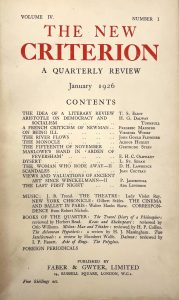
This letter, in which he asks her to ‘forgive the inconvenience’, seems to catch him mid-flight. These words are written in a moment now considered formative to his professional and personal life. First established in 1922, the Criterion is widely accepted to be the writer’s first serious foray into intellectual leadership. In a period where his output as editor quickly exceeded his output as poet, the Criterion thrived. It remained in its original format until January 1926, when the institutional backing of Faber & Gwyer led to a rebrand. The New Criterion lived up to its title in both form and content: a fresh editorial manifesto by Eliot headed up a formidable 220 pages of literature and criticism from emerging European writers.
Defining a new Criterion
A large proportion of these letters find Eliot networking with his counterparts at other European periodicals. The question of where in European letters Eliot’s own periodical stood was as much a question of opposition as alliance. Replying to S. S. Koteliansky in a letter on 8 June 1926, Eliot notes, ‘it is part of an editor’s job to vary the material as much as possible within the prescribed limits’. This pursuit of editorial variety meant he was forced to decline numerous submissions – including the very letters by Dostoevsky that prompted this explanation to Koteliansky. Although Eliot’s reasons for rejection of material are frequently vague in this volume – such as simply telling Alec Brown on 23 June 1926, ‘I am so sorry to find that I cannot use any of these poems’ – he is more forthcoming regarding Dostoevsky. Here, he explains he must avoid the writer ‘for some time to come’, as a recent issue had already featured him heavily.
Eliot appears equally opposed in these letters to piratical periodicals, run by unscrupulous editors. Pearl Fassett writes to John Middleton Murry on his behalf on 23 December 1926:
‘Mr Eliot has seen an announcement of a contribution by yourself to a periodical called Beau which is published by The Two Worlds Publishing Company in New York. As this company is publishing parts of Ulysses without Mr Joyce’s permission, and as it has announced for another of its periodicals (The Two Worlds Monthly) that it proposes to reprint something of Mr Eliot’s without having asked his permission, he would be very interested to know whether you can give him any information about these people.’
Murry confirmed Eliot’s suspicions: the editors of Beau were ‘simply swindlers’.
Eliot was also a tireless talent scout: alongside regular commissions for Herbert Palmer, these letters find him reaching out to figures like Conrad Aiken, Charles Whibley, Wyndham Lewis, and John Hayward. However, his uncompromising care for literary quality – and the pains he took over minutiae – could make him cutting, even toward those he admired. On 8 July 1926, he complains to J. M. Robertson that his essay ‘does not seem to set the Thames on fire’. Two days later, he bluntly informs D. N. Dalglish that her piece is ‘insufficiently interesting’.
As well as rejection, in these letters we find Eliot directing authors elsewhere if their work did not fit The New Criterion. Writing to the literary agency Christy & Moore on July 31 1926, he notes that while their submitted story has ‘a good deal of interest and merit’, it would find a more suitable home in ‘several other periodicals’. On a number of occasions he points D. Fraser-Harris to other publications due to potential ‘disagreement[s]’ (10 May 1927) and, at another point, due to ‘a great deal of accepted material on hand’ that would make publication impossible (8 November 1927). Rather than discouraging contributors, he frequently redirects them. At moments one suspects this was a convenience. At other times Eliot seems to be sincerely acting as agent for those unable to find a home for their work.
Printing Matters
The New Criterion had a simple appearance, with the beige octavo chosen to resemble the popular French monthly, La Nouvelle Revue Française. It deliberately contained no images so as to not disrupt the flow of the contents, with ads only featured sparingly in later issues. Explaining the squeezing and pinching of works, Eliot’s desire to maintain his chosen aesthetic (or perhaps economic) flow is one of the persistent, if not fastidious, lines in these letters.
However, aside from the obvious visual appeal of a well-formatted periodical, Eliot’s concern for the physical page may be a more cerebral one. We may trace this back to ‘The Idea of a Literary Review’, which was published in the first issue of The New Criterion. In it, Eliot says:
‘A review should be an organ of documentation […] its contents should exhibit heterogeneity which the intelligent reader can resolve into order.’
According to this metaphor, The New Criterion becomes something curiously human, its physical pages a body to be enlivened by the perfect, ‘heterogenous’ sequence of work.

Private Affairs
Just as this volume of letters reveals Eliot’s meticulous approach to his periodical’s structure, it also highlights his efforts to impose order on his discussions of public and private affairs. Correspondence from Pearl Fassett on 1 September 1926 details the intense strain his wife Vivienne was under at the time:
‘I feel rather thankful that V. is where she can be really well nursed. Please give her my best love, all my sympathy and every wish for a quick recovery. I will send her a card tonight.’
By this point in the marriage, Vivienne had reached a state of mental and physical breakdown. While both husband and wife had previously suffered from these afflictions, a particularly bad episode led to her placement under suicide watch at the Sanatorium de la Malmaison, where Eliot joined her. In a 3 September letter to Fassett, he describes the institution as a ‘nursing home in France’, and touchingly requests she check if West’s ‘still have a grey dressing gown of V.’s’ to replace the one that is ‘worn out’. This vulnerable exchange is perhaps why Eliot then makes an attempt to strictly separate his professional and personal matters when re-contacting Fassett on 8 October. He writes:
‘In future, I propose to keep Criterion & F. & G. matters strictly apart from private matters in writing to you, & shall address you as ‘Miss Fassett’: these letters can be filed for reference; and I should be glad if you wd do the same, & keep yr. carbons.’
Yet, despite these efforts, this volume reveals moments where this systematic separation of the professional and personal fails. This breakdown is seen most notably in Eliot’s 8 April 1927 letter to former Criterion publisher Richard Cobden-Sanderson:
‘I must apologise for not answering your kind invitation to the Boat Race, which once again I could not attend. But my father in law had just died, and I was immersed in the business of a kind that you know.’
The curious intermingling of personal feeling and professional correspondence is also evident in his letter to Jack Isaacs on 15 April of that year, where he expresses: ‘I am rather hurt at not hearing from you about Stich, and not getting his pamphlet; but from my previous experience, I suppose I might put this down to your general undependability.’ Here, his joke bites with a certain irritation.
New Spring Coat
The volume’s portrayal of Eliot’s personal and professional life as a frayed, disordered patchwork finds a darkly comical parallel in his correspondence with Mary Culpin on 3 June 1927.
Culpin: ‘Was your dog ill last week? He evidently bit a large piece out of my new spring coat. I suppose it’s too late now to recover the fragments.’
Eliot: ‘The dog had a nervous crisis last week but I am glad to say he is now quite recovered so that if it was he who ate the piece out of your coat you may be sure that it did him no harm.’
There is a certain poignancy with which Eliot’s letters move from professional obligations to personal intimacies. Rather than simply indicating disarray, such spillovers are at once chaotic and profoundly necessary. Work and life dance around each other on the page. Far from signalling anguish, these discordances become mutually informing – and even mutually sustaining – for a writer and critic fully absorbed in literary society.
In Eliot’s world, no single facet of life could exist in isolation. He could not (or perhaps simply would not) divide his personal existence from his professional one. In these online letters, as with the printed volume, his roles as scout, agent and friend are woven into one inextricable whole – if not a conventional one, then a deeply human one.
BETH MERRYLEES