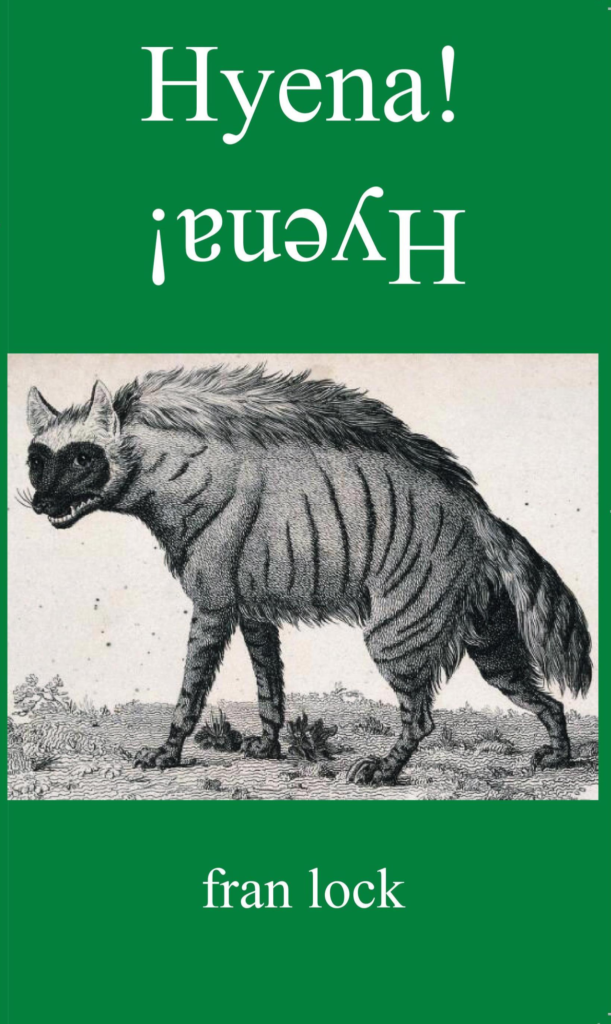
Hyena!

Poetry Bus Press
Fran-Lock-CROP
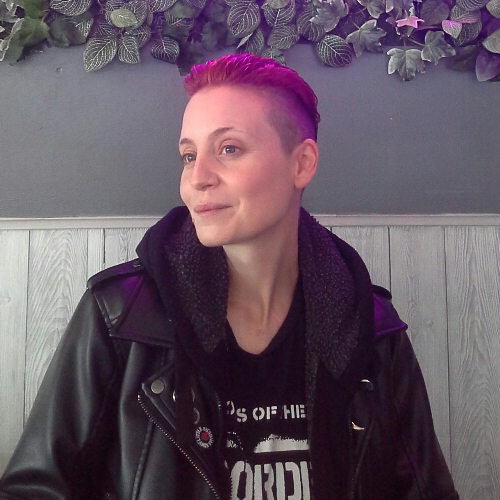
Fran Lock is the former Judith E. Wilson Poetry Fellow at Cambridge University (2022-2023), and the author of twelve poetry collections. She is a member of the Editorial Advisory Board for the Journal of British and Irish Innovative Poetry, and she edits the Soul Food column for Communist Review. Fran is an Associate Editor at the arts and and culture...

Review

Review

Fran Lock’s Hyena! is a collection with its fingers firmly around the throat of the spirit of the age, writes John Field

Read the
Reader's Notes

Videos

Fran Lock reads from Hyena! at the T. S. Eliot Prize Shortlist Readings
Natalie Perman reviews Fran Lock‘s Hyena!
Fran Lock reads ‘Hibernia’
Fran Lock reads ‘La jena di Londra’
Fran Lock reads ‘Hyena in her human form attends a funeral’
Fran Lock talks about her work

Related News Stories

The T. S. Eliot Foundation is delighted to announce the winner of the T. S. Eliot Prize 2023 is Jason Allen-Paisant for his second collection Self-Portrait as Othello, published by Carcanet Press. The judges Paul Muldoon (Chair), Sasha Dugdale and Denise Saul said: Self-Portrait as Othello is a book with...
When the T. S. Eliot Prize founded the Young Critics scheme with The Poetry Society’s Young Poets Network, the aim was to empower young critics, to offer a different critical viewpoint on the shortlisted collections, and to engage more young readers with the Prize. Following a series of workshops led...
We are thrilled to announce the T. S. Eliot Prize 2023 Shortlist, chosen by judges Paul Muldoon (Chair), Sasha Dugdale and Denise Saul from 186 poetry collections submitted by British and Irish publishers. The list comprises a former winner and two previously shortlisted poets, as well as two debuts and two...
As the T. S. Eliot Prize celebrates its 30th year, the T. S. Eliot Foundation is delighted to announce the judges for the 2023 Prize: the panel will be chaired by Paul Muldoon, alongside Sasha Dugdale and Denise Saul.  The judges will be looking for the best new poetry collection...
Review of Hyena!

Fran Lock’s Hyena! is a collection with its fingers firmly around the throat of the spirit of the age, writes John Field

Hyena! is, in part at least, Lock’s tribute to her mentor and friend, the poet Roddy Lumdsen. Its final section, ‘Poems After Roddy Lumsden’, contains eleven responses to his work, so my feeling is that it would be remiss of me not to stop here for a moment. In 2017, I reviewed Lumsden’s So Glad I’m Me for the T. S. Eliot Prize Shortlist, and described the collection as ‘a sensory overload of language, equally at ease with popular and literary culture’. Lock was in the room when Lumsden launched So Glad I’m Me at the famed poetry pub, The Betsey Trotwood, in Clerkenwell, London. In her tribute to Roddy, (do read it in full here), she describes him as her ‘Poetry Paterfamilias’. You can feel this throughout Hyena! – which is not to suggest that Lock’s in any way a Lumsden knock-off. Not at all. She’s a scion bearing her own fruit. As Lock writes in that tribute, it’s ‘infectious fung[al]’ fruit, from her ‘crooked branch’.

The collection plays with ideas of therianthropy (shapeshifting, metamorphosing into animals). The epigraph, ‘This human form where I was born, I now repent’, is taken from ‘Caribou’, a track on the Pixies’ 1987 album, Come on Pilgrim. As Black Francis sings the ‘oo’ of ‘Caribou’, he howls like a wolf – and the song effects its own brand of lycanthropy. Another joyful Easter egg is the album’s cover art. Shot by Simon Larbalestier, we see the hairiest back, a visual analogue for Francis’s wolverine howl. Lock sounds this note in the opening poem, ‘Wild Talents’, where we’re given another epigraph, this one from Charles Hoy Fort (of the still extant Fortean Times fame): ‘there is no man who is without the hyena-element in his composition, and there is no hyena that is not at least rudimentarily human’. In Lock’s poem, these tensions pave the way for grief embodied in physical form: ‘on the day of your death i became a striped / hyena. hysteria’s lank technician, cursorial / man-eater, witch’s mount.’ Grieving and laughter converge and the repeated ‘hy’ identifies the hyena as female (‘hysterikos’ in Greek = belonging to the womb). Lock’s speaker is bereft. More than a stray, she’s utterly out of place (the striped hyena’s natural habitat is not the gothic gloom of the poem’s London): ‘i did not sleep, but lay, panting, on a raft /  of trash: the serial bed-wetter’s flammable / mattress, saturday magazines still in their /  cellophane. Empire, mine. my hackles in / the full flag of this failed state, flea-bit. / the day after your death, when they found me’.

Hyena! also responds to the state of the nation. The Hogarthian prose poem ‘To live on dread’ gives both barrels to the UK’s moral degradation. Lock’s speaker opens with a reboot of Macbeth’s madness: ‘my mind is a fucking scorpion orgy’ before presenting the casual face of contemporary sexual exploitation at the hands of ‘upskirting clerks in novelty ties’ before echoing the language of Trump with ‘the man who grabs at my pussy’. The terse lines of ‘”Vulnerable”’ are dedicated to Dominic Cummings and revisit the experience of a lockdown lived in flats, of those ‘whose escape / extends no further than their balcony, / long sleeves in the summer. there are no / fucking castles here. cheap masks / through which a bilious argot strains. / there’s a queue for the shops / an hour long’. ‘Black Friday’ mediates on consumer culture: ‘cold hard cash. no love / so deep and pure as brand / loyalty’. The line break at ‘no love’ works hard to show the values we’re missing, and the emptiness with which they’ve been replaced. Moving towards its conclusion, the speaker describes London as ‘this city like pestilence’. We see that our disease is far darker, the depth of the infection far deeper, than COVID-19. In ‘False object permanence’ we’re shown the face of Brexit Britain: ‘farage, forage, far-right rage, implying both barrage and farrago simultaneously’. Lock’s dexterity, and the joy with which she reconfigures language is worthy of Finnegans Wake.

Hyena! is dense, rewarding reading, but Lock knows precisely when the blank space of the white page is required. ‘Breath’ is dedicated to the Black Lives Matter movement and concludes ‘this poem, that takes up more space on the page / than some people do in the whole wide world. white / space of the page. white space of a lung. could open / this pieta! into seeming air’ and ends with its final line cut short.

There’s so much more that I wanted to write about Hyena! – it’s had me poking around in the lore of DC and Marvel comics, listening to new music, and reeling at the furious, funny, generous mind that created it. This is a collection with its fingers firmly around the throat of the spirit of the age. I am sure that Lumsden would have loved it.

Fran Lock’s Hyena! (Poetry Bus Press, 2023) is shortlisted for the T. S. Eliot Prize 2023. John Field blogs at Poor Rude Lines.

Hyena!
Poetry Bus Press

Newsletter

Be among the first to receive updates on the latest T. S. Eliot Prize news by subscribing now!


The T. S. Eliot Prize on Social Media

Part of tseliot.com

Designed by thinking

Interview of Hyena!

Hyena!
Poetry Bus Press

Newsletter

Be among the first to receive updates on the latest T. S. Eliot Prize news by subscribing now!


The T. S. Eliot Prize on Social Media

Part of tseliot.com

Designed by thinking