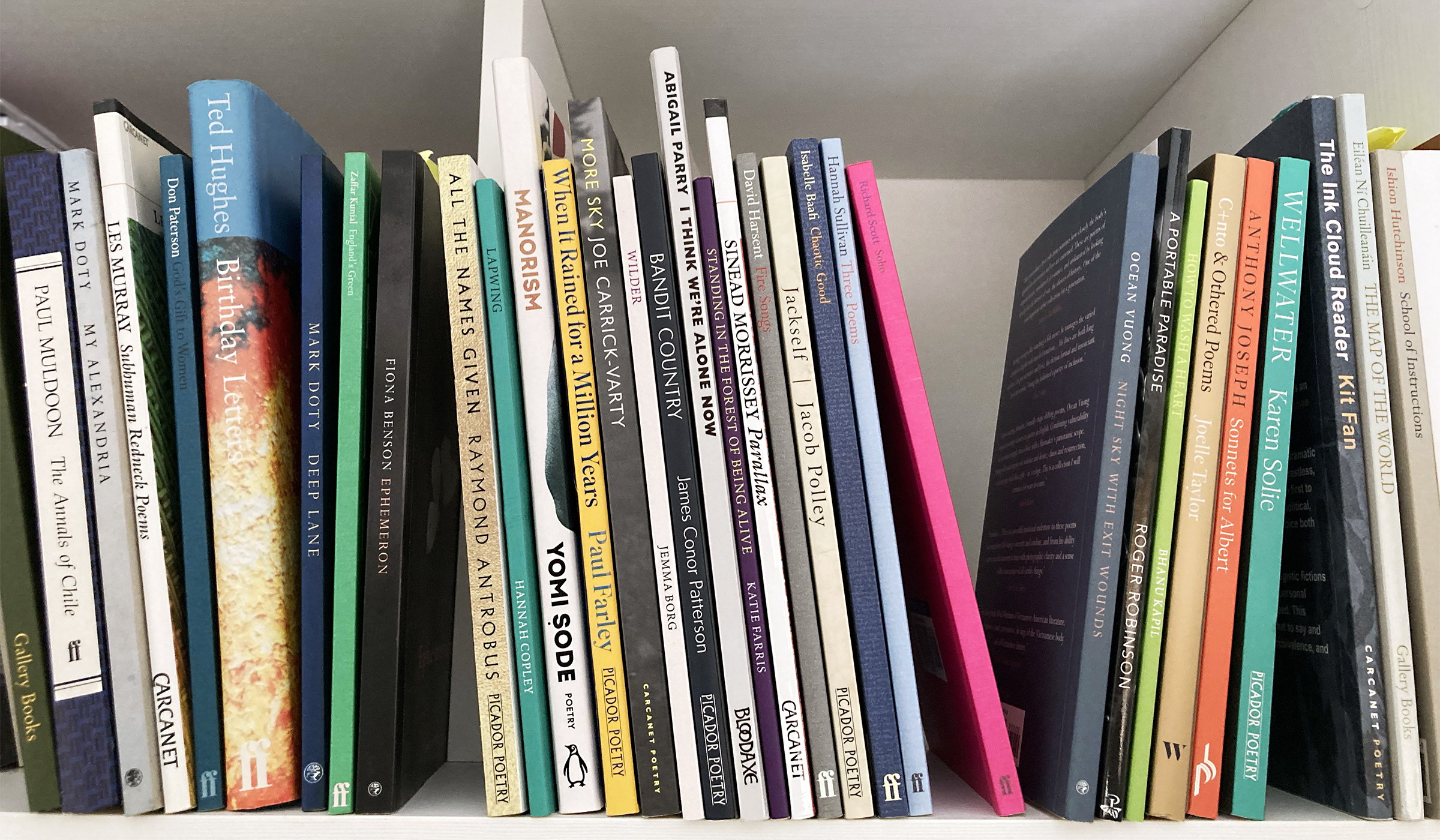
Michael Sims, Director of the T. S. Eliot Prize, has reminded me that I have been writing about the shortlisted books since 2015 – that’s 120 collections! Now that this archive is accessible on the website (with all of the 2015 reviews newly added this month), he has twisted my arm to share a few thoughts about reviewing for the Prize. Spoiler alert: I think that shortlists invite us to leave our algorithmic echo chambers which, in 2026, sounds as much like a political challenge as it does an aesthetic one.
I’m a reader, not a writer of poetry. I arrived at the T. S. Eliot Prize via my blog, Poor Rude Lines. Poor Rude Lines started in 2012 and it led to an invitation to speak and blog at the Aldeburgh Poetry Festival. From there, I was asked to offer readings of single poems and whole collections for the Forward Prizes. In 2014, the Poetry Book Society asked me to write about some of the Next Generation Poets – and the invitation to write about the T. S. Eliot Prize shortlist followed from there.
When reading a shortlist, I’m conscious of the judges’ work creating it – and I’m conscious too of who those judges are: Michael Hofmann, Mimi Khalvati, Paul Muldoon… The judges have seen merit in each collection, so I’m being asked to approach the poetry on the page with humility and respect. Every poet must see that their work has been read with care, and I want my readers to enjoy thinking about the collections enough to want to read them all. (It’s a lofty aim and, when I get it wrong, it’s mortifying.)
We’re creatures of habit. I’ve been around the block enough times to think that I know what I’ll enjoy, but reading freshly-minted poetry is quietly life-changing. I was seven when thirteen young black people were killed in the New Cross Fire. Generations of readers need Jay Bernard’s Surge (Chatto & Windus), shortlisted for the 2019 prize, to make us look at the awkward comparisons between 1981 and 2019. At the time, I wrote that:
The prose poem ‘+’ feels like testimony: a father is […] treated without dignity by a police officer who said ‘oh, it’s very common for culprits to go missing – I said my son isn’t a culprit, and how dare he imply it – and one of the officers stood up by the window and looked out – he didn’t want to look us full in the eye – he made it clear, he made it clear’. The offhand ‘oh’ betrays indifference and the speaker’s repetition signals his impotent rage. Over the page, in ‘–’, Bernard ventriloquises the dead son. Black skin and carbonised flesh are treated in the same way: ‘they were looking at me strangely, dad – like he couldn’t stand to look at me – couldn’t stand the sight of me – Police always looked at me like that’.
‘–’ is the hardest-hitting poem I have read for the T. S. Eliot Prize, and the voice of that son, defaced and erased, has sown its seed in me. Salman Rushdie has remarked that ‘the books we love change the way we see the world’ and, if more people read books like Surge, then I like to think that Britain would be better.
I’ll finish with Richard Scott’s Soho (Faber & Faber), shortlisted for the 2018 prize. At the time I wrote that by opening with ‘Public Library, 1998’, Scott evokes Orton’s and Halliwell’s antics defacing library books:
Scott’s speaker is marginalised: ‘In the library where there is not one gay poem, / not even Cavafy eyeing his grappa-sozzled lads – I / open again the Golden Treasury of Verse and write // in the margin’. Scott has written the word ‘COCK’ in his own margin. It’s an incredible poem. The marginalia of Medieval manuscripts are a riot of misrule: Christian morality takes centre stage but, at the edges of The Macclesfield Psalter you’ll see an ape peering up a man’s asshole while another pulls his robes to his waist to spread his cheeks. The poem revels in innuendo as ‘I underline those that nature, // not the printer, had pricked out; rimming each delicate / stanza in cerulean, illuminating the readers-to-come…’ like an irreligious monk in a queer scriptorium.
The T. S. Eliot Prize needs superb shortlists more than ever. The marginalia of The Macclesfield Psalter showcase the scurrilous inventiveness of East Anglia in the 1330s but I write this from Norwich, where the Pride and the Ukrainian national flag – flags flown in solidarity with people facing oppression across the globe – have been lowered. Prominent coverage of collections shortlisted for the T. S. Eliot Prize will give us all an opportunity to surface, to breathe some fresh air, to think for ourselves. Clare Pollard (T. S. Eliot Prize judge, 2018) writes on her blog, that
we shouldn’t be afraid to articulate our hope or anger or the injustice we witness in the world. But poetry needs to invite, or even compel, the reader to think as well – a poem should feel like the opening up of a debate not the closing down of it.
These are Brecht’s ‘dark times’, in which poets must not be silent, but should question the official language.
I hope that I’m doing my bit to put the books on the T. S. Eliot Prize Shortlist into more hands.
To read John Field’s newly added reviews of the 2015 Shortlist, visit the Past Years section of our website, where you will also find all of his reviews up to 2025.
Find John’s blog at Poor Rude Lines.
The Poetry Book Society has just launched the newest iteration of the Next Generation Poets. Visit the website for details.
The Aldeburgh Poetry Festival has been followed by the Poetry in Aldeburgh festival. Visit the website for details.