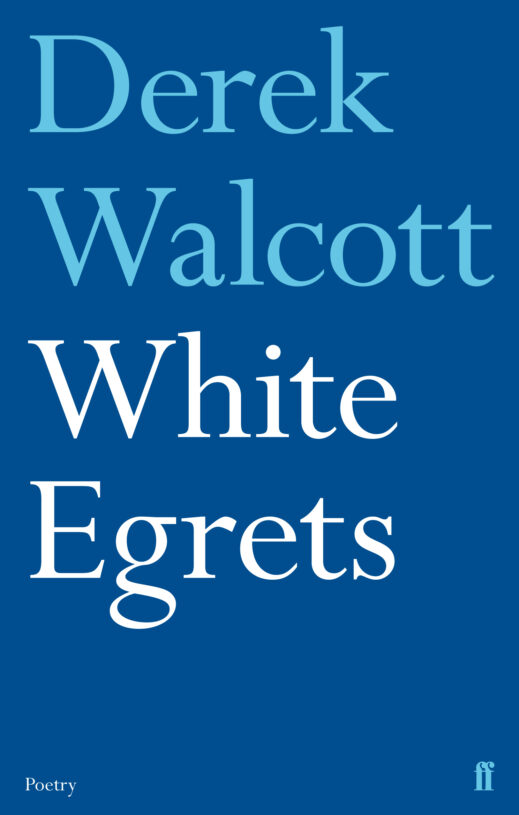

Derek Walcott’s White Egrets is a painter’s collection, filled with the landscapes of St. Lucia, Walcott’s home, and elsewhere. But the nail marks of colonialism are also apparent, writes Shannon Clinton-Copeland
Be among the first to receive updates on the latest T. S. Eliot Prize news by subscribing now!
Derek Walcott’s White Egrets is a painter’s collection, filled with the landscapes of St. Lucia, Walcott’s home, and elsewhere. But the nail marks of colonialism are also apparent, writes Shannon Clinton-Copeland
Derek Walcott’s White Egrets is a gallery we enter, filled with landscapes: St. Lucia, Walcott’s home, but also Italy, Spain, Amsterdam, New York, London, others. It is a painter’s collection, Walcott’s artist’s eye starkly evident. Nothing, though, is rendered in broad strokes.
Every attention is paid to the fine details, such as the ‘sodden canvas of the sky like a hopeless sail’ over Santa Cruz Valley, or one of multiple renderings of the titular bird:
[…] the white gasp of an egret sent
sailing into the frame then teetering to rest
with its gawky stride, erect, an egret-emblem!
Rather than posturing Western spaces as bastions to which the landscapes of the Caribbean ought to aspire, the two find themselves on par; Walcott paints them with equalising language, thick as impasto, with similes strong enough to spring off the page. That is not to say that Walcott presents a utopic vision of the postcolonial archipelago, for still:
[…] I watched the doomed acres
where yet another luxury hotel will be built
with ordinary people fenced out. […]
The nail marks of colonialism are not so easily erased. The Caribbean remains pocked with ‘[t]hese new plantations / by the sea; a slavery without chains’. Colonial legacy is both an easy and difficult subject to treat. Easy, because its fingerprints are everywhere—‘[t]hink of the treaties signed by the same one-ringed hand, / think of the width its power could encompass / “one-seventh of the globe,” we learnt in class’ – difficult, because so many poets – Roger Robinson, Aimé Césaire, Grace Nichols – have sketched over similar ground.
Walcott possesses the same genuinely inspiring inclination to remake and reinvent with writing as he does with painting, the medium which bleeds such vivid colours into this collection:
[…] I want to repaint
those rubicund Flemish faces, even if it’s been done
by Frans Hals, by Rubens, by Rembrandt,
the clear grey eyes of Renée […]
Walcott writes of colonial failure and loss but also of personal errors and shames – missed loves, mistreated wives, botched paintings. The collection’s nexus is perhaps best described by the tenth poem of fifty-four, “In Italy”: ‘our books are tombstones, every / poem a hymn’.
This collection is a record of the possibilities destroyed by empire, but also what, with its ephemerality (and thus predestined fall), still remains, long after; ‘a sea so / deep it has lost its stuttering memory of our hates’.
Derek Walcott’s White Egrets (Faber & Faber) won the T. S. Eliot Prize 2010.
This review was specially commissioned from Shannon Clinton-Copeland, a Young Critic in 2025. The Young Critics Scheme, established in 2022, is a partnership programme run by The Poetry Society and the T. S. Eliot Prize. Each year, the scheme commissions ten emerging poetry reviewers to produce video reviews of the Prize Shortlist. For 2026, we also asked four Young Critics to dive into the Prize archives and review past winning collections.
Shannon Clinton-Copeland is an Irish-Jamaican poet completing a PhD in early modern Irish literature and colonialism at UEA. Her work has been published by The Rialto, Acumen, Crannóg, berlin lit and others. She came runner-up in the Manchester Micropoetry Competition 2025.
Be among the first to receive updates on the latest T. S. Eliot Prize news by subscribing now!