The Thirteenth Angel

Bloodaxe Books
Gross-Philip-by-Stephen-Morris
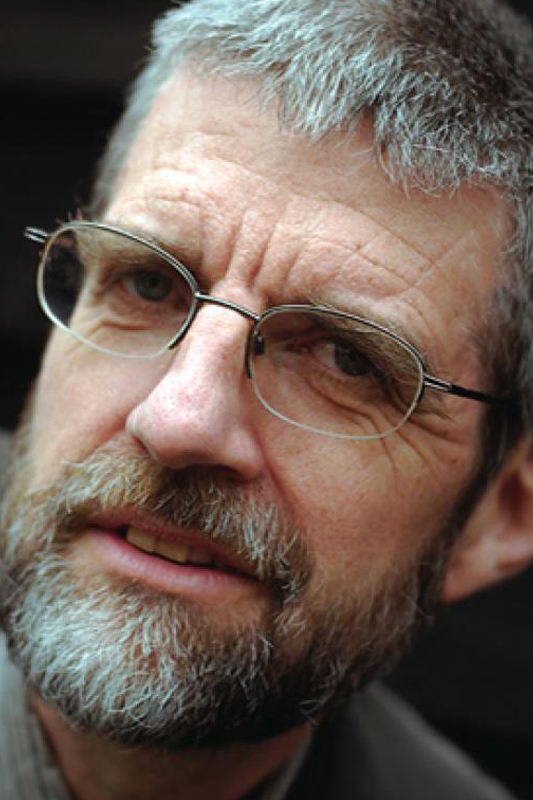
Philip Gross was born in Cornwall, the son of an Estonian wartime refugee. He has lived in Plymouth, Bristol and South Wales, where he was Professor of Creative Writing at Glamorgan University (USW). His twenty-eighth book of poetry, The Shores of Vaikus, was published by Bloodaxe in 2024. His previous collection, The Thirteenth Angel (2022), was a Poetry Book Society...

Review

Interview

Review

Philip Gross, winner of the 2009 T. S. Eliot Prize with The Water Table, has been shortlisted for the T. S. Eliot Prize 2022 for his twenty-seventh collection, The Thirteenth...

Interview

‘We are all desperately and rightly confused and unsettled about what’s going on around us. Is that a comfort? No, perhaps not, but it is life’, Philip Gross comments in his T. S. Eliot Prize interview film. We asked him about his shortlisted collection The Thirteenth Angel (Bloodaxe, 2022) – and how poetry can help

Read the
Reader's Notes

Videos

Philip Gross reads from The Thirteenth Angel at the T. S. Eliot Prize Shortlist Readings
Aliyah Begum reviews Philip Gross‘s The Thirteenth Angel
Philip Gross talks about his work
Philip Gross reads ‘Of Breath (Thirteen Angels)’
Philip Gross reads ‘Moon, O’
Philip Gross reads ‘In the Light of the Times (Springtime in Pandemia, 4)’

Related News Stories

The T. S. Eliot Foundation is delighted to announce that the winner of the T. S. Eliot Prize 2022 is Anthony Joseph for his collection Sonnets for Albert published by Bloomsbury Poetry.
The T. S. Eliot Prize and The Poetry Society have now published the first set of video reviews created by participants in the new Young Critics Scheme.
Judges Jean Sprackland (Chair), Hannah Lowe and Roger Robinson have chosen the 2022 T. S. Eliot Prize shortlist from a record 201 poetry collections submitted by British and Irish publishers. The eclectic list comprises seasoned poets, including one previous winner, and five debut collections. Victoria Adukwei Bulley – Quiet (Faber &...
Neil Astley of Bloodaxe Books on a poetry list that has always been avowedly adventurous and internationalist We are delighted to have another pair of Bloodaxe collections on the T. S. Eliot Prize 2021 Shortlist: Hannah Lowe’s third collection The Kids and Selima Hill’s twentieth, Men Who Feed Pigeons. Two...
Review of The Thirteenth Angel

Philip Gross, winner of the 2009 T. S. Eliot Prize with The Water Table, has been shortlisted for the T. S. Eliot Prize 2022 for his twenty-seventh collection, The Thirteenth Angel. It offers an airy flight above the city and a meditation on angels

Towering above Rome’s Castel Sant’Angelo, the archangel Michael stands guard over the city. He’s sheathing his sword as a sign that the terrible pandemic of 590 CE has ended and promises the city future protection from plague. The Thirteenth Angel views our humdrum urban spaces through a similarly angelic lens: like Michael, high above the city, Gross’s speaker sees the geometry – the angles – of the city from a fresh perspective. It’s not so long ago that all of us were required to watch the world from our windows, so it’s difficult to view the urban world from this angle without the COVID-19 pandemic springing to mind, but The Thirteenth Angel is a wider, richer meditation on modernity and the crises facing humanity.

Gross opens with ‘Nocturne: The Information’ but, where the nocturne once celebrated the night, Gross explores the expulsion of darkness from the city. He opens with the terse, ominous fragmented half-line ‘Night, wired and ticking’, as if the night were an IED, awaiting a bright, violent destruction. ‘[T]he park’s null, an amnesia amongst us’ suggests that there’s nothing positive about the absence of light. In the poem’s first movement, we are empowered as the bearers of this light. The speaker observes a woman using a smartphone, ‘the cold blush of blue / on a cheek: stranger, her mobile tingling / with presence’. Light brings a frisson of excitement, of connection or connectivity, albeit a cold one. However, viewed from the perspective of the speaker’s third floor window, buses appear as ‘dim stacked / blocks of pixels,’ as if the city’s grid were a printed circuit board and its inhabitants were merely electrons, travelling pre-ordained routes, their free will revoked in a fatalistic world-as-machine. As the speaker comments, ‘We are the information.’ Gross reimagines the city as a newly inscribed circle of Dante’s Inferno but, even here, the speaker wryly observes that the town planners have been at work: ‘The underworld’s arranged / not in circles but parallel.’

In the ekphrastic ‘Paul Klee: the Later Angels’, the speaker deconstructs Klee’s Angelus Novus (1920). Instead of seeing Klee’s angel, he sees ‘the intersections of the things – // shapes, colour-bodies, masses – / that make up the world’ and so, perhaps, we are invited to equate the city’s ‘live flow diagram. The pulse of us’, that Gross sees in ‘Nocturne: The Information’, with an otherworldly power and beauty here. Klee’s Angelus Novus resurfaces in the literary-philosophical work of Walter Benjamin (1892–1940). Indeed, Benjamin purchased the print in 1921. Benjamin imagines it as the angel of history and, in ‘Theses on the Philosophy of History,’ he writes that ‘A storm is blowing from Paradise; it has got caught in his wings with such violence that the angel can no longer close them. This storm irresistibly propels him into the future to which his back is turned, while the pile of debris before him grows skyward. This storm is what we call progress.’ Gross’s collection echoes Benjamin’s doubt in progress. In ‘The Follies’, the modern City of London still labours under the ‘grey-brown fug’ we glimpse in Eliot’s ‘The Burial of the Dead’, where London’s commuters walk to work under a pall of ‘brown fog’. The next poem, ‘Smatter’, debases the sacred with ‘The plainchant of speed. The monks, the truckers, / in their high cabs, or their satnavs, telling the names // of Europe over, till the words mean nothing; there is only / flow and eddy, mattins, evensong, the rise and fall.’ We’re back in The Waste Land, this time in ‘Death by Water’, where the bones of Phlebas the Phoenician are picked ‘As he rose and fell’ with a current mimicking the relentless cycles of the marketplace. 

Gross presents us hurtling forwards, across the circuit board of the modern city, but making the same old mistakes. What we need is perspective, an opportunity to gain some objectivity, and The Thirteenth Angel offers us this divine intervention and the opportunity to step outside of ourselves and to view the world from a fresh angle.

Philip Gross’s The Thirteenth Angel (Bloodaxe, 2022) is shortlisted for the T. S. Eliot Prize 2022. John Field blogs at Poor Rude Lines.

The Thirteenth Angel
Bloodaxe Books

Newsletter

Be among the first to receive updates on the latest T. S. Eliot Prize news by subscribing now!


The T. S. Eliot Prize on Social Media

Part of tseliot.com

Designed by thinking

Interview of The Thirteenth Angel

‘We are all desperately and rightly confused and unsettled about what’s going on around us. Is that a comfort? No, perhaps not, but it is life’, Philip Gross comments in his T. S. Eliot Prize interview film. We asked him about his shortlisted collection The Thirteenth Angel (Bloodaxe, 2022) – and how poetry can help

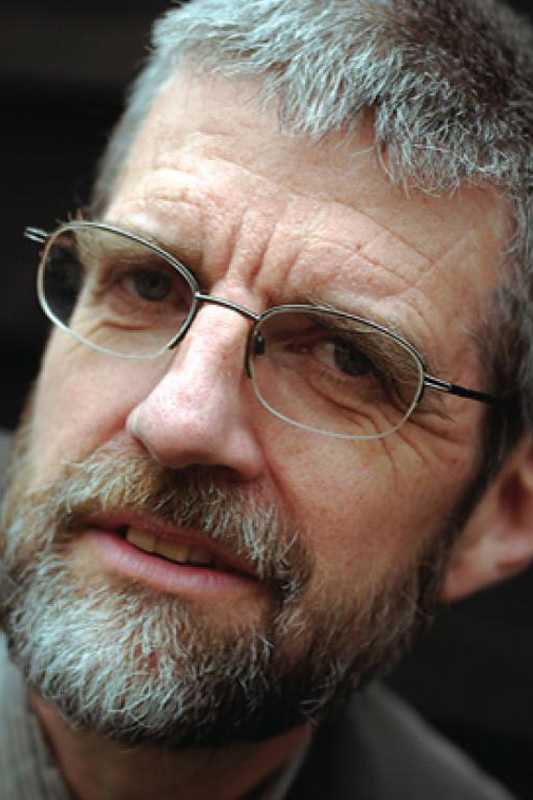
Philip Gross. Photo © Stephen Morris

T. S. Eliot Prize: Was ‘Nocturne: The Information’, the long opening poem in The Thirteenth Angel the one that lit the idea or ideas for the book? At the online launch of your book, hosted by your publisher Neil Astley of Bloodaxe, you talked about a collection forming as a process of ‘gravitational clumps of things which start being in relationship with one another’. Could you expand?

Philip Gross: ‘Nocturne: The Information’ came to be written as most of my things do – by existing as fragments in a swirling, all-angled, ongoing notebook with no pressure of expectation that they become anything at all. Far from being the idea for a book, it wasn’t even the idea for itself at the start.

It was six months after a stay of some weeks in Finsbury Park before I looked back into that material, and seemed to see an emergent shape and voice among them, which I hadn’t been aware of at the time. That’s what I meant by the gravitational clumps – the way that asteroids or planets appear to have formed. The interesting thing is not so much the inert material, but the force that patterns it.

Sometimes a form on the page helps to reveal that patterning. The staccato, rather breathless sweeping over the sensations in the opening lines offered a shape that was constrained but with built-in fractures. That became a vehicle for episode after episode. Or maybe a channel (with built-in disjunctions, like weirs on a stream) down which the poem can flow.

What the selection in a relatively short reading couldn’t capture was a kind of urgency that drives on through the sequence as a whole, the echoes and coherences that crept up on me as I wrote. I hope I got a little of that into the reading anyway.

TSEP: You read with Aleš Šteger at your launch, and he and Neil talked about other angels in film, literature and philosophy – Wim Wenders’ angels in his film Wings of Desire, Rafael Alberti’s angels, Walter Benjamin’s Angel of History. In response, you talked about the artist Paul Klee’s ‘playful’ angels, less the ‘tragic onlookers’ portrayed in Wenders’ film. Can you say a bit more about what your angels represent, what as a motif they helped you articulate?

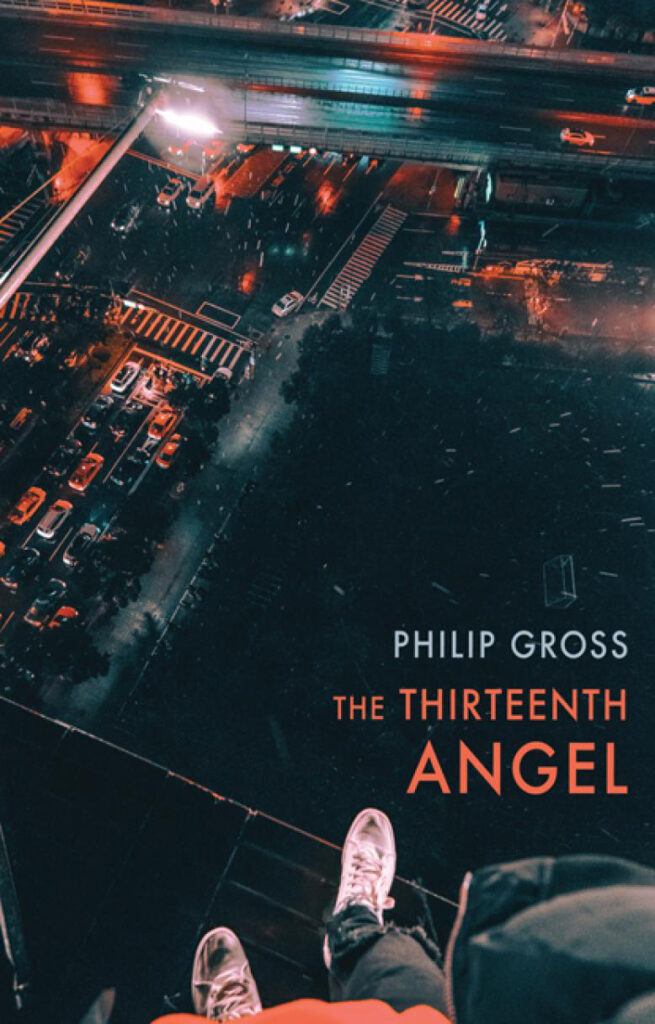
PG: Wim Wenders’ angels were consciously there by the time the book was taking shape. The cover image nods in that direction. I’ve lived with Klee’s angels for a long time – playful, yes, but the great rush of them came when he knew he was already, slowly, dying, and some of them do partake of the violence building in the world of 1939-40, too. I hadn’t encountered Alberti, and I’m hugely grateful to Aleš for that. And angels were appearing in the cracks of the poems, in the form of incidental metaphors, for a long time before I noticed, let alone thought ‘motif’.

What mine ‘mean’ stays, I think – I hope, just a little beyond my reach. We could start with: the ability to surprise, to make the very ordinary a revelation, to upend our perspectives, maybe throw us outside of our everyday selves, looking back or looking simply further – to be a moment of intense presence and, also, not there when you blink.

TSEP: How did the ‘Thirteen Angels’ sequence evolve? Is the way that it did typical of your writing process?

PG: The evolution of ‘Thirteen Angels’… I hesitate to call it a method, but there’s a habit of thought here that comes naturally to me: walk around a subject, question, object, concept from multiple angles – you could call it many takes – assuming that the truth is in the ensemble of them more than any single view. Imagine a voice saying ‘Yes… And on the other hand…? And what if, then…?’

TSEP: You described being in the flat in north east London during the pandemic, where you began to write, as a gift. Can you say why? Neil Astley observed that the urban scene has not been typical of your work to date.

PG: Neil is right(-ish) to say that urban scenes are untypical for me. There are exceptions – my 1993 collection Scratch City (for young people, nominally, but adults as well) was very much immersed in urban Bristol, where I lived then. Since then, there’s been a lot of water; crossing the Severn estuary nearly twenty years ago (as in The Water Table) and living now beside it has been fundamental in a way I still can’t quite explain.

The discussion I had with Aleš Šteger at our launch, about me rediscovering a certain amount of foreignness, felt revealing – and was certainly not planned in advance. That may be a clue. To find myself intensely in that place, above Stroud Green Road, but not exactly of it – home-making, but not being at home – was the gift. Maybe the sheer physical hard work of it, and being stripped of our usual habits, played a part, too.

But I’m wary of equating the subject matter of a poem – the material – with what it’s about. There might have seemed to be a change of subject from The Water Table to the book that followed it, Deep Field, about my father’s old age and loss of language. But in the writing they felt all of a piece to me, to do with shifting or dissolving boundaries of our selves, with what we’re part of, and (increasingly, of course, with older age) with letting go.

TSEP: In the film interview you did for us, you talked about the ‘trusting the proudly ageing body’. Can you say what that means for your writing?

PG: The line about the ‘proudly’ ageing body is a little defiance – the nagging pains and malfunctions of it are a bugger, of course. It was at least an assertion that our validity or value doesn’t depend on how long we can look or feel young. I’ve never felt wrong to write from the moment, the life-stage, I’m in. No assumption that time brings wisdom, certainly – just a kind of relativity. The physical facts of my eyes, skin, brain and all the senses, as well as the bank of memories and associations, richer and faultier as time goes on – all this forms the lens for me now, which will see something particular, till the moment shifts and moves on. And meanwhile the world is changing too.

TSEP: You also say this striking thing in the film interview: ‘This is the first time I’ve ever been here, in the me I am in the world I’m in now. We are all desperately and rightly confused and unsettled about what’s going on around us. Is that a comfort? No, perhaps not, but it is life.’ You may be referring to the pandemic or the climate crisis or the war in Ukraine, politics or the economy. How does poetry help?

PG: Can I even separate the strands of strangeness and unsettlement? The pandemic itself, of course, but also its deeply ambiguous way of not-quite-ending… And yes, the sense that the margins of error we thought we could rattle around in, in environmental terms or in the geopolitics of Europe, are suddenly narrowing sharply – just like my and my loved ones’ health, at the age I am, things could suddenly fracture. Deeper even than that, the sense of possibly unbridgeable disjunctions opening between people not just at the level of opinion but of their whole construction of reality, as algorithms feed us with confirming evidence of whatever prejudice… And real questions about what being human will come to mean as it becomes a (paid-for) choice how we can remould our biology, alongside a cast of AIs, avatars and outright deepfakes. And so on, I’m tempted to say.

How does poetry help? By surprising us with the possibility of fresh perspectives. By being a place we can be, in a resonant space, to let the swirling of sensations settle. By offering sudden rises in the ground from which the view is longer… The shade of a palm tree in a desert. In turbulent sea, islands of clarity… (All of a sudden this starts to sound like my answer to the ‘what are your angels?’ question. OK. So be it. Stet.)

Philip Gross’s The Thirteenth Angel is published by Bloodaxe Books. Watch the T. S. Eliot Prize filmed readings and interview, and read the reviews and Readers’ Notes online to find out more.

The Thirteenth Angel
Bloodaxe Books

Newsletter

Be among the first to receive updates on the latest T. S. Eliot Prize news by subscribing now!


The T. S. Eliot Prize on Social Media

Part of tseliot.com

Designed by thinking