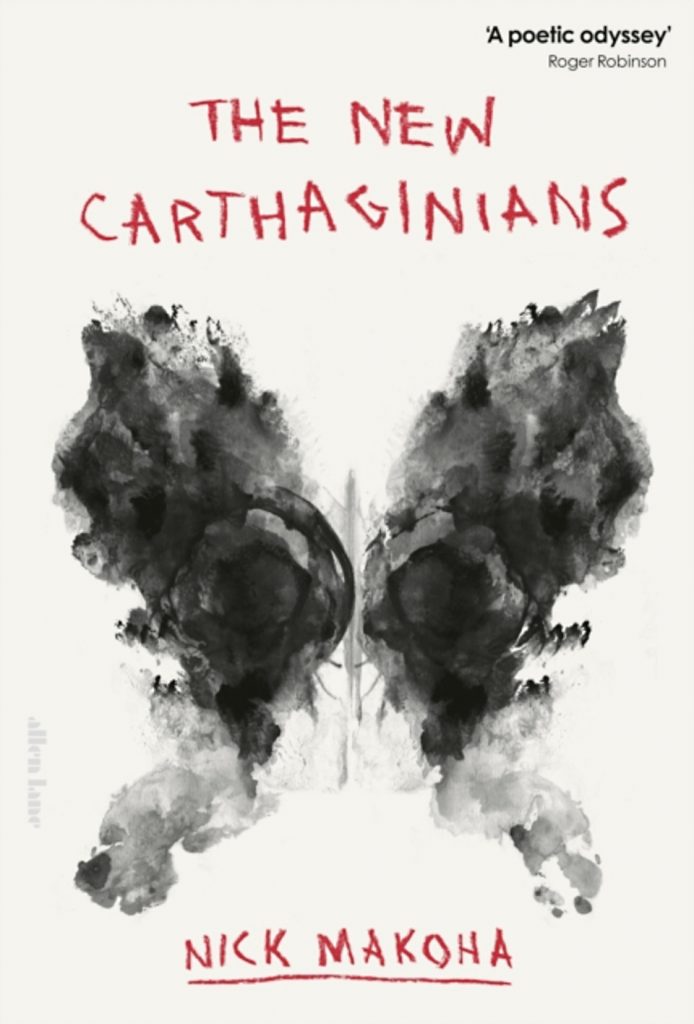
The New Carthaginians

Penguin Poetry
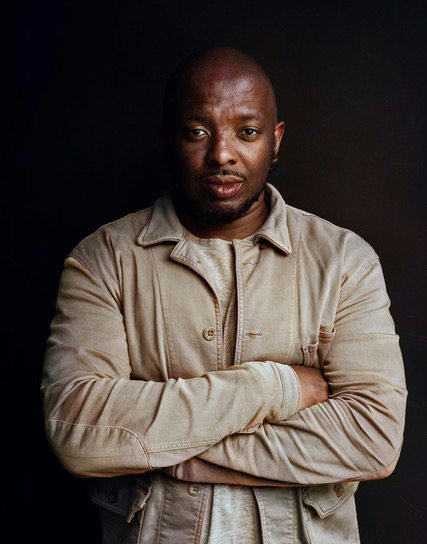
Nick Makoha a1200x1530 (c) Dirk Skiba
Dr. Nick Makoha is a Ugandan poet based in London. The New Carthaginians follows his debut collection Kingdom of Gravity (2017), which was shortlisted for the Forward Prize for Best First Collection and named one of The Guardian’s Best Books of the Year. Winner of the Ivan Juritz Prize, the Poetry London Prize, the Brunel African Poetry Prize and the...

Review

Review

Nick Makoha’s The New Carthaginians is expansive, lyrical and beautiful, an exploded collage of text that is epic in scope and ambition, writes John Field

Read the
Reader's Notes

Related News Stories

We’re delighted to announce the T. S. Eliot Prize 2025 Shortlist, which offers ‘something for everyone’ in collections of ‘great range, suggestiveness and power’. Judges Michael Hofmann (Chair), Patience Agbabi and Niall Campbell chose the Shortlist from 177 poetry collections submitted by 64 British and Irish publishers. The diverse list...
The T. S. Eliot Prize and The Poetry Society are delighted to announce the cohort for the fourth instalment of the Young Critics Scheme. Ten young writers have been selected and will each review, in video form, one of the poetry collections shortlisted for the T. S. Eliot Prize 2025....
The T. S. Eliot Foundation is delighted to announce the judges for the T. S. Eliot Prize 2025. Chair Michael Hofmann will be joined on the panel by Patience Agbabi and Niall Campbell.  Michael Hofmann said: I’m delighted to be asked to judge the T. S. Eliot Prize and look...
Review of The New Carthaginians

Nick Makoha’s The New Carthaginians is expansive, lyrical and beautiful, an exploded collage of text that is epic in scope and ambition, writes John Field

Between 2022 and 2023 Nick Makoha was poet-in-residence at the Institute of Contemporary Arts, London, where he explored the work of Jean-Michel Basquiat. His second collection, The New Carthaginians, could be regarded as fruit of this residency.

We might start by looking at Jean-Michel Basquiat’s 1986 painting, Icarus Esso. When we visualise Icarus, we’re likely to be thinking along the lines of Jacob Peter Gowy’s 1636–8 painting: robes, muscles and beauty tumbling to a watery doom, father looking on aghast. By contrast, Basquiat gives us a collage of acrylic paint, oil stick and Xerox copies: an arrangement of repeated motifs and constituent parts. Makoha uses the ‘exploded collage’ as poetic device. In his notes, he cites the Basquiat critic Diego Cortez who praises Basquiat’s ability to ‘give physical equality to all particles’. The New Carthaginians replicates this approach.

The book opens with ‘flight|flʌɪt’, and the phonetic spelling tells us that we’re looking at a dictionary head word. Poetry puts language under pressure, making words work on multiple levels but, in this respect, the dictionary is the text par excellence, and Makoha co-opts it as a form of hagiography, as mythmaking. Perhaps the opening definition of flight is voiced by Al Diaz, Basquiat’s childhood partner in crime (under the moniker ‘SAMO©’ they tagged the streets together): ‘2 AM. This is the actual / moment when Basquiat and I first meet. In the light of that moment, he begins to talk about doing / something other than art’. It feels auspicious, and echoes John 1:5’s ‘the light shines in the darkness, and the darkness has not overcome it’, endowing Basquiat’s work with messianic power. The meeting also reads as a dream vision – Basquiat playing Virgil to Makoha’s Dante. As well as offering us radiant, joyful flight, we’re also shown the tragic descent of Icarus. It’s fun chasing down the clues as we read that ‘I didn’t get to choose the location, 0.0436O N, 32.4418O E in its darkness’. The grid reference puts us on the hard standing outside Entebbe International Airport, the future tense lending the events which unfolded there the tragic inevitability of the collision between Titanic and iceberg in Thomas Hardy’s ‘The Convergence of the Twain’. The speaker tells us that ‘The year is 1976. It will be a long summer. / Air France Flight 139 will depart from Tel Aviv. So far, no sign of blood. The future, what does it know?’ Makoha sets the continuing international interest in the hijacking of Air France Flight 139 against personal history (as a child, he fled from Idi Amin’s dictatorship) and the poem’s fragmented images echo our relationship with early memories and experiences.

Early memories are untrustworthy as we suspect that they are constructed from family anecdotes and photos so, while we think we visualise lived experiences with clarity, perhaps we are not recalling them at all. As we move through Makoha’s opening sequence, ‘Deep Space Quartet’, we are asked ‘What do you know about / Operation Thunderbolt? You may or may not have heard of Yoni / and what happened in 1976. In the movie, Yoni is the hero’. The speaker does not italicise ‘Operation Thunderbolt’, nor does he place it in inverted commas. He refers to the military operation to rescue the hostages and not to Operation Thunderbolt (1977), the Israeli film about the hijacking. We’re asked to acknowledge that much of what we think that we know about the world is mediated by culture: ‘We are seven days away / from the 4th of July but this is not an American story.’ However, our memories and our certainties about the world are shaped as much by popular culture as they are by lived experiences.

Makoha picks this up later in ‘Julius Caesar’. We’ve jumped forwards to 2006, to Kevin Macdonald’s Hollywood movie, The Last King of Scotland – another representation of the hijacking of Air France Flight 139. James McAvoy and Forest Whitaker star, and the speaker asks us whether we have ‘noticed that superstars always want to / play our parts’, elbowing ordinary people out of the frame. Over the page, in ‘Basquiat asks the Poet to Paint him the Truth’, we’re in Raid on Entebbe (1977) where: ‘They just cast Charles Bronson because he’s going down / well in Europe’ and, with Bronson playing Dan Shomron, the man who planned and commanded Operation Entebbe, the hijacking itself is hijacked.

The New Carthaginians is expansive, lyrical and beautiful. The poem ‘The New Carthaginian’ (one of two with this title) puts human affairs in perspective and reminds us that attending to the details of the natural world is salutary: ‘Notice how the river carries the water away? / Notice the hawk’s descent and how it aligns with the mountains beyond?’ Makoha’s exploded collage is epic in scope and ambition.

 Nick Makoha’s The New Carthaginians (Penguin Poetry) is shortlisted for the T. S. Eliot Prize 2025. John Field blogs at Poor Rude Lines.

The New Carthaginians
Penguin Poetry

Newsletter

Be among the first to receive updates on the latest T. S. Eliot Prize news by subscribing now!


The T. S. Eliot Prize on Social Media

Part of tseliot.com

Designed by thinking

Interview of The New Carthaginians

The New Carthaginians
Penguin Poetry

Newsletter

Be among the first to receive updates on the latest T. S. Eliot Prize news by subscribing now!


The T. S. Eliot Prize on Social Media

Part of tseliot.com

Designed by thinking