
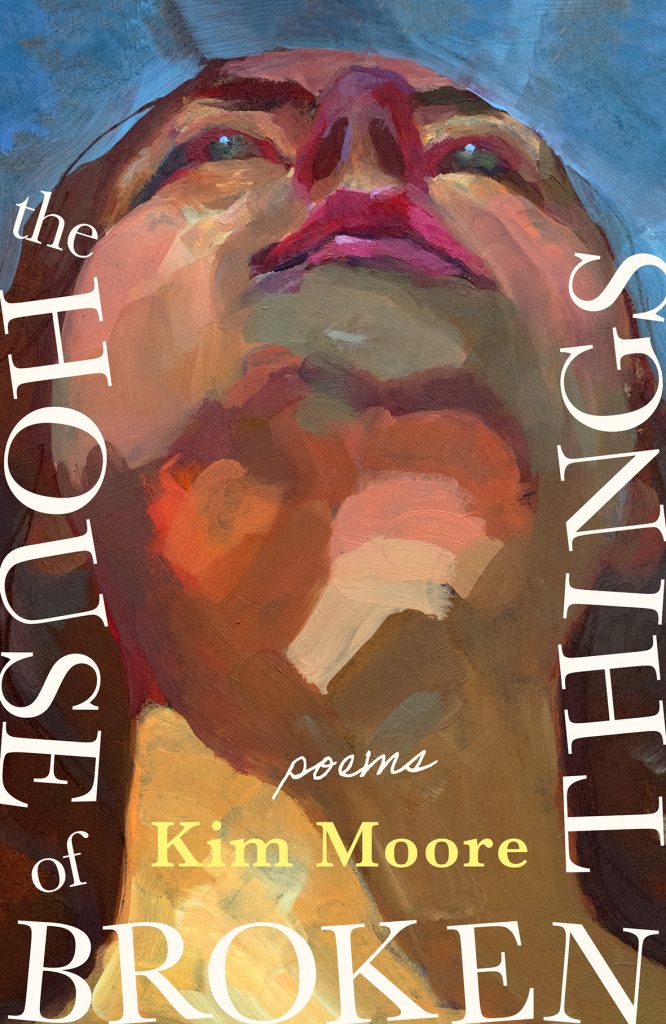

The House of Broken Things

Corsair Poetry
Moore, Kim 1200x1530 author photo © Rebecca Higson
Kim Moore’s collection All the Men I Never Married (Seren Books, 2021) won the 2022 Forward Prize for Best Collection. Her first collection The Art of Falling (Seren, 2015) won the Geoffrey Faber Memorial Prize. She is the author of the non-fiction titles What the Trumpet Taught Me (Smith|Doorstop, 2022) and Are You Judging Me Yet? Poetry and Everyday Sexism...

Review

Review

In Kim Moore’s The House of Broken Things to be a mother is to risk personal peril to rescue your daughter and to be a daughter is to brave a world haunted by the ghosts of women

Read the
Reader's Notes

Videos

Kim Moore reads ‘Giving Birth with Anne Sexton’
Kim Moore interviewed about being shortlisted for the T. S. Eliot Prize 2026
Kim Moore reads ‘Motherhood as Refuge’
Kim Moore reads ‘Advice from My Family’

Related News Stories

Kim Moore, shortlisted for the T. S. Eliot Prize 2026 with her collection The House of Broken Things (Corsair Poetry), is the featured poet in this week’s Eliot Prize newsletter. The newsletter tells you about the wide range of content we have created to help you get to know Kim...
We’re delighted to announce the T. S. Eliot Prize 2026 Shortlist – ten exciting collections of ‘linguistic disruption, personal reflection [and] humorous lyricism’. They are books, says Leontia Flynn, Chair of judges, that ‘share a determination to meet the challenges faced in difficult times with closer attention to language’. The...
Get your tickets now for our annual celebration of the best of British and Irish poetry, the prestigious T. S. Eliot Prize Shortlist Readings at the Southbank Centre’s Royal Festival Hall on Sunday 17 January 2027. You won’t want to miss performances from the shortlisted poets, as chosen by judges...

Review of The House of Broken Things

In Kim Moore’s The House of Broken Things to be a mother is to risk personal peril to rescue your daughter and to be a daughter is to brave a world haunted by the ghosts of women

The House of Broken Things rips off our rose-tinted spectacles and shows us the female body in its hairy splendour. Somehow, through Kim Moore’s warts and all vision of motherhood, love shines all the brighter.

One of the collection’s epigraphs, ‘You never saw such a wild thing as my mother’, references ‘The Bloody Chamber’, Angela Carter’s Sadeian reworking of ‘Bluebeard’. The daughter, trapped in the Marquis’s chateau, unlocks a secret room deep within it and discovers a chamber decorated with broken things – the mutilated remains of his murdered wives. Female intuition brings the mother roaring into view to save the day. To be a mother is to drive to a lonely chateau, willing to face personal peril to rescue your daughter. To be a daughter is to brave a world haunted by the ghosts of women.

Stories like ‘Bluebeard’ are a cultural permafrost: their malignity infects the everyday. It should be simple for a child to play in a park but, in ‘Taking Our Daughter to the Park’, the speaker’s partner ‘opened the gate / and the pram sailed through like a boat / into the world’. Even in her pram, even pushed by her father, the gothic intrudes; this journey of innocence into the unknown conjures Little Red Riding Hood’s walk through the forest, or entry into the Marquis’s bloody chamber. Moore’s speaker admits that ‘Now I keep imagining something / happening, something very bad’. That ‘something’ is seen twice – an automatic negative thought – at once both an improbable fiction and the aggregate of every news story seen in a lifetime. It flexes with the hidden horror of Spielberg’s shark.

‘The Black Notices’ also functions like automatic negative thoughts: ‘There’s a girl in the parking lot. No sign of any clothes. / Hungry when she died. May have been thirteen.’ Line after line of this poem is fractured, severed across its caesuras – disjunctures describing more broken things. Later in the collection, these thoughts intrude again in ‘My Black Notice’ where the body ‘found inside a pit / hole / river / // next to a motorway / border / parking lot’ belongs to the speaker and offers an insight into a woman’s thoughts on any journey – am I safe here?

‘The Kidnap’ looks again at Carter’s heroine, the mother. This time, she is aligned with the mythical figure of Demeter, willing to tackle the underworld in order to rescue her daughter, Persephone. The stage is set as we read that ‘My oldest sister went missing when I was seven, / rumoured to be “staying in a squat with some boys”.’ The sinister possibilities being easy to imagine, the mother, in response, again becomes Carter’s heroic wild mother, ‘fierce-eyed and leaping from the car’. The parents’ intervention is a disaster for all concerned:

Kidnapping in broad daylight – though now

they both deny that’s what it was. I can see my mother
can’t believe they did it, though now I understand
what you might do to get a daughter back

But Persephone has swallowed Hades’ pomegranate seeds, and ‘they would never get her back’. Yes, mothers are heroic but their love for their daughters can also be self-sabotaging and unwelcome.

One of the collection’s final poems, ‘My Mother’s Tumour’, makes a devastating comparison between child and tumour. With a black humour, Moore describes the tumour as a ‘brave, bright traveller’, evoking Fiona Benson’s exacting look at miscarriage, ‘Visitations’ (Bright Travellers, Cape Poetry, 2015). Moore’s bright traveller is a grotesque parody of pregnancy: ‘My mother / is a refuge for this tumour. / When she eats, the tumour eats.’

If that mother ‘waits and waits and waits’ as the tumour grows and the gears of the NHS grind, then ‘The Years’ is a breathless slab of a prose poem, presenting time hurtling past young mothers:

One year ago today I was breastfeeding probably with mastitis probably exhausted probably on antibiotics and she was six months old and not yet crawling and two years ago today I was twelve weeks pregnant and sick and sick all day and didn’t move from the sofa and cried alone for hours

And yet, at the end of it, there is ‘love which colours everything’.

The House of Broken Things offers us a candid, raw glimpse of motherhood – and of the lives lived by girls and women – and its existence makes the world a better place.

Kim Moore’s The House of Broken Things (Corsair Poetry) is shortlisted for the T. S. Eliot Prize 2026. John Field blogs at Poor Rude Lines.

The House of Broken Things
Corsair Poetry

Newsletter

Be among the first to receive updates on the latest T. S. Eliot Prize news by subscribing now!

The T. S. Eliot Prize on Social Media

Part of tseliot.com

Designed by thinking

Interview of The House of Broken Things

The House of Broken Things
Corsair Poetry

Newsletter

Be among the first to receive updates on the latest T. S. Eliot Prize news by subscribing now!

The T. S. Eliot Prize on Social Media

Part of tseliot.com

Designed by thinking