The poems in Anne Carson’s The Beauty of the Husband have all the dramatic tension, eroticism and energy of the tango – voices dance at arms’ length as the distance between husband and wife is laid bare, writes Cal O'Reilly
Be among the first to receive updates on the latest T. S. Eliot Prize news by subscribing now!
The poems in Anne Carson’s The Beauty of the Husband have all the dramatic tension, eroticism and energy of the tango – voices dance at arms’ length as the distance between husband and wife is laid bare, writes Cal O’Reilly
Anne Carson’s signature formal flair, remixing of the classical and the contemporary, and magnetic use of imagery are all on display in her T.S. Eliot Prize-winning collection The Beauty of the Husband, which takes the form of ‘a Fictional Essay in 29 Tangos’. These poems are attentive to ideas around beauty and truth on a linguistic, emotional, artistic and philosophical level.
Using the narrative framework of a doomed marriage, Carson probes Keats’s idea that ‘Beauty is truth, truth beauty’ by casting the beautiful husband as a pathological liar. While the relationship feels almost mythic in its reckoning with timeless lyric ideas of love, beauty and betrayal, Carson’s cutting use of language makes it immediate and embodied. In one poem,
A cold ship
moves out of harbor somewhere way inside the wife
and slides off toward a flat gray horizon.
Here, Carson’s imagery feels muscular, both intellectually and of the heart, and pulses with the pain of the narrator.
Choreographed around recurring motifs – letters, games, military language, molecular structures – a mixture of staccato and flowing lines, and voices that variously lead and react, the poems have all the dramatic tension, eroticism and energy of the tango. At times, the voices dance at arms’ length as the distance between husband and wife is laid bare: ‘it closed his breath. / her strange evening.’ Elsewhere, they lean into each other ‘as players may rest against the rules of the game.’
The poems draw attention to poetic truth as distinct from literal truth. Carson pairs sincerity with archness while interrogating the ramifications of this distinction within the speaker’s relationship and beyond:
And from the true lies of poetry
trickled out a question.
What really connects words and things?
Not much, decided my husband.
While the narrator uses poetic language to express an emotional truth – ‘Now of course you know / that isn’t the true story, what broke wasn’t glass, what fell to earth wasn’t body’ – the husband displaces blame onto language for his personal betrayals: ‘when need arose I may have used words that lied’.
Stunning images stop you in your tracks, even when describing the mundane: eight strained days in Athens have ‘‘the internal texture of petradavki (ancient pevtros) / – that is ‘broken crushed stone, roadstone, gravel.’’ Another poem describes a daily record of a branch viewed from a back window in elegiac couplets. Carson’s narrator quotes eight couplets in all, such as:
Foaming against its own green cheek it cools in brief
or seems to cool each underleaf.
She then downplays this:
Well I won’t bore you with the whole annal.
Point is, in total so far, 5820 elegiacs.
Which occupy 53 wirebound notebooks.
Piled on four shelves in the back kitchen.
And would take maybe a night and a day and a night to read through.
With fervor.
Referencing the earlier question of what connects words and things, this archive charts a dance around a poetic truth that modulates daily. There is a sense of exhaustion in the sparse line, ‘With fervour’, suggesting the challenges of containing this constant flux within language.
The final three lines of the penultimate poem are a direct address to the reader: “Here’s my advice, / Hold. / Hold beauty.” This feels like both holding and breaking from the centrifugal force of the tango as a two-person dance. The meaning of the word ‘hold’ is left oblique and ambiguous. Does it refer to another? To beauty contained within oneself? Echoing the first poem, to a ‘delay,’ a finitude? This ambiguity dances at the limits of language, as does Carson’s whole rapturous book.
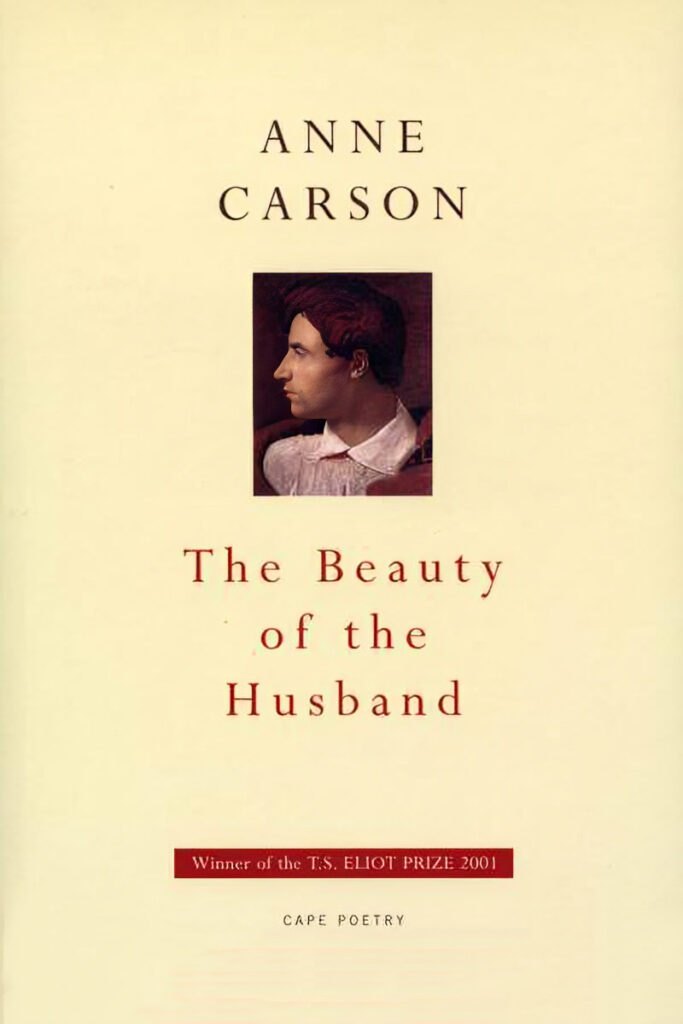
Anne Carson’s The Beauty of the Husband (Cape Poetry) won the T. S. Eliot Prize 2001.
This review was specially commissioned from Cal O’Reilly, a Young Critic in 2024. The Young Critics Scheme, established in 2022, is a partnership programme run by The Poetry Society and the T. S. Eliot Prize. Each year, the scheme commissions ten emerging poetry reviewers to produce video reviews of the Prize Shortlist. For 2026, we also asked four Young Critics to dive into the Prize archives and review past winning collections.
Cal O’Reilly (he/they) is a poet from Wexford. He currently works in a cafe and will begin an MA in poetry this autumn. His debut pamphlet Boyish is forthcoming with fourteen poems.
Be among the first to receive updates on the latest T. S. Eliot Prize news by subscribing now!