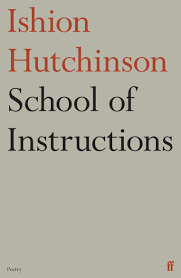

Ishion Hutchinson’s powerful School of Instructions explores the legacy of Empire, lost lives and histories, with the vividness of a dream vision, writes John Field
Be among the first to receive updates on the latest T. S. Eliot Prize news by subscribing now!
Ishion Hutchinson’s powerful School of Instructions explores the legacy of Empire, lost lives and histories, with the vividness of a dream vision, writes John Field
Ishion Hutchinson’s School of Instructions memorialises the West Indian soldiers who served in British regiments during World War I: both those who perished, and those who returned to campaign for independence from the very country they had been fighting for. It is an extraordinary work of literature. Like Blake and Milton, Hutchinson reforges language with a biblical, visionary grandeur. His words have heft and permanence. They feel chiselled in stone as a fitting, powerful act of remembrance for the people who fell in the mud and the sand of the Middle Eastern campaigns of 1916–1918, and whose names were forgotten.
The collection opens by presenting the reader with Godspeed, a young schoolboy living in rural Jamaica in the 1990s. He reads the world through his Encyclopaedia Britannica, whose ‘long-drawn leaves echo Vallombrosa’. Vallombrosa evokes Paradise Lost immediately. Satan and the fallen angels, cast from Heaven, lie scattered across the surface of Hell, ‘Thick as Autumnal Leaves that strow the Brooks / In Vallombrosa’. Vall (valley) ombrosa (shady) near Florence becomes, through wordplay, the valley of the shadow of death (and, in turn, a slant reference to Psalm 23). For the schoolboy, doing his best to read the world, something is missing, something is concealed in the shadows: ‘off-key volumes buried now in his head, / or somewhere else, irrecoverably lost’. The dates in his book are ‘corrosive’, suggesting, perhaps, the problems faced by people the world over when reading history through Anglocentric tomes such as Encyclopaedia Britannica.
The poem takes on the vividness of a dream vision as the men of the West Indian regiments appear to Godspeed. ‘He recalled / rain gauzed cannons with steam’ and vows to ‘Recover them’. What follows reads like an act of forensic archaeology as we see soldiers shovelling mud: ‘Mene mene tekel upharsin mud. Civil war mud. / And darkness and worms will be their dwelling place mud. / Yaws mud. Gog mud. Magog mud. God mud.’ Language slips and slides and, in the mess, one thing looks much like another. According to Daniel (of the lions’ den) a shadowy hand inscribes ‘Mene mene tekel upharsin’ (You have been weighed and found wanting) on Belshazzar’s palace wall; perhaps in this context of mud these words equate the British Empire with the decadence, and transience, of Babylon. The ‘darkness and worm’ echo Psalm 18, David’s prayer to be delivered from his enemies. In Hutchinson’s hands, biblical material crackles with energy and brings the necessary gravitas to this story of a people wandering in the desert like the Israelites.
In the next section, ‘The Anabasis of Godspeed’, (‘anabasis’ – a military advance, but also used especially by Xenophon to describe Cyrus the Younger’s advance into Asia) – campaigns separated by thousands of years merge into one another and School of Instructions speaks to all wars at all times. In this section, Hutchinson’s style changes again. Place names are referenced with biblical reverence, with the care of a chronicler. It opens: ‘Now these were the embarkations they made to the HOLY PLACES of EGYPT SINAI PALESTINE and of SYRIA in the years of the furies 1916–17 unto the last 1918’. It’s pitch perfect (embarkation taking us back to the Latin, barca, meaning small boat). The meticulous listing is an act of devotion to the dead and, in tone and technique, takes its inspiration from the Old Testament Book of Numbers, a book which works with great lists of places, dates and (surprise) numbers. Sections of the poem generally sign-off with a quantity survey, just as they do in its biblical counterpart: ‘The strength of the battalion stood at 328 officers and 5321 other ranks’. Men are simply an index to measure the strength of the battalion – the only entity which matters – and ordinary people are snubbed and dismissed as merely ‘other ranks’. Horrendous losses and sufferings disappear when reported as single numbers. The reader has to compare them to reconstruct the scale of the bloodshed. A little later, ’The strength of the battalion stood at 24 officers and 915 other ranks’.
School of Instructions resonates with a biblical authority. It reads like Blake, Milton, Herman Melville and Cormac McCarthy. A collection like this does not come around often, but you know it when you see it. The fallen West Indian soldiers of the British regiments have been given a memorial as breathtaking as those made of stone on the battlefields of Western Europe and the Middle East.
Ishion Hutchinson’s School of Instructions (Faber & Faber, 2023) is shortlisted for the T. S. Eliot Prize 2023. John Field blogs at Poor Rude Lines.
Be among the first to receive updates on the latest T. S. Eliot Prize news by subscribing now!