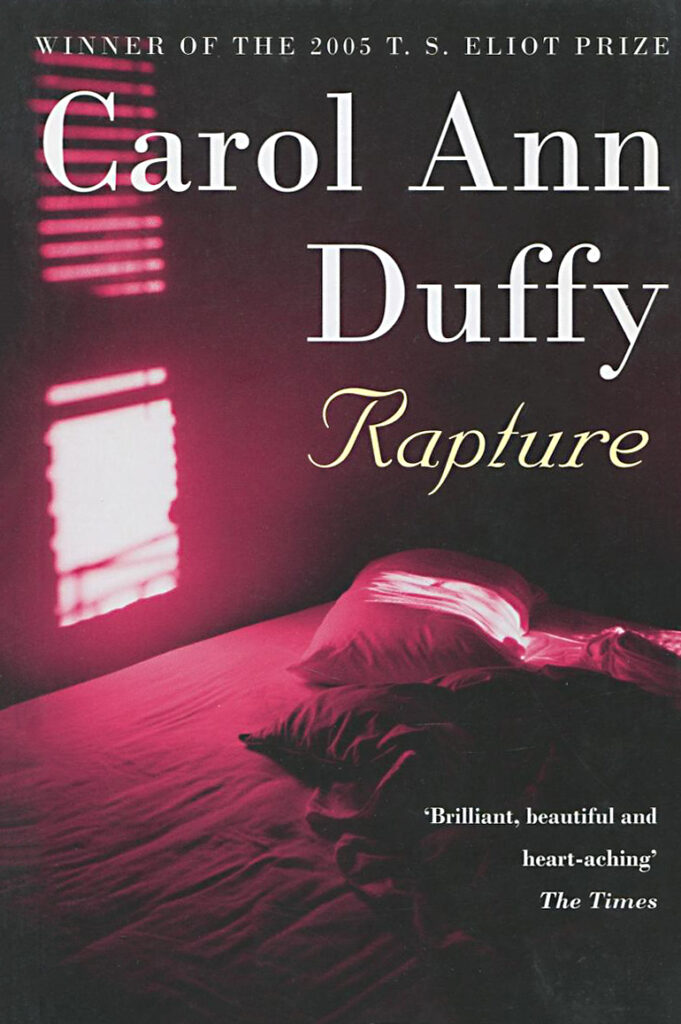

WINNER
2005

Rapture

Picador Poetry
Carol Ann Duffy (c) Jemimah Kuhfeld (1)
Carol Ann Duffy (born 23 December 1955) is a Scottish poet and playwright. She is a professor of contemporary poetry at Manchester Metropolitan University, and was Poet Laureate 2009–2019. She was the first female poet laureate, the first Scottish-born poet and the first openly lesbian poet to hold the Poet Laureate position. Her poetry has received many awards, including the...

Review

Review

In Carol Ann Duffy's Rapture, the speaker uses metaphorical comparison obsessively, making the ‘you’ manifest so widely that their image becomes oppressive to speaker and lover. Each is trapped in a circular chain of metaphors, writes Elliot Ruff

Videos

Melanie Banim reads from Carol Ann Duffy’s Rapture

Related News Stories

This year, in conjunction with our partners at The Poetry Society, we asked a handful of Young Critics to dive into the T.S. Eliot Prize archives and explore winning collections from the Prize’s history. Our aim is to reintroduce you to a classic on the Eliot Prize bookshelf. Our latest...
This article on the T. S. Eliot Prize was first published on the Poetry Book Society website in 2006. The Poetry Book Society is pleased to announce that the winner of the T. S. Eliot Prize for the best single-author collection of poetry published in 2005 is Carol Ann Duffy, for...
This article on the T. S. Eliot Prize was first published on the Poetry Book Society website in 2005.   The Poetry Book Society is pleased to announce the Shortlist for the T. S. Eliot Prize 2005, to be awarded to the writer of the best new collection of poetry...

Review of Rapture

In Carol Ann Duffy’s Rapture, the speaker uses metaphorical comparison obsessively, making the ‘you’ manifest so widely that their image becomes oppressive to speaker and lover. Each is trapped in a circular chain of metaphors, writes Elliot Ruff

In ‘The Rival’, included in Carol Ann Duffy’s 2012 selection of Sylvia Plath’s poems, Plath writes:

If the moon smiled, she would resemble you.
You leave the same impression
Of something beautiful, but annihilating.

Likewise, Duffy’s Rapture paints its subject – the ‘you’ addressed throughout – by moving between ecstasy and grief, love and absence, in what reads like a book-length chain of metaphors tracing a relationship from its beginning to its end.

The moon is the most abundant metaphor in Duffy’s Rapture, its richest but most oppressive image, in poems like ‘Absence’ (‘the river staring up, lovesick for the moon, / is my long night’) or ‘The Lovers’ (‘The moon, their own death, / follows them’). Each time the speaker encounters the moon-as-metaphor, a kind of annihilation takes place, a feeling of whirling to one’s death like ‘October’s leaves’.

Over the course of the collection, this annihilation extends to metaphor itself and becomes increasingly foregrounded, as in ‘Write’ where we see ‘the night / pressing and pressing my bones / into the ground’. Even in the final poem ‘Over’, when there is ‘no moon to speak of’, the speaker still looks for it, searching for its image in their memory, writing it over and over, finding it impossible to turn away.

There is an immediacy to Duffy’s metaphors, as if their power is in the suddenness of their arrival and how quickly they must be captured on the page. The effect is that the speaker’s muse keeps metamorphosing between poems: ‘You […] from the pining, earth-struck moon which gapes at me’ in the opening poem, followed by ‘You were […] the heavy, wet perfume of soil’ in ‘Forest’, and then, a few poems later in ‘Haworth’, ‘[t]he heathery breath of the moor’s simply your smell.’

Indeed, in the aptly-titled sonnet ‘Love’, ‘the world [is] love’s metaphor’:

Aflame, October’s leaves adore the wind,
its urgent breath, whirl to their own death.
Not here, you’re everywhere.

The speaker uses metaphorical comparison obsessively, making the ‘you’ manifest so widely that their image becomes oppressive to speaker and lover. They’re each trapped in a circular chain of metaphors where, as in the book’s epigraph from Shakespeare, there is ‘[n]ow no discourse, except it be of Love’.

Carol Ann Duffy’s Rapture (Picador Poetry) won the T. S. Eliot Prize 2005.

This review was specially commissioned from Elliot Ruff, a Young Critic in 2024. The Young Critics Scheme, established in 2022, is a partnership programme run by The Poetry Society and the T. S. Eliot Prize. Each year, the scheme commissions ten emerging poetry reviewers to produce video reviews of the Prize Shortlist. For 2026, we also asked four Young Critics to dive into the Prize archives and review past winning collections.

Elliot Ruff is originally from Shrewsbury and works in publishing. 

Rapture
Picador Poetry

Newsletter

Be among the first to receive updates on the latest T. S. Eliot Prize news by subscribing now!


The T. S. Eliot Prize on Social Media

Part of tseliot.com

Designed by thinking

Interview of Rapture

Rapture
Picador Poetry

Newsletter

Be among the first to receive updates on the latest T. S. Eliot Prize news by subscribing now!


The T. S. Eliot Prize on Social Media

Part of tseliot.com

Designed by thinking