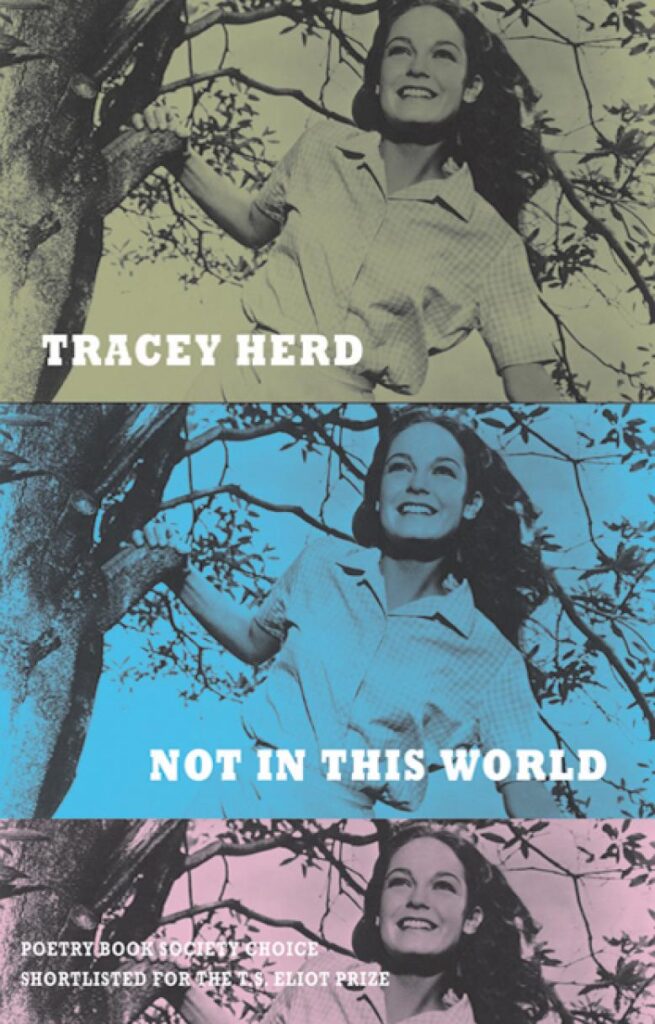

Not in This World by Tracey Herd interrogates identity as it celebrates popular culture, writes John Field
Be among the first to receive updates on the latest T. S. Eliot Prize news by subscribing now!
Not in This World by Tracey Herd interrogates identity as it celebrates popular culture, writes John Field
Gasoline fuelled Hollywood glamour collides with the everyday in Tracey Herd’s latest Not In This World and, as the collection explores obsession, the air crash which killed Buddy Holly, J P ‘The Big Bopper’ Richardson and Ritchie Valens forms its epicentre.
The crash is first encountered halfway through the collection in ‘When a Lovely Flame Dies’ which takes its name from a line in The Platters’ song ‘Smoke Gets in Your Eyes’, now darkly ironic as the plane was lost in blizzard conditions. Herd offers the reader little context, requiring us to witness the accident afresh, struggling to make sense of unfolding events, or to understand their significance. Reduced to unidentified victims, the gentle, slow smallness of the crash shrinks these musical icons, like Pieter Bruegel’s Icarus, slipping unnoticed into the ocean.
Snow thickens like a muffled melody:
silently, on the wooden stage, the encore dies
as the tail-lights slip quietly down the sky.The mangled wreckage will always lie
against that fence, snow flurrying as the plane taxis.
Stars beckon. The snow plays its muffled melody
The seemingly irrepressible noise and energy of youth and the emergence of rock and roll is alluded to in the line immediately below the poem title: ‘When your heart’s on fire, you must be alive’ (another echo of ‘Smoke Gets in Your Eyes’). However, it is the snow, not the performers, that sits centre stage, and implacable nature cools the hottest fires. Despite this, the wreckage is ossified in the present perfect tense: it has been mangled but will continue to be so, endowing it with an immortality of sorts, and a legend is born even as the music dies. This is one of the collection’s villanelles and Herd exploits the form to create the tragic brooding repetition of the legend.
‘Vivien and Scarlett’, another villanelle, nods to the ‘Rage, rage’ refrain of Dylan Thomas’s ‘Do not go gentle into that good night’. The reader is unsettled as the poem’s third person singular ‘she’ slides between Vivien Leigh and the character Scarlett O’Hara. The villanelle’s repetition fuses their identities until we can no longer tell them apart and wonder whether, through the actress, the character has achieved a sort of becoming:
To her, the world was always a stage.
She was youthful and stubborn, a dreamer and fey,
her green eyes outstaring the fire’s wild rage.Filled with a hunger she could never assuage,
she knelt in Tara’s red earth to mourn and to pray
no longer needing to read from the page
Like Herd’s second collection, Dead Redhead, Not In This World offers provocative portraits of Hollywood’s greats. In ‘Norma Shearer’ her physique is described frankly:
her legs were too thick and she knew
that one eye cast about in a delinquent
skew that parodied beauty.
Rhyming ‘knew’ with ‘skew’, Herd also parodies beauty as the rhyming words occupy positions at the end of one line and the beginning of another, rehearsing their own kind of skewing. The villanelle’s repetition of the assertion that ‘Shearer had eyes of the palest blue’ implies that they were the sole reason for her success, and the language used to present her acting is dismissive. She:
impersonated queens and tragic heroines
after going through the rollcall of starlets,
flappers and prettily bobbed poppets,
a meticulous attention to the meanest detail:
sexy suffering in satin gowns, and why not?
‘Impersonate’ implies that Shearer merely represented these characters’ physical forms, that, by sticking a crown on her head, she represented a queen. Similarly, ‘rollcall’ reduces characters to mere names on a list and the speaker’s ironic ‘meticulous attention to the meanest detail’ is set against Hollywood’s desire to aestheticise and sexualise passivity.
The selves in this collection are destabilised, reflected and distorted by a series of mirrors and many have a touch of Angela Carter-esque gothic about them. As reflections bounce and repeat, so does language: through individual poems and across the collection, creating an echo chamber which interrogates identity as it celebrates popular culture.
Tracey Herd’s Not in This World (Bloodaxe Books) was shortlisted for the T. S. Eliot Prize 2015. John Field blogs at Poor Rude Lines.
Be among the first to receive updates on the latest T. S. Eliot Prize news by subscribing now!