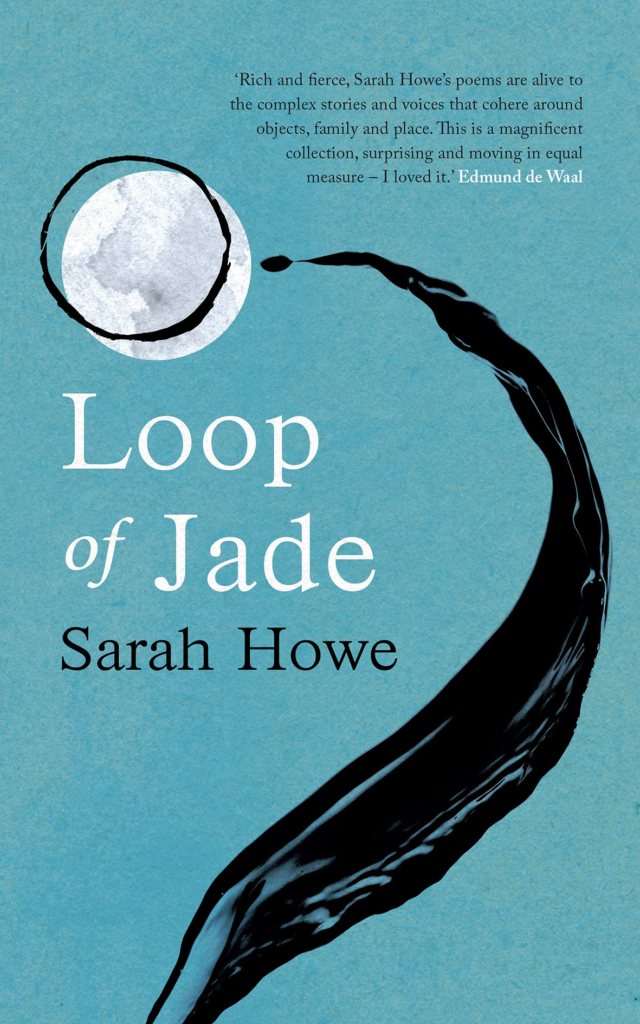

Language twists and shifts like a bonfire’s sparks in Sarah Howe’s timely and urgent Loop of Jade, writes John Field
Be among the first to receive updates on the latest T. S. Eliot Prize news by subscribing now!
Language twists and shifts like a bonfire’s sparks in Sarah Howe’s timely and urgent Loop of Jade, writes John Field
To see Sarah Howe’s Loop of Jade as concerned solely with the philosophy of language would be to miss the point. Loop of Jade is a satisfying, coherent collection. It develops an urgent, timely political message and celebrates human ingenuity and bravery, as they weigh in against the might of the state. A flick through the collection at your local bookshop may suggest that it is intimidatingly multilingual. However, you can trust Howe – her poetry is all you need to see you through and enjoy this memorable collection, in which exuberant language twists and shifts like a bonfire’s sparks.
Fittingly, the collection opens with ‘Mother’s Jewellery Box’. Each tercet suggests the diagonal slant of a hand-addressed envelope, an effect which allows the eyes to luxuriate on their first lines – objects float onto the page in freedom: ‘a moonlit lake’, ‘silver chains’, ‘carnelians’. This effect, together with Howe’s close observation and stripped language, lends the poem a sense of physical solidity:
silver chains
careful o’s and a’s
in copperplate
Those engraved letters invite us to suppose that language offers some physical permanence and solidity. However, as the poem ends, the mother’s amber ring, initially immured in darkness between ‘the twin lids / of the black lacquer box’, is transformed. It has become a ‘teaspoon of honey / whiskey poured / by morning light.’
The collection’s epigraph is taken from Borges’s essay ‘The Analytical Language of John Wilkins’, in which Borges offers a taxonomy from the Chinese ‘Celestial Emporium of Benevolent Knowledge’, which classifies animals as ‘(a) belonging to the emperor, (b) embalmed, (c) tame’ and so on. Borges’s ludicrous taxonomy forms the backbone of Howe’s collection and, as in her poem ‘Mother’s Jewellery Box’, it calls into question the spurious ways in which we grasp at associations and systems to classify and understand the world around us. Apparently, only about ten percent of Chinese characters function as guessable ideographs and, in ‘(k) Drawn with a very fine camelhair brush’ Howe presents the reader with 木 (tree): ‘Landing at Canton, the first Jesuits believed / they’d stumbled on the lost language of Eden – / that Ham had helped offload the Art / then set off for the East, its walled lands, / taking with him Adam’s perfect tongue / that named the animals one by one.’ To some, the idea that language might enjoy concrete relationships with the material world would be something to celebrate – it would at least make learning them easier. However, Howe continues:
A hand, a brush, its inclination –
involved in an anchoring of sign to thing
so artful that we, like the Jesuits, might forget
words’ tenuous moorings
As the collection develops, it becomes clear that Howe’s project is timely and urgently political and that Chinese is not as fixed as those Jesuits first believed. ‘(m) Having just broken the water pitcher’ opens with an epigram from Wumen Huikai’s The Gateless Gate, a thirteenth-century Zen text where we are asked ‘If you cannot call it a water pitcher, what do you call it?’ And so Howe presents the Chinese blogger: ‘He ponders how strange it is (how useful…) / that I beg you for the truth is pronounced / the same as I beg you, Elephant of Truth!’ With a single ‘slip’ one Chinese character can become another, and the answer to Wumen’s koan becomes clear as truth and meaning squeeze themselves into the narrowest spaces between sounds and pen strokes and, in even the toughest of environments, protest remains possible:
in some remote coal-mining district
sits an anonymous blogger, his face lit
by more than just the ancient monitor.
Sarah Howe’s Loop of Jade (Chatto & Windus) was shortlisted for the T. S. Eliot Prize 2015. John Field blogs at Poor Rude Lines.
Be among the first to receive updates on the latest T. S. Eliot Prize news by subscribing now!