
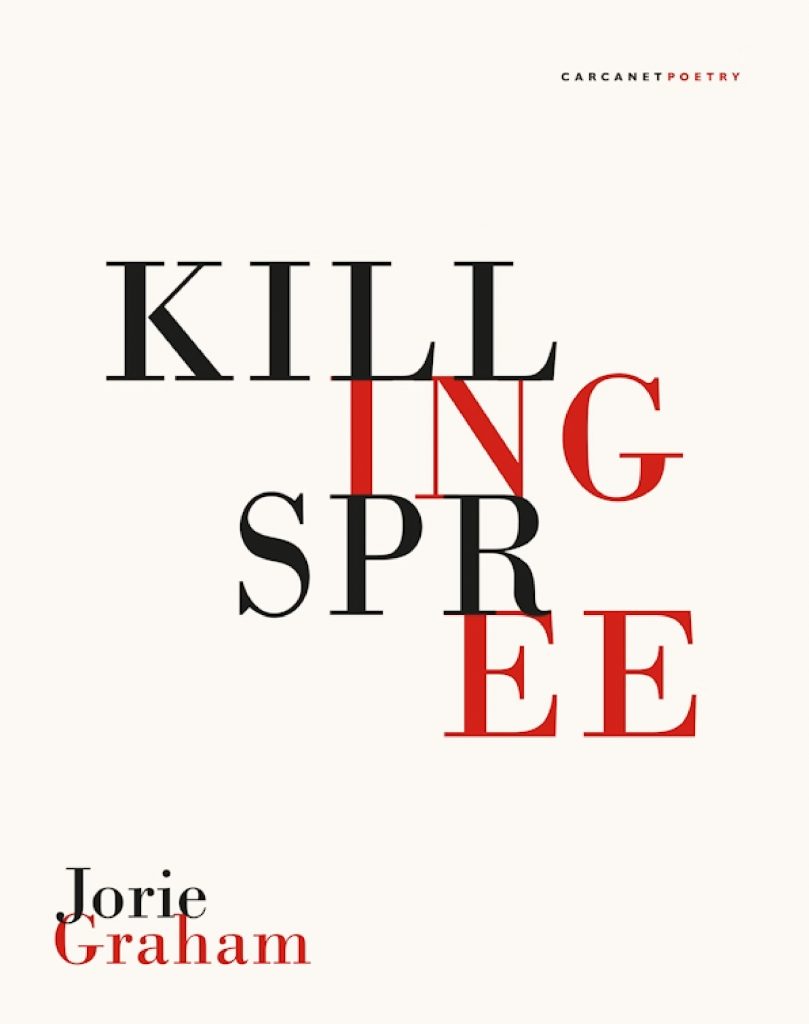

Jorie Graham’s Killing Spree offers a devastating vision of humanity at the cliff edge, but affirms the enduring presence of the poet, of the human witness, writes John Field
Be among the first to receive updates on the latest T. S. Eliot Prize news by subscribing now!
Jorie Graham’s Killing Spree offers a devastating vision of humanity at the cliff edge, but affirms the enduring presence of the poet, of the human witness, writes John Field
Jorie Graham, awarded the 1996 Pulitzer Prize for poetry and shortlisted for the 2012 T. S. Eliot Prize, has published sixteen collections of poetry. Killing Spree casts her as Cassandra, shaking a sleepy world by the shoulders. Readers should leave copies of Killing Spree in train carriages and rent billboards from which to display them at unavoidable scale.
The collection opens sotto voce. Graham’s stage is an unusual 190 x 235 mm page, meaning that the lines of ‘The World’, lines which mostly amount to no more than a couple of words, are pebbles cast on the surface of the white page: ‘THE WORLD // didn’t change much / at first.’ Perhaps the page feels calm and clean, but understatement and line breaks are used to devastating effect as predictability and stability are reframed as barely perceptible but nevertheless significant change: ‘It’s so / quiet now. The now / used to be a noisy / place & now // it is so / still.’ In an article published in Nature, Lior Green et al estimate a global decline in marine mammal biomass of around seventy per cent since the 1850s. It’s getting quieter out there and Graham’s speaker remarks that ‘Then you, / then I, cry out / where are you / everyone.’ The calm white of Killing Spree assumes a funereal aspect.
There’s a scriptural quality to the collection too. ‘The Falling’ suggests Adam and Eve’s desire for more, and their expulsion from Eden. Graham’s poem reads like a dream vision, like words of prophecy: ‘A hand or something like / a hand / appeared in the upper / sky’. Perhaps we’re reminded of Belshazzar’s feast, the revellers making merry as the hand of God appears to write ‘Mene, Mene, Tekel, Upharsin’ on the wall: God hath numbered thy kingdom, and finished it. Thou art weighed in the balances, and art found wanting. Midway through the collection, in ‘When the End Starts’, the speaker observes wryly that ‘all of us are shopping’ – the twenty-first century version of Belshazzar’s consumption. Much of the collection – and most of its later poems – are right-justified, perhaps suggesting the dawning realisation that time and space no longer accommodate what we wish to say. Our utterances arrive late in the day and there’s no room left to manoeuvre as we contemplate the cliff edge at the end of the page. Capitalism, our consumption of the world and its resources, is at the forefront of the mind: ‘Our lists are made out carefully. / Don’t forget anything a voice calls out. / Remember what I asked you for’ and ‘The finished list is our masterpiece. / There must be nothing left on it’. However, even as the collection deals in specifics, it remains richly allusive too. Deeper into the poem: ‘Then the lists started—didn’t they?—someone started to keep / track. Of what. Of the façade. Of the cracking façade of the / here-to-stay. Of your imminent replacement. Of your market-based / behaviour […]’.
Lists become the observations of structural engineers – not healing the world but recording its decline. They also become the cookie crumbs we drop in the online forest – not crumbs dropped to enable us to escape, but dropped by business and governments to surveil us.
Despite the darkness, the final poem, ‘Suddenly’, marks a defiance and a return to left-justified poems. The speaker remarks that ‘What remains is // always, only, voice—this, here, / this creature in the bony / enclosure’. Killing Spree affirms the presence of the poet, of the human witness. From the multifarious disasters humanity has exacted on the world – and on itself – Graham’s poetry becomes more than a charge sheet. It affirms the dignity of the planet — of the human person — and, while both prophetic and visionary, it is equivocal enough to speak the language of both the specific and the universal simultaneously. It is never patronising, judgemental or hectoring, and begs to be passed on. Cassandra, we’re listening.
Jorie Graham’s Killing Spree (Carcanet Press) is shortlisted for the T. S. Eliot Prize 2026. John Field blogs at Poor Rude Lines.
Be among the first to receive updates on the latest T. S. Eliot Prize news by subscribing now!