Abigail Parry’s I Think We’re Alone Now delivers ‘a gloriously perverse take on intimacy’, writes John Field
Be among the first to receive updates on the latest T. S. Eliot Prize news by subscribing now!
Abigail Parry’s I Think We’re Alone Now delivers ‘a gloriously perverse take on intimacy’, writes John Field
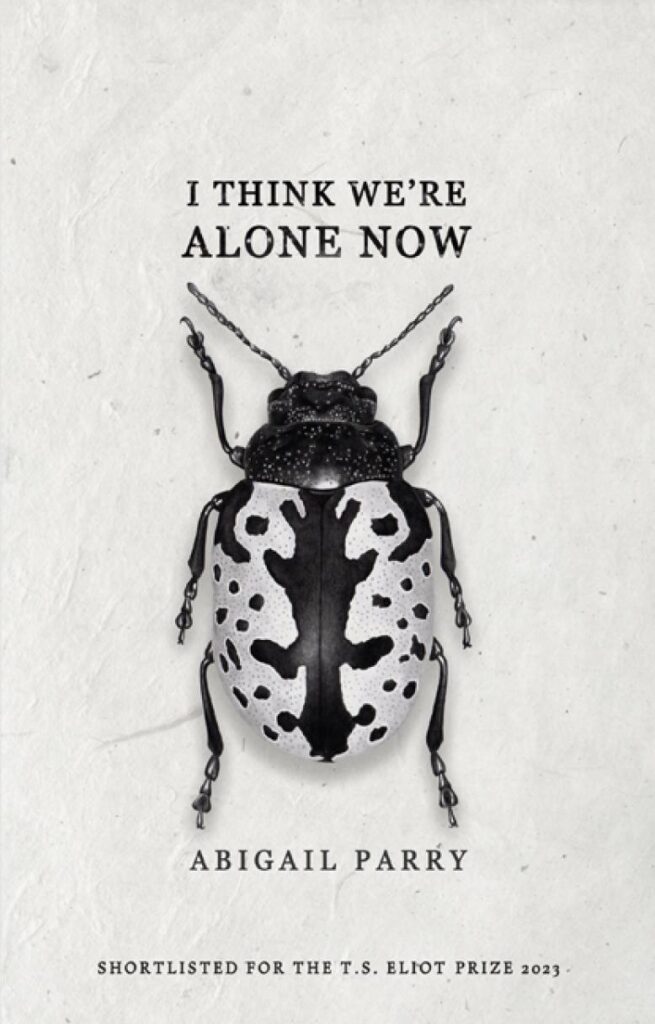
The theatre company Frantic Assembly asked Abigail Parry to write about intimacy and I Think We’re Alone Now is the fruit of this request. It takes its title from Tommy James and the Shondells’ 1967 hit single of the same name. So far so good, as the song’s lyrics invite us to anticipate young lovers running from their parents and into the darkness where, under its cover, they can explore their love for one another. It’s a song with a hot, racing, youthful pulse. However, the collection Parry delivers is more playful and subversive. It buzzes with its own joie de vivre and thrills on its own terms.
Parry’s tone isn’t bubblegum pop. Instead, an early poem, ‘Speculum’, dispenses with the ‘dull fuss of sloven pinks’. No surprise that a former toymaker’s attention is drawn by one of these: ‘I like the word – how pert it is. / Inquisitive. Part instrument, part / clockwork bird’ (hear how the repeated ‘part’ chimes with the cheeky ‘pert’, making it pop). We’re uncertain how to proceed with ‘instrument’ – are we dealing with a Stradavarius or an iron maiden? Perhaps it’s both. Either way, this is a gloriously perverse take on intimacy. The speaker continues: ‘In the Vulgate, it’s a mirror: / videmus nunc per speculum.’ The ‘Vulgate’ is St. Jerome’s Bible of the common tongue (Latin being Europe’s lingua franca in the Middle Ages), and already we’re thinking of tongues – and of whatever else we might playfully associate with ‘Vulgate’. ‘Videmus nunc per speculum’ is a quotation from Paul’s first letter to the Corinthians – ‘Now we see things through a mirror, by enigmas, but one day we will see them face to face’ – and Parry’s speaker is looking for something more numinous than ‘an absence’.
Using a genre of Italian slasher movies, ‘Giallo’ develops the ideas explored in ‘Speculum’. It’s an audacious leap as the craning necks and tilting mirrors of ‘Speculum’ become the stylised camera angles of arty Italian sexploitation, this time working with implied violence where, ‘Between the cleaver coming down / and the merry spatter – another image darkens on the retina’. It’s also a cheeky riff on T. S. Eliot’s ‘The Hollow Men’ – ‘between the motion / and the act / falls the shadow’. Like Spielberg’s shark, ‘you were rattled, weren’t you, by that mirror – / by what you saw just now, or thought you saw’. Absence, although not exactly a presence, possesses a monstrous power to affect.
The penultimate section of the book, a long poem in parts called ‘The Squint’, engages ostensibly with church architecture, but again we’re exploring the act of seeing – presence and absence. The epigraph for the first poem in this sequence, taken from Notes and Queries reads: ‘In the chancel is a narrow, low window, called to this day, ‘the Lepers’ window’, through which it is concluded, the lepers who knelt outside the building witnessed the elevation of the host at the altar’. The editing of this collection is another strength as, read against ‘Speculum’, ‘The Squint’ is reframed as an ecclesiastical burlesque… a peep show: ‘What’s it like? A little like a cut, / although it is a cut. Ditto apertures of different kinds / (eyelet, coin-slot, arrow slit). / Too trim to be an inkblot.’ ‘Coin-slot’ is a slang word for vagina and, as the poem interacts with ‘Speculum’, the lepers become who? Gynaecologists? Diseased and untouchable, praying for a glimpse of the presence of Christ, hidden inside.
I Think We’re Alone Now is a tour de force. Parry’s poems burst off the page, playing with marginalia, footnotes, references to a broad range of culture. It’s joyful and, when it needs to, it displays a mastery of formal structures. Parry’s at the top of her game.
Abigail Parry’s I Think We’re Alone Now (Bloodaxe, 2023) is shortlisted for the T. S. Eliot Prize 2023. John Field blogs at Poor Rude Lines.
Be among the first to receive updates on the latest T. S. Eliot Prize news by subscribing now!