
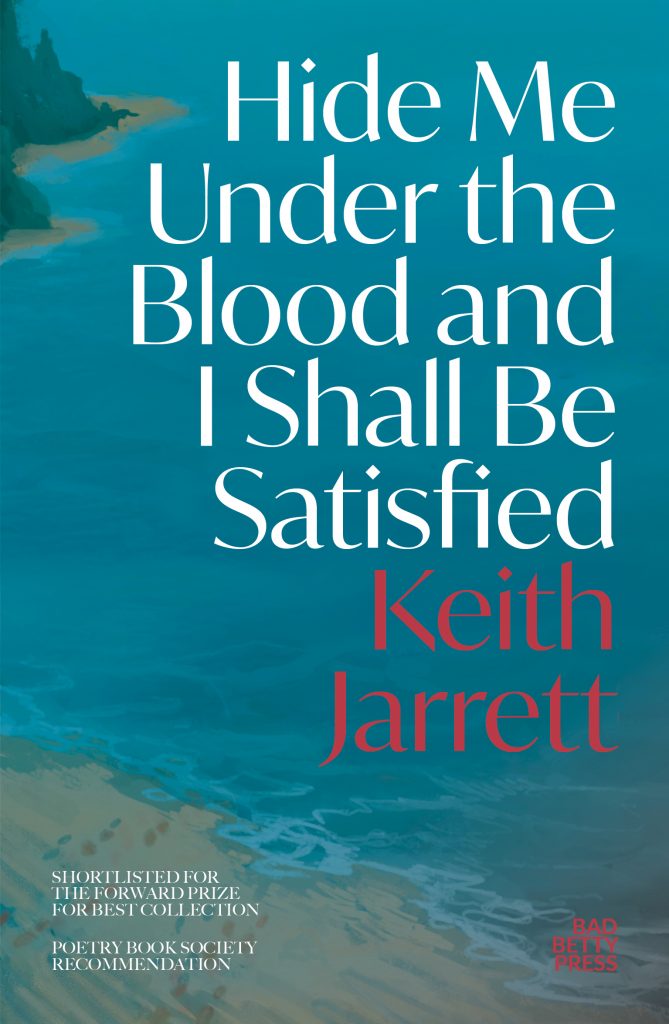

Hide Me Under the Blood and I Shall Be Satisfied

Bad Betty Press
Jarrett, Keith 1200x1530 © Adrian-Pope-HR
Keith Jarrett is a writer and educator of Jamaican heritage. His debut poetry collection, Selah (2017), was published by Burning Eye Books. Also in 2017, his play, Safest Spot in Town, was performed at the Old Vic, London, and aired on BBC Four. An international slam champion, he has appeared on Benjamin Zephaniah’s BAFTA-winning show, Life & Rhymes, and his...

Review

Review

Keith Jarrett’s Hide Me Under the Blood and I Shall Be Satisfied offers an unmuzzling of language. The results are beautiful, playful and rich, writes John Field

Read the
Reader's Notes

Review of Hide Me Under the Blood and I Shall Be Satisfied

Keith Jarrett’s Hide Me Under the Blood and I Shall Be Satisfied offers an unmuzzling of language. The results are beautiful, playful and rich, writes John Field

Keith Jarrett’s second poetry collection treats the reader to a riotous, joyful and metamorphic experience of language. It is steeped in the King James Version of the Bible and Caribbean creole and reminds us that the sounds we make – and the forces circumscribing their use – continue to duke it out. Hide Me Under the Blood and I Shall Be Satisfied strikes a body blow for the forces of light.

An early poem, ‘London Proverbs 9:10’, dramatises the tension between Christianity’s capacity both to liberate and to oppress. The poem works with the Bible’s Book of Proverbs: ‘The fear of the Lord is the beginning of all wisdom, and knowledge of the Holy One is understanding.’ Initially, Jarrett’s poem promises community and consolation: ‘The Fear of the Lord will keep you’ but, across the line break, the tone changes, and the fear of the Lord ‘will keep you shut up’. Over the page, in ‘Hide Me Under the Blood, Lord’, the police force’s powers to stop and search are perhaps the motivation behind the father keeping his children under lock and key, ‘suffering them / only to shuffle to school and church and back’. Families of Jamaican heritage repress themselves in their efforts to keep their loved ones safe. However, ‘shut up’ also suggests the gagging of speech and the censorship of the written word. The collection is punctuated by a series of poems meditating on the African and Caribbean practice of kissing your teeth. It is telling that, in one of the poems entitled ‘wind sucked between teeth’, the first example of teeth kissing is ‘auntie’s chastisement’, placing the practice on the family hearth. Jarrett isn’t one to oversimplify the complex and so he follows this example with ‘ear-splitting rebuke’. This even-handed acknowledgement of the richness, the power, the capacity for teeth kissing to signify, makes the ‘state-sanctioned sound ban’ even more unacceptable and ridiculous: banning a sound. Jarrett’s notes for the poem direct the reader to a 2015 article in La Nouvelle République which notes that, although kissing your teeth has been banned in some schools, it has also been politicised – Christiane Taubira kissed her teeth to a National Front candidate who compared her to a monkey. Read against this poem, the shutting up of ‘London Proverbs 9:10’ becomes the silencing and control of people with Caribbean heritage. The poem engages with Biblical language to the last, signing off with a reference to Exodus: ‘The fear of the Lord will be passed down to your children and yea, even unto your children’s children, Amen.’ Regardless of whether we’re dealing with the fear to walk the streets, or the repression of speech, the poem speaks to the blight of generational trauma.

The collection also offers a powerful consideration of the deleterious effects of the languages of power. ‘Sun newspaper’ comprises a series of couplets, the lines of which jar against one another. In typical brash fashion, The Sun speaks first as Jarrett works with material taken from the paper’s April 27, 1987 editorial, published under the headline ‘Would you let this man near your daughter?’, written in response to the news that Trinity College, Cambridge was considering Benjamin Zephaniah for a visiting creative arts fellowship. The poem pulls no punches, opening with ‘Would you let this man near your daughter? He is black –’ This sordid little headline sits cheek by jowl with a line from the Bible’s Song of Solomon: ‘I am black but comely oh ye daughters of Jerusalem’. It’s too easy to excuse this editorial as peculiar to the 1980s – in our own time an assessment of the spleen vented gleefully against Jason Arday speaks against this.

Meanwhile, in ‘Re: The Caribbean “Experience”’ we see how the dominant culture is able to have its cake and eat it as the speaker walks through London’s Square Mile where if you ‘Ask an archivist […] she will tell you how much is hidden in banal documents. How the spectacle of blood, of executioners, of marrow and splinters flying, are muted in administrative language.’

Hide Me Under the Blood and I Shall Be Satisfied is an unmuzzling of language. It’s beautiful, playful and rich. It offers no easy conclusions, but time spent with Jarrett is time rewarded.

Keith Jarrett’s Hide Me Under the Blood and I Shall Be Satisfied (Bad Betty Press) is shortlisted for the T. S. Eliot Prize 2026. John Field blogs at Poor Rude Lines.

Hide Me Under the Blood and I Shall Be Satisfied
Bad Betty Press

Newsletter

Be among the first to receive updates on the latest T. S. Eliot Prize news by subscribing now!

The T. S. Eliot Prize on Social Media

Part of tseliot.com

Designed by thinking

Interview of Hide Me Under the Blood and I Shall Be Satisfied

Hide Me Under the Blood and I Shall Be Satisfied
Bad Betty Press

Newsletter

Be among the first to receive updates on the latest T. S. Eliot Prize news by subscribing now!

The T. S. Eliot Prize on Social Media

Part of tseliot.com

Designed by thinking