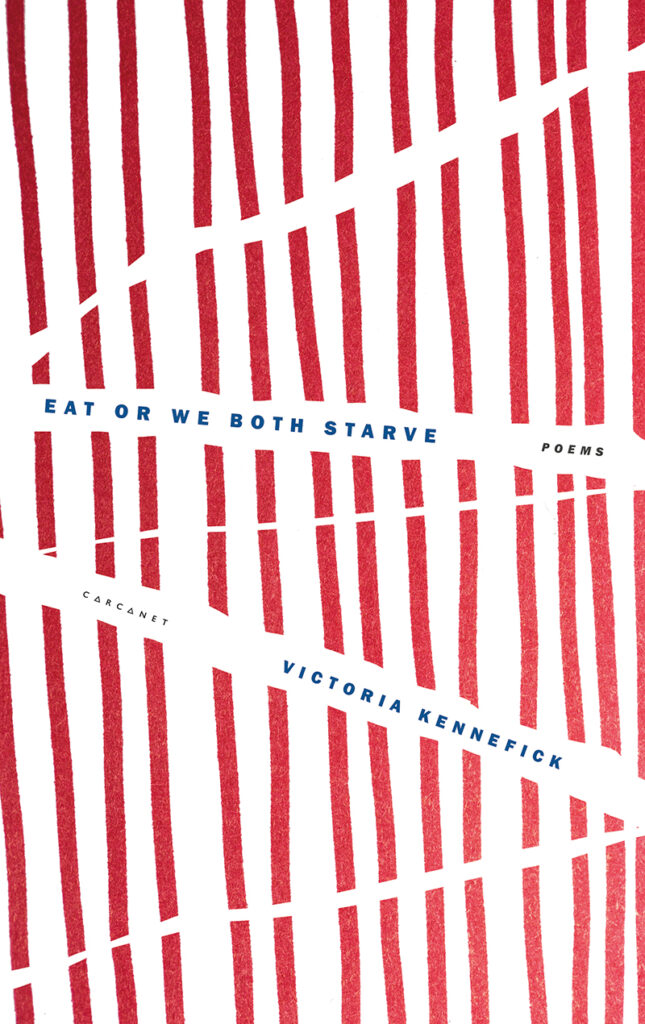

Eat or We Both Starve

Carcanet Press
Victoria-Kennefick-2021_bw
Victoria Kennefick is a poet, writer and teacher from Shanagarry, Co. Cork now based in Co. Kerry. She holds a doctorate in English from University College Cork and studied at Emory University and Georgia College and State University as part of a Fulbright Scholarship. Her pamphlet, White Whale (Southword Editions, 2015), won the Munster Literature Centre Fool for Poetry Chapbook...

Review

Review

Victoria Kennefick's Eat Or We Both Starve explores Catholic culture and consumption to devastating effect, ''the sins of the tongue’ bringing us back to Eden where eating did no-one any good', writes John Field

Read the
Reader's Notes

Videos

Victoria Kennefick reads from Eat or We Both Starve at the T. S. Eliot Prize Shortlist Readings
Victoria Kennefick reads ‘Selfie’
Victoria Kennefick reads ‘(M)eat’
Victoria Kennefick reads ‘Hunger’
Victoria Kennefick talks about her work
Victoria Kennefick reads ‘Cork Schoolgirl Considers the GPO, Dublin 2016’

Related News Stories

The T. S. Eliot Foundation is delighted to announce that the winner of the T. S. Eliot Prize 2021 is Joelle Taylor for C+nto & Othered Poems, published by The Westbourne Press. Chair Glyn Maxwell said: Every book on the Shortlist had a strong claim on the award. We found...
Michael Schmidt on debuts, range, reach and awards as spotlights Carcanet is proud to have the only first collection on the T. S. Eliot Prize 2021 Shortlist. Victoria Kennefick featured in our New Poetries introductory series in January and her book came out three months later. It had a tremendous reception...
  Judges Glyn Maxwell (Chair), Caroline Bird and Zaffar Kunial have chosen the T. S. Eliot Prize 2021 Shortlist from a record 177 poetry collections submitted by British and Irish publishers. The Shortlist consists of an eclectic mixture of established poets, none of whom has previously won the Prize, and...
The T. S. Eliot Foundation is delighted to announce the judges for the 2021 Prize. The panel will be chaired by Glyn Maxwell, alongside Caroline Bird and Zaffar Kunial. The 2021 judging panel will be looking for the best new poetry collection written in English and published in 2021. The...
Review of Eat or We Both Starve

Victoria Kennefick’s Eat Or We Both Starve explores Catholic culture and consumption to devastating effect, ‘‘the sins of the tongue’ bringing us back to Eden where eating did no-one any good’, writes John Field

In James Joyce’s Ulysses, Buck Mulligan tells Stephen Dedalus that, ‘You have the cursed Jesuit strain in you, only it’s injected the wrong way’. To be raised as a Roman Catholic means to read the world as a Roman Catholic, regardless of one’s current beliefs. Eat or We Both Starve, Victoria Kennefick’s debut collection, reads the world through Catholic culture and, in its echoes and reverberations, we grasp something of how history’s long shadow influences the individual.

In ‘Second Communion’, nothing is as it seems. Kennefick opens by describing Holy Mass: ‘Father Madden enters, his chasuble fluid as milk; / a shaft of sunlight pierces the Christ embroidered in tinsel’. As milk, the priest himself is wholesome, pure and nutritious, perhaps because of his ontological difference – at the consecration of the bread and the wine, the priest is Christ. His ‘fluid’ chasuble underscores his Protean form. The piercing ‘shaft of sunlight’ evokes Bernini’s ‘Ecstasy of Saint Teresa’ and, at one level, suggests that the ‘Christ embroidered in tinsel’ is a part of the sanctuary’s statuary – but it also refers to the priest himself: at the moment of consecration he is pierced as Christ was. Furthermore, this consummation also feminizes him. The host becomes Christ’s flesh and the wine becomes his blood. The congregation watch the priest consume Christ – consume himself – before queuing for their turn at ‘the chalice sloshing with blood’. Kennefick’s ‘sloshing’ reimagines the chalice as a trough of swill. It’s a weird experience drinking from the same cup as a couple of hundred other people, and the poem’s young speaker wonders ‘If I eat Jesus will he want to eat me?’

If ‘Second Communion’ explores a response to consumption, then the following poem, ‘Forty Days’, explores abstinence through the Lenten fast. We visit a family home, ‘mother, cutting / tiny slices of bread in the kitchen corner, / eating from doll plates. She couldn’t be prouder / of our ecstasy of denial, little letter-box lips / refusing the sins of the tongue’. It’s an inversion of the accepted maternal role in which the provision of food is virtuous. Food brings joy but, here, we’re back with the ‘Ecstasy of Saint Teresa’, and ‘the sins of the tongue’ bring us back to Eden where eating did no-one any good.

The collection engages with the hagiographies of female saints to powerful effect. ‘Hunger Strikes Gemma Calgani (1878–1903)’ works with chapter titles: ‘Chapter 11: St. Gemma’s Heroic Mortification’ uses the language of action and masculine strength to present her subjugating her passions and appetites. In Roman Catholicism, mortification possesses connotations of strength and virtue, and focuses on the eternal hereafter, not on the transitory pleasures of the present. However, the OED records the principle meaning of mortify as ‘to deprive of life; to kill, put to death’. Kennefick’s footnotes subvert the energetic hagiography. Chapter 12 explores ‘Attacks by the Devil’ but the footnote voices the Saint: ‘All night I dream of food, Jesus take the taste from me’. Since time immemorial, people have been encouraged to shun the temptations of food as another pleasure of the flesh – yesterday’s saint is today’s anorexic.

Kennefick echoes this series of hagiographic hunger strike poems in ‘Hunger Strikes Victoria Kennefick’ where ‘she cannot wash herself clean / the way she’d like’, where food is seen as filthy and sensual, stuffed ‘into a wide / moist orifice’.

These personal histories are linked to the broader passage of time. In ‘Cork Schoolgirl Considers the GPO, Dublin 2016’, the speaker puts her ‘finger into the bullet holes’ to ‘poke around in its wounds’ as if the GPO were Christ’s mortified flesh, and ‘Researching the Irish Famine’ takes us not to 1845, but to the mass graves of Ireland’s orphanages. Babies ‘Wasted away / like potatoes / in the ground. The whole / country rotten’.

Returning to Ulysses, ‘History, Stephen said, is a nightmare from which I am trying to awake’. In the visceral Eat or We Both Starve, Kennefick shakes us by the shoulders.

Victoria Kennefick’s Eat Or We Both Starve (Carcanet Press) is shortlisted for the T. S. Eliot Prize 2021. John Field blogs at Poor Rude Lines.

Eat or We Both Starve
Carcanet Press

Newsletter

Be among the first to receive updates on the latest T. S. Eliot Prize news by subscribing now!


The T. S. Eliot Prize on Social Media

Part of tseliot.com

Designed by thinking

Interview of Eat or We Both Starve

Eat or We Both Starve
Carcanet Press

Newsletter

Be among the first to receive updates on the latest T. S. Eliot Prize news by subscribing now!


The T. S. Eliot Prize on Social Media

Part of tseliot.com

Designed by thinking