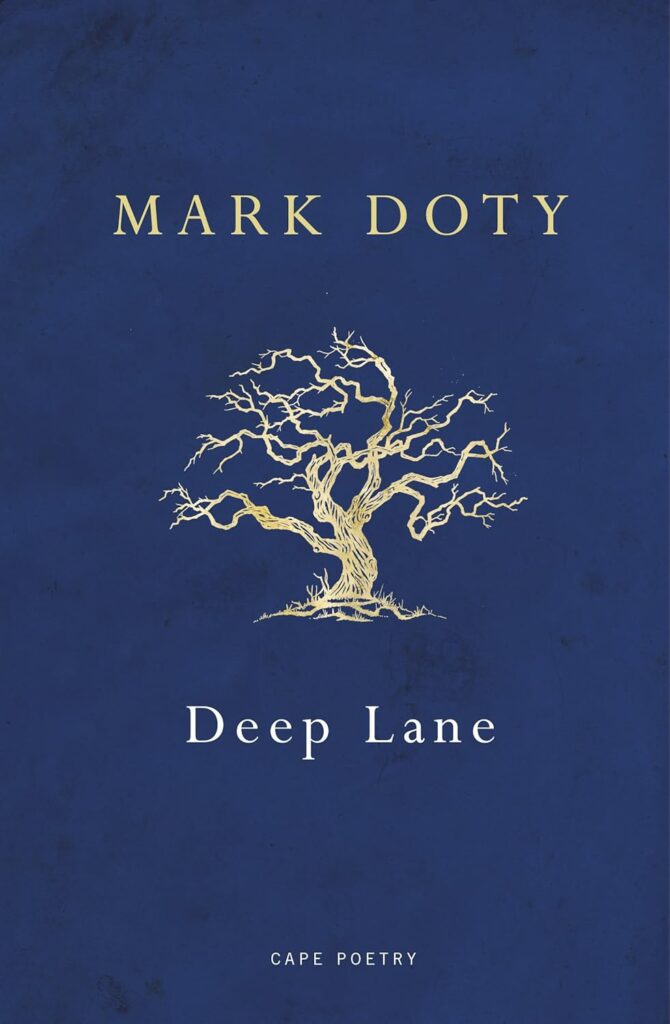

Despite the insistence of mortality and decay, Mark Doty’s Deep Lane is unflinching and humblingly candid, writes John Field
Be among the first to receive updates on the latest T. S. Eliot Prize news by subscribing now!
Despite the insistence of mortality and decay, Mark Doty’s Deep Lane is unflinching and humblingly candid, writes John Field
When I’m down on my knees pulling up wild mustard
by the roots before it sets seed, hauling the old ferns
further into the shade, I’m talking to the anvil of darkness
There’s a sense of desperation and futility to the opening of ‘Deep Lane’, the first poem in Mark Doty’s collection of the same name. To be on your knees is to embody defeat, awaiting the coup de grâce and this significant image is repeated in the poem. Gardening becomes a Sisyphean battle with time and we’re perhaps reminded of Willy Loman from Death of a Salesman, hoe in hand, planting in the dark and fighting his fruitless battle with regret for the road not taken. Either that, or there’s a sense of the supernatural to the scene – as the cover of darkness was the prescribed time for pulling up mandrake.
When the shovel slips into white root-flesh,
into the meat coursing with cool water,
when I’m grubbing on my knees, what is the hammer?Dusky skin of the tuber, naked worms
who write on the soil every letter,
my companion blind, all day we go digging,harrowing, rooting deep.
The spirits of other poets, other poems, whisper beneath Doty’s words. He summons Heaney to assist him but, unlike the methodical progress of ‘Digging’, Doty battles with the anvil of darkness, and his question ‘what is the hammer?’ carries us to the infernal forest of Blake’s Tyger: ‘What the hammer? what the chain? / In what furnace was thy brain? / What the anvil? what dread grasp / Dare its deadly terrors clasp?’ This garden lies at the gates of the underworld and, at the poem’s close, the anvil is described as ‘adamant,’ evoking Milton’s gates of Hell in Paradise Lost Book II: ‘gates of burning Adamant Barr’d over us prohibit all egress.’ Yet, despite the poem’s darkness and profundity, its central line offers a ‘harrowing’. At one level, this presents digging as a destructive laceration and tearing. However, the harrowing of hell is redemptive: the gates are opened allowing the deep lane to receive two-way traffic.
The image of the deep lane offers an ecosystem teeming with life. Although soil comprises death and decay, there’s symbiosis, regeneration, and balance. So, although the deep lane is a haunted, liminal space, its ghosts point to reconciliation not malevolence. In the first of two poems entitled ‘Apparition’, the voice of the mother blends seamlessly into the couplets, suggesting harmony and belonging. In the second poem, the father’s voice cuts across in its own disruptive single line stanza, but the speaker then echoes this form, ending the poem with his own single line, creating order and harmony of form and, perhaps, salving a cut.
This collection is dark, haunted and packs an existential punch as heavy as anything thrown by Hardy. Yet the speaker shares confidences, creating intimate warmth and the prosaic details of the day-to-day lend the poems a joyous levity. This is why Doty’s allusions work so well; with the economy of a painterly brushstroke, the unplumbable depths of his deep lane are intimated. For me, ‘This Your Home Now’ was one of the collection’s stand out poems, where ‘For years I went to the Peruvian barbers on 18th Street / – comforting, welcome: the full coat-rack, three chairs / held by three barbers’ yet, in an instant, it is gone. Then:
dull early winter, back on 18th, just past the post office,
upspiraling red in a cylinder of glass, and just below the line
of sidewalk, a new red sign, WILLIE’S BARBERSHOP. Dark hallway,glass door, and there’s (presumably) Willie.
When I tell him I used to go down the street
He says in an inscrutable accent, This your home now,puts me in a chair, asks me what I want and soon he’s clipping
and singing with the radio’s Latin dance tune.
That’s when I notice Willie’s walls,though he’s been here all of a week, spangled with images
hung in barber shops since the beginning of time:
lounge singers, near celebrities, random boxers
Revel in Doty’s neologism, ‘upspiraling’. The precision of the observation and the economy of his language is worthy of Hardy. Then feel the uncanny, gothic quality of this doppelgänger. The red sign upspirals into infinity and every barbershop is, in a sense, aspiring to a Platonic ideal. We like to believe that a patina of age and idiosyncrasy allows us to recognise home, but these are constructs and the good news is that we can belong anywhere.
Despite the ghosts, despite the insistence of mortality and decay, Mark Doty’s gaze is unflinching and humblingly candid. His Deep Lane is an intimation of immortality and his words are the words of a seer with his other eye fixed deep in the other place.
Mark Doty’s Deep Lane (Cape Poetry) was shortlisted for the T. S. Eliot Prize 2015. John Field blogs at Poor Rude Lines.
Be among the first to receive updates on the latest T. S. Eliot Prize news by subscribing now!