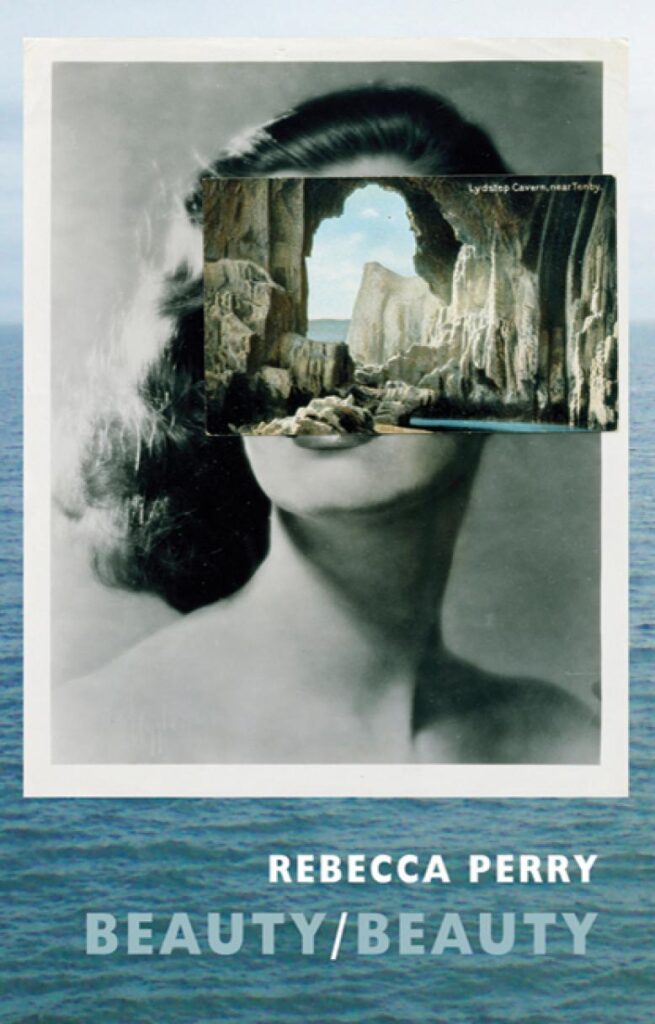

Beauty/Beauty

Bloodaxe Books
Rebecca Perry photo © Ross Jones
Rebecca Perry was born in London in 1986. Her pamphlet, little armoured (Seren, 2012), won the Poetry Wales Purple Moose Prize and was a Poetry Book Society Pamphlet Choice. Beauty/Beauty, her first full collection (Bloodaxe Books, 2015) was a Poetry Book Society Recommendation and won the Michael Murphy Memorial Prize 2017, and was also shortlisted for the T. S. Eliot Prize, the...

Review

Review

In Beauty/Beauty the physical world is observed with care as Rebecca Perry meditates upon some of life’s binary oppositions with deft clarity, writes John Field

Videos

Rebecca Perry reads from Beauty/Beauty at the T. S. Eliot Prize 2015 Shortlist Readings

Related News Stories

This article on the T. S. Eliot Prize was first published on the Poetry Book Society website in 2016.   The Poetry Book Society is delighted to announce that the winner of the T. S. Eliot Prize 2015 is Sarah Howe for her debut collection Loop of Jade, an intimate...
This article on the T. S. Eliot Prize was first published on the Poetry Book Society website in 2015. The Poetry Book Society is delighted to announce a distinguished international Shortlist for the T. S. Eliot Prize 2015, with one poet from the US, one from Jamaica, one from Australia,...
Review of Beauty/Beauty

In Beauty/Beauty the physical world is observed with care as Rebecca Perry meditates upon some of life’s binary oppositions with deft clarity, writes John Field

In poem after poem, many of the words in Rebecca Perry’s Beauty/Beauty maintain a guarded distance from one another. Across the caesura, her half-lines are banished to opposite ends of the page. They’re poles apart, sleeping on either side of the bed, leaving the caesura as a cold waste whiteness, a chasm, a void. ‘Estrapade’ opens:

When you turned away
from me in bed that final time,

your back was a cold, white plate
with no food on it.

Perry’s metaphor is instantly memorable and her caesurae place that cold white divide physically on the page. In the first few lines, the reader might suppose that the poem’s opposing columns of text are some sort of embodiment of the couple, as the poem’s ‘you’ seems to belong on the left and the ‘I’ on the right. However, using the image of a horse (‘estrapade’ can mean the actions of a horse trying to throw of its rider, or a form of torture by suspension) this opposition is destabilised as:

I remembered

the video on the news of the horse
that threw off its rider, then fell down,

but I didn’t know if I was the horse
or the rider in this scenario

so my body became a shipwreck instead.

The poem jumps easily and swiftly with the speaker’s mind and, in its final movement, explores a childhood recollection of Hans Christian Anderson’s The Little Mermaid, throwing time into the mix, as the moment when the inevitability of the happy ending is challenged and replaced by possibilities of pain, tragedy and unrequited love. The vivid economy with which Perry covers this ground is astonishing.

Perry’s oppositions and splits do not just run left to right. In ‘Character Development of the Lovers’ they also divide couplets, echoing the surety and absolutism of the Roman Catholic catechism:

Which part of his body does He lead with and what does this tell us about him?
Leads 8/10 with the groin suggesting sexual aggression/prowess/masculinity.

Which part of the body does She lead with and what does this tell us about her?
Leads 9/10 with chest – indicates promiscuity.

As a ‘character development’, the sort of exercise one might expect to find in a drama workshop, the poem reminds us that our behaviour is a construct, dictated by ritual and, as such, open to reading. However, Perry pushes this to absurd levels as the colour of the lovers’ room, blue, suggests ‘a coldness. Could also hint at drowning (son’s death is never explained fully, though water is involved).’ Art mirrors life, but only so far. Many of the poem’s questions are evaded: even here, in the drama workshop, motivation is elusive.

A stand out poem in the collection is ‘Kintsugi 金継ぎ’. Kintsugi is a Japanese method of repairing broken pottery, where flakes of precious metal are mixed into the lacquer to celebrate the repair as a beautiful addition to the object’s history, rather than as something ugly which should be disguised:

You said I treated you like a dog,
stroking through your hair
and down over your ears,
and that’s what can turn kindness bad.
I would apologise,
but love is the soft parts of us.

As she does in ‘Estrapade’, here Perry makes an example of fractured beauty and, despite the broken relationship, the physical world is observed with care, as chillies redden in the pot, the sky darkens and the absent other’s few possessions become ‘shadowy objects at the / edges of a Renaissance painting’.

Beauty/Beauty meditates upon some of life’s binary oppositions with deft clarity and simplicity – all of which is achieved with sympathetic technique and memorable language

Rebecca Perry’s Beauty/Beauty (Bloodaxe Books) was shortlisted for the T. S. Eliot Prize 2015. John Field blogs at Poor Rude Lines.

Beauty/Beauty
Bloodaxe Books

Newsletter

Be among the first to receive updates on the latest T. S. Eliot Prize news by subscribing now!


The T. S. Eliot Prize on Social Media

Part of tseliot.com

Designed by thinking

Interview of Beauty/Beauty

Beauty/Beauty
Bloodaxe Books

Newsletter

Be among the first to receive updates on the latest T. S. Eliot Prize news by subscribing now!


The T. S. Eliot Prize on Social Media

Part of tseliot.com

Designed by thinking