Sharon Olds ‘celebrates the human’, bringing her ‘unflinching gaze’ and ‘painterly clarity’ to bear on both the personal and political in Balladz, writes John Field
Be among the first to receive updates on the latest T. S. Eliot Prize news by subscribing now!
Sharon Olds ‘celebrates the human’, bringing her ‘unflinching gaze’ and ‘painterly clarity’ to bear on both the personal and political in Balladz, writes John Field
That ‘z’ lends Olds’s ballads a hard, street edge. Balladz deals in abuse, ageing, isolation, and death. It is framed by the experiences of living in lockdown during the COVID-19 pandemic and the murder of George Floyd. Memories and nightmares surface and re-surface from poem to poem, showing us how the child lives on in the adult.
Reading Olds on the human body is akin to looking at Rembrandt’s late self-portraits: hers is an unflinching gaze but, despite this, she sees the body in all its beauty, dignity and wonder. Looking closely is transformational. In ‘Quarantine Morning’, the speaker observes her shins as she crawls up the stairs: she sees ‘their indigo and red-violet fireworks, / their royal blue wormholes’. Ageing is explosive and destructive, but it is also a life drawing class. The ‘wormholes’ are both tiny – evoking microscopic parasites breaking blood vessels – and the mysteries of the universe. Perhaps we’re reminded of William Blake’s ‘Auguries of Innocence’, where we’re invited to ‘see a World in a Grain of Sand’. In ‘My Hand’, the speaker studies her ageing body, where she sees ‘fine / wrinkles, many making diamond shapes, / some of them long cicatrice wobbles’ – the body’s kintsugi – each repair an adornment.
At various points, the collection reads like a journal, as we stay in the speaker’s house and ride out the COVID-19 lockdown. Olds’s speaker is at pains to point out that her quarantine was easy but it is, nevertheless, disturbing. In ‘Quarantine Puzzle’ we start with a ‘broken thumb’ but the poem is structured as an endless list of physical worries and ailments, rendered with Olds’s painterly clarity: ‘Meanwhile my sprained / thumb was a lurid pacifier, and the / stain on my elderly-lady crepe / bicep opulent, the surface / like spotted dick or a clayey cream / brûlée.’ It’s tender, fragile, and speaks eloquently of the myopic hypochondria many of us faced in lockdown’s cabin fever. The poem’s rhyme offers a light-hearted counterpoint to this intensity. As it closes, the speaker asks us (asks herself), ‘What happened last evening? What had / been my liquid refreshment, had I / gone on the Chardonnay roundabout, had I / become a wine roustabout? Now my / thumb is fat as the earthenware teapot’s / cracked spout.’ The collection’s journal-style discursiveness darkens even a moment like this as in ‘339th Morning of My Easy Quarantine’ we hit the booze again: ‘My passport has been the Chardonnay label on the bottle, / its contents have been the loop-de-loop of my fun-fair ride.’ Loop-de-loop suggests a dangerous, real world, visceral thrill and that Chardonnay ‘passport’ is at once comic, tragic and worrying.
This is an iconoclastic collection. ‘Joined Ballad’ is written in response to a photograph of the comely young Karol Wojtyla who, in the fullness of time, would become Pope John Paul II. The speaker’s gaze travels through the cassock to the heart of his sex: ‘a delicate / clapper at the center of a bell’, ‘a ghostly fish’. There’s an echo of Sylvia Plath’s ‘Mirror’ here, where a reflection rises to greet Plath’s speaker like a ‘terrible fish’. It’s an uncanny doubling: monstrously gothic — even more so as, in the heat of the darkness, Wojtyla’s clapper ‘stands up / in praise of God.’
Violence is never far from the home and in ‘Amherst Ballad 1’ we’re channelling Emily Dickinson and a cloistered East Coast idyll: ‘New England School – Old Mansions – / Everyone a Woman – / Some Sweet – some Noble’. It’s a dream vision of the States, but nothing is sacred: ‘One Senior had slept with her Half-Brother – / And the Girl – Dearest to me – / Had been Attempted – by her Father – / Who Was my Father’. Those terse Dickinson fragments – and the silences behind the dashes – become upsettingly eloquent.
Balladz celebrates the human. Looked at closely enough, one body looks much like another. In ‘Anatomy Lesson for the Officer’, Olds’s speaker spells it out: ‘that is a human throat you are kneeling / on. That is our throat, our brother’s, / our son’s, maybe our father’s throat.’ It’s a call to love the body.
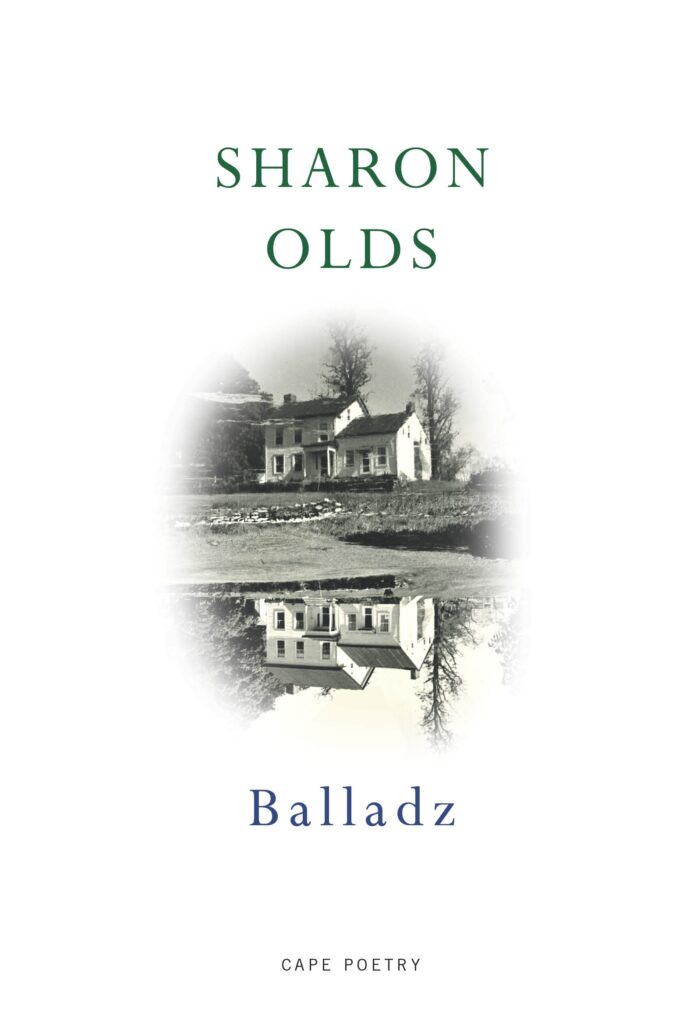
Sharon Olds’s Balladz (Cape Poetry, 2023) is shortlisted for the T. S. Eliot Prize 2023. John Field blogs at Poor Rude Lines.
Be among the first to receive updates on the latest T. S. Eliot Prize news by subscribing now!