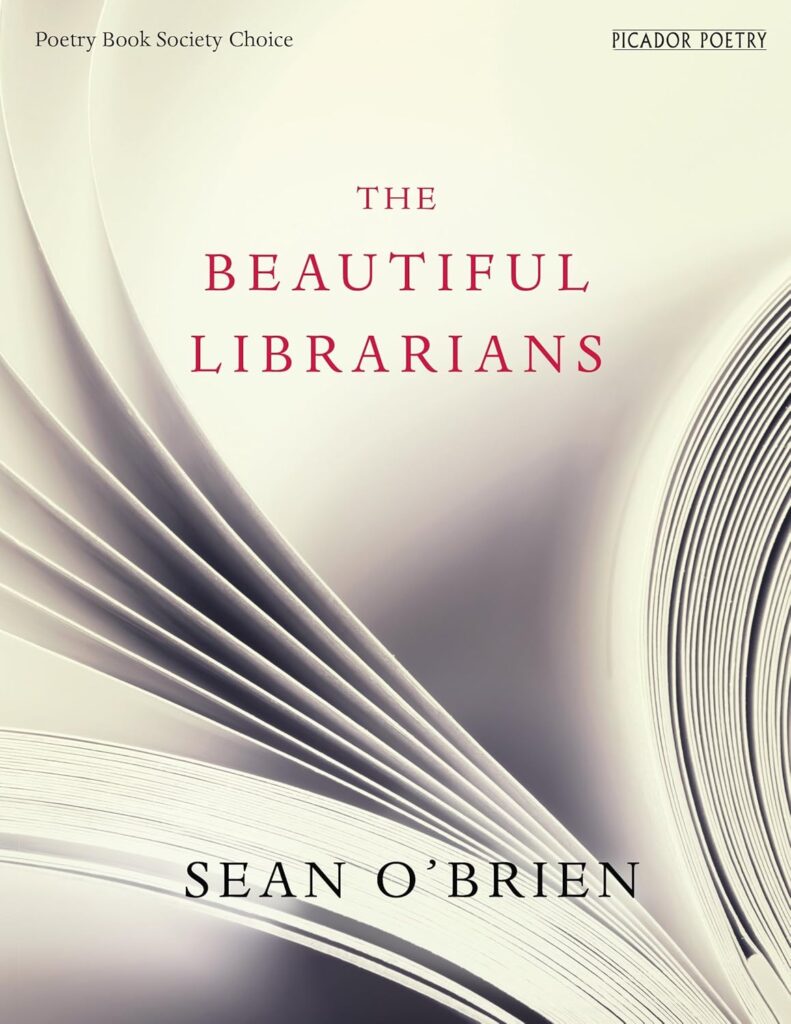
The Beautiful Librarians

Picador Poetry
WINNER Sean O'Brien 1200 x 1530 © Caroline Forbes
Sean O’Brien is a poet, critic, novelist and short-fiction writer. Born in London in 1952, he grew up in Hull and now lives in Newcastle. His poetry collections include The Indoor Park, The Frighteners (both Bloodaxe Books) and HMS Glasshouse and Ghost Train (both Oxford University Press). His collection, Downriver (2001), shortlisted for the T. S. Eliot Prize, was published...

Review

Review

Strident, angry, unashamed and uncomfortable, Sean O’Brien’s The Beautiful Librarians is endowed with a deep sense of the pastness of the present, writes John Field

Videos

Sean O’Brien reads from The Beautiful Librarians at the T. S. Eliot Prize 2015 Shortlist Readings

Related News Stories

This article on the T. S. Eliot Prize was first published on the Poetry Book Society website in 2016.   The Poetry Book Society is delighted to announce that the winner of the T. S. Eliot Prize 2015 is Sarah Howe for her debut collection Loop of Jade, an intimate...
This article on the T. S. Eliot Prize was first published on the Poetry Book Society website in 2015. The Poetry Book Society is delighted to announce a distinguished international Shortlist for the T. S. Eliot Prize 2015, with one poet from the US, one from Jamaica, one from Australia,...
Review of The Beautiful Librarians

Strident, angry, unashamed and uncomfortable, Sean O’Brien’s The Beautiful Librarians is endowed with a deep sense of the pastness of the present, writes John Field

In The Beautiful Librarians, O’Brien’s influences accrete, endowing his poetry with a deep sense of the pastness of the present. We’re living on a civil war battlefield where bygones like the Miners’ Strike are perhaps too heinous to be left as bygones and, despite the passing of the years, atonement may yet be required.

‘Always’ begins by asserting that ‘The morning lasts forever. It does not.’ Broken by a caesura, the line offers two seemingly contradictory statements, yet, existing in a single line, they enjoy an uneasy belonging. Anyone who has clock-watched away an existence in a mind-numbing job knows that a day in the office can warp time. Caught on the treadmill of the daily grind, routine creates its own timeless horror.

The morning lasts forever. It does not.
The teller in the high white room
Beside the silent harbour loathes
His ledgers and his counterfoils
But adds and checks and enters, does
What he is here to do. He knows the rules.

The ‘high white room’ evokes the neoclassical respectability and solidity of financial institutions. However, there’s something wrong here: the high walls also evoke a prison and the room’s whiteness adds a touch of the padded cell. There’s something amiss in the harbour too. This one lacks the buzz of commercial activity, perhaps adding another layer of futility to the teller’s work which is further immured by the enclosing repetition of the structures of lines one and six. ‘Always’ is written after Ruth Stone’s ‘Train Ride’, modulating her images of the American landscape into something avaricious and dirty, and lurking underneath all of this is Auden’s ‘The Fall of Rome’, whose ‘abandoned train’ and failed Roman bureaucracy points to the fall of empires. O’Brien’s poem reminds us that ‘Venetians, Turks, and all the rest / Are dead and gone, likewise their gold’ and, following the collapse of Lehman Brothers, few features of the cosmopolitan landscape feel permanent.

‘Another Country’ also addresses avarice but O’Brien turns the temperature up and presents it as the root cause of a class war.

Scattered comrades, now remember: someone stole the staffroom tin
Where we collected for the miners, for the strike they couldn’t win,

Someone stole a tenner, tops, and then went smirkingly away.

The comrades are now scattered points to a broken society, rejecting the ‘Big Society’ O’Brien trains his sights on in the Rabelaisian excesses of his next poem, ‘Oysterity’. The colloquial ‘tenner’ belittles the sum, inviting us to read it as a metaphor for exploitation and theft at a national level, as those with wealth belittle the paltry sums depended upon by the rest of us. The poem’s epigraph, ‘Get there if you can’, directs the reader to Auden but again, lurking deeper, lies another influence – this time Tennyson’s ‘Locksley Hall’. O’Brien’s catalectic octometer and language evokes Tennyson’s poem: ‘Comrades, leave me here a little, while as yet ’t is early morn’. However, it’s the sentiment that matters and Tennyson offers us:

Cursed be the social wants that sin against the strength of youth!
Cursed be the social lies that warp us from the living truth!

Echoing Tennyson’s 1835 form and theme, O’Brien points to the fact that ‘though you bury stuff forever, it keeps on coming back’. Just as a deadly crop of ordnance wriggles to the surface of the site of the 1916 battle of Verdun every year, O’Brien presents the miners as ‘the casualties of one more English Civil War’ and, as the nation buried Margaret Thatcher in 2013, it was clear that the legacy of the socioeconomic revolution of the 1980s has yet to be laid to rest.

O’Brien’s poetry is strident, angry, unashamed and uncomfortable, pointing off the page and towards the reader. ‘Another Country’ finishes:

Here then lie the casualties of one more English Civil War,
That someone, sometime – you, perhaps – will have to answer for.

Sean O’Brien’s The Beautiful Librarians (Picador Poetry) was shortlisted for the T. S. Eliot Prize 2015. John Field blogs at Poor Rude Lines.

The Beautiful Librarians
Picador Poetry

Newsletter

Be among the first to receive updates on the latest T. S. Eliot Prize news by subscribing now!


The T. S. Eliot Prize on Social Media

Part of tseliot.com

Designed by thinking

Interview of The Beautiful Librarians

The Beautiful Librarians
Picador Poetry

Newsletter

Be among the first to receive updates on the latest T. S. Eliot Prize news by subscribing now!


The T. S. Eliot Prize on Social Media

Part of tseliot.com

Designed by thinking