
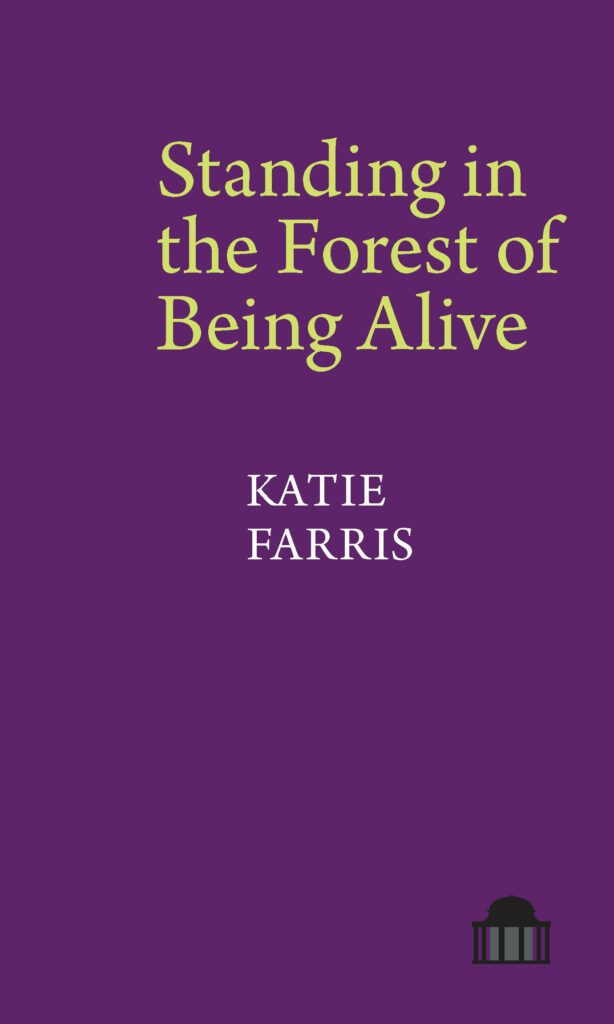
Standing in the Forest of Being Alive

Pavilion Poetry (Liverpool University Press)
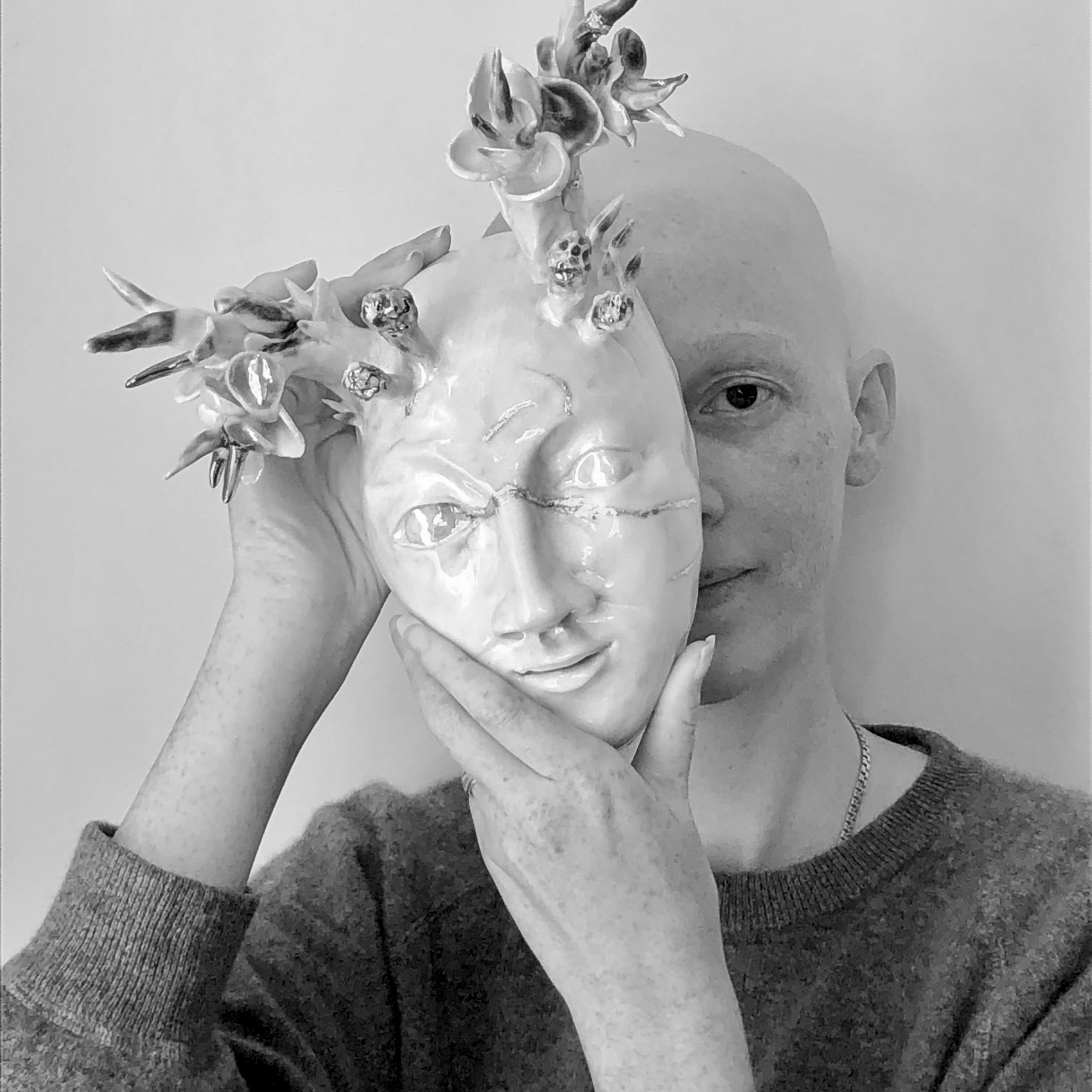
Katie-Farris-bw-c-photo-Ilya-Kaminsky-©-2020-scaled
Katie Farris’s recent work appears in Granta, Poetry, and The New York Times. She is the author of the chapbook, A Net to Catch My Body in its Weaving, which won the 2020 Chad Walsh Poetry Award, and boysgirls, a hybrid-form book. She is also the co-translator of many works from Ukraine, including The Country Where Everyone’s Name is Fear...

Review

Review

Personal history and the state of America brilliantly converge in Katie Farris’s Standing in the Forest of Being Alive, writes John Field

Read the
Reader's Notes

Videos

Katie Farris reads from Standing in the Forest of Being Alive at the T. S. Eliot Prize Shortlist Readings
Godelieve de Bree reviews Katie Farris‘s Standing in the Forest of Being Alive
Katie Farris talks about her work
Katie Farris reads ‘What Would Root’
Katie Farris reads ‘In the Event of My Death’
Katie Farris reads ‘Why Write Love Poetry in a Burning World’

Related News Stories

The T. S. Eliot Foundation is delighted to announce the winner of the T. S. Eliot Prize 2023 is Jason Allen-Paisant for his second collection Self-Portrait as Othello, published by Carcanet Press. The judges Paul Muldoon (Chair), Sasha Dugdale and Denise Saul said: Self-Portrait as Othello is a book with...
When the T. S. Eliot Prize founded the Young Critics scheme with The Poetry Society’s Young Poets Network, the aim was to empower young critics, to offer a different critical viewpoint on the shortlisted collections, and to engage more young readers with the Prize. Following a series of workshops led...
We are thrilled to announce the T. S. Eliot Prize 2023 Shortlist, chosen by judges Paul Muldoon (Chair), Sasha Dugdale and Denise Saul from 186 poetry collections submitted by British and Irish publishers. The list comprises a former winner and two previously shortlisted poets, as well as two debuts and two...
As the T. S. Eliot Prize celebrates its 30th year, the T. S. Eliot Foundation is delighted to announce the judges for the 2023 Prize: the panel will be chaired by Paul Muldoon, alongside Sasha Dugdale and Denise Saul.  The judges will be looking for the best new poetry collection...
Review of Standing in the Forest of Being Alive

Personal history and the state of America brilliantly converge in Katie Farris’s Standing in the Forest of Being Alive, writes John Field

On the face of things, Standing in the Forest of Being Alive details Farris’s diagnosis and treatment for breast cancer. However, other forms of illness run through it too. The January 6 attack on the Capitol could be read as another form of cancer: rogue cells, converging on America’s organ of democracy, threaten the health – the life – of the body politic. On a broader scale, the events detailed in the collection play out against the backdrop of the COVID-19 pandemic.

The first person is a slippery perspective. As the writer stands in the shadows, masked and inscrutable, we refer to ‘the speaker’ no matter how tempted we are to conflate the construct with its creator. However, Standing in the Forest of Being Alive is subtitled ‘A Memoir in Poems’ — and as such the first person speaker cannot be sandboxed away from its author. We’re encouraged to view the ‘I’s we encounter as versions of Farris and the poems become intimate spaces, drawing power from proximity to their creator.

The memoir opens with a manifesto: ‘Why Write Love Poetry in a Burning World’. Farris locates herself at the threshold of ‘a door / I cannot close I stand / within its wedge / a shield’. This liminal position re-casts the speaker as Proserpina. Her cancer diagnosis means that she doesn’t just live on Earth, she lives in the Underworld too – and belongs fully to neither. Her position in the threshold, serving as a ‘shield’, figures her as some kind of epic hero. 

The collection explores the challenges we face negotiating medical language. ‘Tell It Slant’ references Emily Dickinson’s ‘Tell all the truth but tell it slant—’, in which the speaker concludes that ‘Truth must dazzle gradually’. The two stanzas of Farris’s poem explore the languages used to discuss cancer. Farris addresses the cancer: ‘You float in the MRI gloam, / several spiculated masses; / I name you “cactus,” / carcinoma be damned’. Perhaps ‘gloam’ lends the growth a poetic warmth and beauty, or perhaps Keats’ ‘La Belle Dame sans Merci’ springs to mind, as his knight-at-arms envisions the Belle Dame’s previous victims: ‘I saw their starved lips in the gloam, / With horrid warning gapèd wide’. Either way, it’s a rich, beautiful, dreadful way to envisage an MRI. The language of oncology is too precise for the uninitiated. A spiculated mass is a ‘centrally dense lesion’ and, although ‘a classic finding of malignancy on mammography’, ‘its differential diagnosis includes benign lesions’ (Breast Imaging, eds. Christoph I. Lee, Constance D. Lehman and Lawrence W. Bassett, Oxford University Press, 2018). We’re left wondering what this means. Is it cancer? Isn’t it? Is it a threat? Will I be okay? However, if the language of oncology is the sublime – too nuanced, too couched in detail for the uninitiated – then the language of medical admin is the ridiculous, too blunt and tone deaf: ‘a stranger called and said, / You have cancer. Unfortunately. / And then hung up the phone.’ How can a patient negotiate these languages? We’re not doing very well when Dickinson looks a damn sight clearer than medical discourse.

Miraculously, the medical and the poetic begin to converge. In ‘To the Pathologist Reading My Breast, Palimpsest’, Farris credits Kimberley Point du Jour MD, whose report, in its new context, becomes a piece of found poetry: ‘Specimen B, received fresh and subsequently placed in formalin’. And, in this new context, the poet talks back: ‘Dear Doctor—you’ve done my work for me in your first line / with your tidy slanting rhyme of specimen and formalin’. As the poem progresses, Farris works with fluent confidence, riffing and rhyming with the medical report: ‘Beneath my grossly unremarkable skin ellipse / an inscription there of every kiss’ – it’s virtuosic stuff.

In ‘Five Days Before the Mastectomy, Insurrection at the Capitol’, we’re asked ‘What is the door / the bullet makes / in the body?’ and the answer can only be the ungodly mess of an exit wound. No-one can hold the door closed against a force like this. ‘America, the gun— / predictable, mechanical, /  possessed of several chambers’ feels less bicameral and more like a revolver. Farris asks, ‘Who holds you holstered / America the gun?’ We recall Trump’s remarks, made on January 6 – ‘If you don’t fight like hell, you’re not going to have a country anymore’ – and hope that future presidents can keep the gun buttoned in its holster.

On the face of it, Standing in the Forest of Being Alive is acutely personal, confessional, intimate poetry. However, this enables Farris to explore the fragility of the state and its structures. We’re reminded that we’d be better served listening to our hearts or – perish the thought – to our poets.

Katie Farris’s Standing in the Forest of Being Alive (Pavilion Poetry / Liverpool University Press, 2023) is shortlisted for the T. S. Eliot Prize 2023. John Field blogs at Poor Rude Lines.

Standing in the Forest of Being Alive
Pavilion Poetry (Liverpool University Press)

Newsletter

Be among the first to receive updates on the latest T. S. Eliot Prize news by subscribing now!


The T. S. Eliot Prize on Social Media

Part of tseliot.com

Designed by thinking

Interview of Standing in the Forest of Being Alive

Standing in the Forest of Being Alive
Pavilion Poetry (Liverpool University Press)

Newsletter

Be among the first to receive updates on the latest T. S. Eliot Prize news by subscribing now!


The T. S. Eliot Prize on Social Media

Part of tseliot.com

Designed by thinking