
Kit Fan’s The Ink Cloud Reader is a virtuosic exploration of ambiguity, play, indelibility and truth, writes John Field
Be among the first to receive updates on the latest T. S. Eliot Prize news by subscribing now!
Kit Fan’s The Ink Cloud Reader is a virtuosic exploration of ambiguity, play, indelibility and truth, writes John Field
You can see when I’ve been working because my hands are, well, if they’re not covered in ink exactly, then they’re splattered randomly with the stuff. I like to choose the inks I write with. I want my heavier strokes to be shaded, and my lighter ones to be dryish scratches. My partner becomes anxious when she sees a pot of ink on the table, or on the sofa, because I’ve had accidents when filling pens before. It gets everywhere. Even when I’m cleaning up, I’m usually making a bigger mess
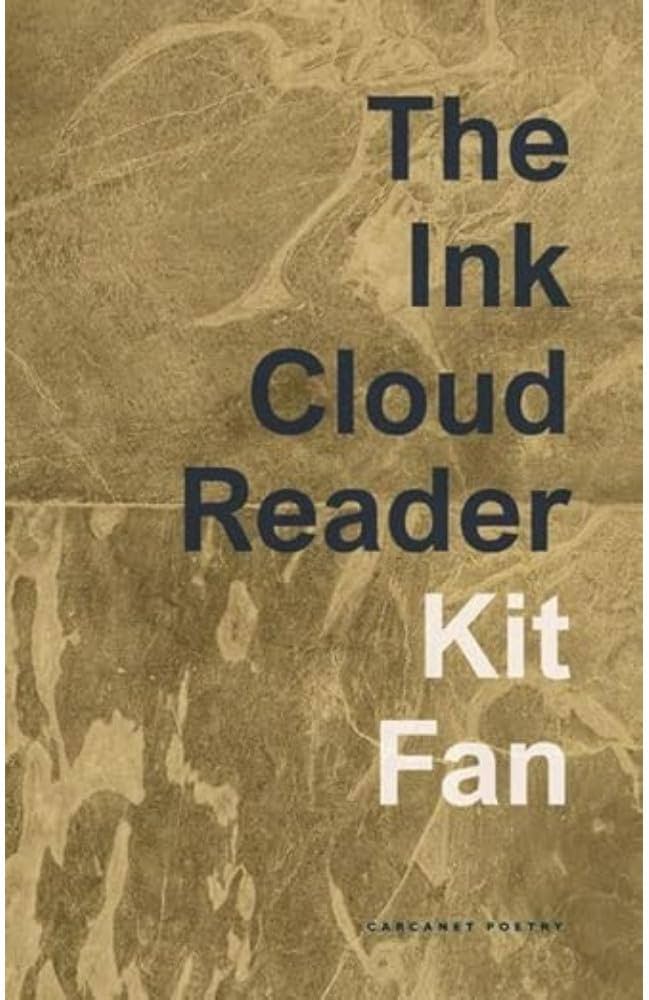
The Ink Cloud Reader, Kit Fan’s third collection of poetry, is prefaced with a story. Ink, always unpredictable and messy, defeats a student of calligraphy and, after every mistake, his teacher asks him to clean his brush in the pond outside. In time, he has created an ink pond, through which he sees the clouds, the wind, and the fish below the surface. Developing this idea, the collection’s front cover and section breaks are illustrated with Fan’s photographs of the marble sheeting that decorates Venice’s Santa Maria dei Miracoli, a reminder of nature’s exquisite, unpredictable patterning, and of how this apparent randomness can find a place to belong – even in the symmetry of the Renaissance.
‘Cumulonimbus’, the first poem proper, sounds the collection’s keynote. We’re working with ink again, although we’re unsure whose hands are stained. Are we reading a dramatic monologue, voiced by an Edo period printmaker, or does the speaker stand closer to Fan? Either way, the speaker tells us: ‘I fear I’ve over- / inked, or the linseed oil / soured the sky’. The poem is almost an invocation to the muses. Fan’s published two collections already, but can lightning strike a third time? The artist cannot take creativity for granted; it should never feel like a boring old gig, dusting off the same old licks and riffs. It’s a poem full of questions, of humility, and the remedy is movement, the unexpected… the miraculous: ‘What I need now, to change / the half-course of my life, / is to be struck by lightning / and survive it, like Hokusai.’
Speaking at the online launch of The Ink Cloud Reader, Fan says that, in poetry, he’s ‘much more interested in questions than in answers’ and we see this in ‘Delphi’, Fan’s poetic response to the evocative columns but otherwise scant remains of the Temple of Apollo at Delphi. In European culture, the temple embodies humanity’s need to ask the big questions, something people insist on doing, despite the enigmatic answers. Fan’s poem is an example of concrete poetry – which is, in itself, pretty funny, given that there’s not a whiff of brutalism (or concrete) in the temple’s marble Doric columns. The poem’s a panoramic double-page spread, each column is topped with a resplendent ‘If’.
Fan invites us to adopt a fresh perspective on things. ‘The Art of Reading’ is written after André Kertész, a Hungarian photographer who innovated with form, geometry, and the stuff of everyday life. The result reads like a set of aphorisms – each inspired by a Kertész photograph. They are, at turns, loaded with menacing undertones: ‘Once I stole a book from the library in Paris where the eyes of oak beams stared at me like bullet holes’, and seismic shifts in perspective: ‘A cow glances over my shoulder and shuns the news in the manger’.
Given Fan’s Hong Kong heritage, perhaps the reader will focus on the section ‘Hong Kong, China’, which Fan describes as ‘a suite of love letters’. Here, Fan’s playfulness bites its thumb at the repressive Chinese state. For example, ‘Mnemosyne’ references the Greek goddess of memory. Stanzas waft across the page, perhaps another nod to ‘Cumulonimbus’. Each quatrain fades, gradating line by line from black to light grey – an act of forgetting as China’s promises about press freedom, freedom of expression, freedom to assembly and freedom of religion fade from view: ‘beneath flames and sirens / under shield and batons / which sheep from the flock / would you remove’.
The Ink Cloud Reader demands your undivided attention. Fan has high expectations of his readers, but the payoff is equally high. The collection is broad in focus, ambitious and virtuosic in its range of forms.
Kit Fan’s The Ink Cloud Reader (Carcanet Press, 2023) is shortlisted for the T. S. Eliot Prize 2023. John Field blogs at Poor Rude Lines.
Be among the first to receive updates on the latest T. S. Eliot Prize news by subscribing now!