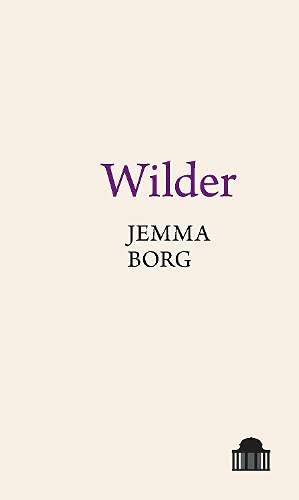
Wilder, Borg’s second collection, recoils from the sterility of a changing climate and embraces the resilience and fertility of the natural world – and the trials of motherhood, writes John Field
‘I wanted Wilder to be as much about what kinds of things hold us back from change as about anything else. Wildness […] is a process and we need to commit to living as a process.’ We talked to Jemma Borg about her magical and disturbing collection Wilder (Pavilion / Liverpool University Press, 2022)
Be among the first to receive updates on the latest T. S. Eliot Prize news by subscribing now!
Wilder, Borg’s second collection, recoils from the sterility of a changing climate and embraces the resilience and fertility of the natural world – and the trials of motherhood, writes John Field
Instinctively, we fear the wild. Ours is a disposition to fence, to enclose, to map and to sign. Borg’s epigraphs remind us that, like a hardy, deep-rooted plant, the word ‘wild’ stems from the Old English ‘uelt’ – ‘open field or woodlands’ – and that ‘wilder’ is ‘to lose one’s way’. The collection opens with ‘Marsh thistle’, one of the poems selected to celebrate 2022’s environment-themed National Poetry Day. In Borg’s poem, ‘A gong sounds in the dark temple of the earth’, to mark the coming of the thistle. There’s a numinous, Wordsworthian quality to the sounding note that reminds us of the preciousness of all life. In William Blake’s ‘The Tyger’, the speaker’s succession of questions point to his feelings of awe when contemplating one of the biggest and most powerful of nature’s beasts. ‘What immortal hand’, he asks, ‘In what distant deeps’, and so on. We catch an echo of Blake in Borg as her speaker asks ‘And what soul is it that embellishes the sky / with battlements and bristling lances? / What part of a human soul is this thistle?’ Blake’s speaker is seduced by the big cat, but Borg finds majesty in the small and humble. Her ‘battlements and bristling lances’ embellish the sky with heraldic flourishes and recast ‘our unpalatable, / fen-meadow’ as regal, where thistles are ‘nectar-rich candelabra rampant with bees’. ‘Rampant’ borrows from the language of heraldry. The thistle flutters in the breeze like a lion on a royal standard; it rears in a threatening manner and, across the fen, it also grows rampant: abundant and unchecked.
Moving to the domestic sphere, ‘Nulliparous’ offers a stark contrast. The word ‘nulliparous’ designates a female animal who has never given birth, and so we move from unchecked fertility to an unsettling contemplation of sterility and absence. Borg opens with two terse simple sentences: ‘Here lies no-one. Let the angels pass.’ The caesura is emphasised by that full stop and the line is riven, suggesting absolute brokenness. The first sentence echoes the epitaph on a gravestone. The poem comprises a series of couplets but, by the end, we’re left with a stark single line floating alone in the void of the page: ‘barrows sleeping in a green field.’ It’s an image of beauty and depicts a healed landscape, the momentous earthwork smoothed and covered by grasses but at its heart there remains an aching emptiness.
In ‘Ultrasound’, the smooth undulation of the barrow resurfaces as a pregnant belly and the void at its centre has been filled. ‘We have peeked – forgive us – to find you / are barely more than a sound: a rally drum, / a two-valved butterfly-engine, piston-rapid, / among bright haloes of finger-buds, a secret / miner working in the sonorous mountain.’ The listing of those metaphors makes this a love poem, and those haloes are a delightful expression of unrestrained love. Look at any sacred painting and you’ll see that even the heaviest-hitting saints, the Peters and the Pauls, are granted but a single halo each… but the peeking mother can find ten – and that’s just on the fingers!
Given the war in Ukraine, one poem in particular resonates. ‘The engineer’ is a dramatic monologue, subtitled ‘Chernobyl, 1986’ and it’s currently difficult to think of Chernobyl, without also thinking of Zaporizhzhia. The irrepressible fecundity of ‘Wilder’ has a flip side of ‘cankers, sores, bitter rashes weeping milk’. The engineer tells us that he has ‘seen the trilling heart of the reactor’ inside this modern, deadly barrow – a musical pulse that can be read as the dark dance partner of ‘Ultrasound’s’ ‘urgent heart’ – where ‘At last, we could know / the object of our faith.’
Thankfully, Borg’s vision of the natural world crackles with life and beauty and, rather than bewildering us, reminds us that the open landscape offers freedom and possibility.
Jemma Borg’s Wilder (Pavilion / Liverpool University Press, 2022) is shortlisted for the T. S. Eliot Prize 2022. John Field blogs at Poor Rude Lines.
Be among the first to receive updates on the latest T. S. Eliot Prize news by subscribing now!

T. S. Eliot Prize: Would you mind saying something about ‘weald’ and ‘wilder’, as words and their meanings – the ideas of the ‘place-present’ and a kind of ‘placelessness’?
Jemma Borg: The area I live in in East Sussex is part of the High Weald. The word ‘weald’ comes from a root shared with ‘wild’, and is an Old English word meaning woodland or forest. The word ‘wilderness’ used to mean simply a wooded area, a place outside of habitation, outside of the village, say. Though that place might have been the site for quests and initiations and a source of mythology, fairy-tale, imagination, risk. That said, to many indigenous cultures, wilderness doesn’t make sense – the world is home and this is a false distinction to make.
In the book, the Weald is both a specific location then, but it’s also a state of mind. As Gary Snyder said, as he made a contrast between the words ‘nature’ and ‘wild’, wildness is not an object or subject, but must be ‘admitted from within, as a quality intrinsic to who we are’ (my emphasis). There’s a curiosity and a fear about it. What waits to burst out of us in a wilder way? How are we wild – is it only in relation to the communal values of our culture? Is it about our animal nature? Is it threatening therefore? And do we not need to threaten the current order to envisage something new, a position where it is possible to behave in the interests of all life on this planet, and not just our own? Is it not a kind of coming home?
Much has, rightly, been made of the division that humans have made between themselves and everything ‘natural’ as though we were not ourselves natural. It’s so deep-rooted it can be hard to see this deeply flawed viewpoint for what it is – a wound as well as an error. Even if intellectually we understand that humans are part of a larger planetary ecosystem which we are profoundly affected by (and it by us), our Western culture at least seems predicated on this idea of separation, of rupture even, as though somewhere along the line we came to lose our connection with who we are and the planet that we are inside of and which is inside us.
I think what is interesting about poetry and any practice of attention is that they situate us in the ‘place-present’, the unending ‘now’. It’s a radical place to be because it’s transformative and challenging, and it’s also not really a place in the sense that we tend to think of it – it’s more of an event, both placeless, as process, but also conversely rooted in location as experience. Poetry and attention revel in naming, in observation, in the act of noticing, and that is how placelessness – or perhaps the erosion of strong selfhood, the dominant ‘I’ – is situated into a local context. The place-present, which I mention in the marsh thistle poem, means this kind of effervescing moment of life: holistic, free, absolutely ‘now’.
TSEP: It seems to me there is a balancing in Wilder, between stasis/stubbornness, a kind of indomitability, and dreaming/liberation/moments of extreme joy – ‘Marsh thistle’ balanced against ‘Wilder’, ‘The swing’, ‘San Pedro and the bee’; the ‘unbound’/’bound’ in ‘Portrait of shingle and wildflower’. Does that seem right to you?
Stasis/indomitability as a strength seems balanced against flow – the fresh spring in ‘Shadows and warriors’ with its ‘almost crystalline smoke, making ladders of freshwater / and shock in the warmer salt’ of the sea into which is runs; the ‘positive unravelling’ of ‘An anecdote for September’. Still there’s a kind of spiralling duality, isn’t there – water (or perhaps what human activity has water do) can be a problem too, as in ‘Little rivers feed bigger rivers’…
JB: I would agree there is a tension or contrast between stasis and movement or flow – and this is one of the driving forces in the book. I think this is about distinguishing between what seems evident as being part of life – a sense of process, movement, a not staying still, which is wildness if you like – and stasis which is the fossilisation of attitudes within us, for example, that is to be challenged and which represents, at its extreme, death. So, a tree is indomitable in its desire to grow – life is relentless, rampant, ready to spring up everywhere given half a chance. But stasis is the opposite of that – a kind of unwillingness to ‘be wilder’.
Without Snyder’s ‘etiquette of freedom’ – the ethics of learning to live in a way that is not primarily led by the ego, a way that is naturally found by being in contact with what he calls ‘wilderness’, but perhaps with the non-human in particular – the risk is getting stuck in a limited worldview, one which permits us to do devastating things to the planet. Perhaps we all go a little bit mad, like a big cat in a cage, when we don’t have contact with the earth beneath our feet. Never mind contact with true ‘wilderness’ as we mean it today – which if we define it as being pristine, free of human contact, doesn’t exist anymore, except perhaps in our imaginations. It’s also worth saying that some of the most pristine areas are – or have been – inhabited by indigenous cultures who have acted as caretakers over thousands of years.
TSEP: In my reading of your interview on the Pavilion Press blog, you oppose anthropocentrism (an outcome of which may be said to be the Chernobyl disaster you write about in ‘The engineer’), the separation of human existence and, well, everything else. It seems to me Wilder charts a widening, deepening engagement with a biocentrist view of existence. Is that right?
JB: I do subscribe to the view that centring everything around humans is a viewpoint with error and even moral deficiency. From my training as a biologist, it’s a natural position to take – the human isn’t the only story being told, if you like. The idea of deepening or widening our sense of empathy, care and rights to include all the non-human world is an inevitable development from that.
It’s instructive I think to contrast what we used to call ‘conservation’ with the newer movement of ‘rewilding’. Conservation often sought to protect specific species or habitats, keeping things in a static position, freezing them as if in a zoo. One of the problems was that this approach often seems to have been about preserving species we humans decided we like over others – the cute, cuddly ones, say. What has become clearer is that not only is it questionable to prioritise one species over another, but that in order to keep our planet healthy, we need to think about the larger scale ecosystems over considerations of single species. So, rewilding is a giving over of land to process, which results in a richer ecosystem, and perhaps not in predictable ways – it’s a process of discovery. The result seems to be more complex, functioning and wild compared with the old ideas of ‘preservation’.
TSEP: Can you say something about the structure of your book? Some of our poets have named sections, you have blank pages – pauses, not chapters?
JB: My editor, Deryn Rees-Jones, was very helpful by disrupting my initial plans to divide the book into two halves. As things progressed, I didn’t want to break the book into hard sections, but just to pause, that’s right. There’s a movement in the book which has been both discovered and constructed and that’s not only as a form of narrative but also in terms of pacing, and it seemed that the poems naturally divided into sections.
Form on the page is a kind of listening and the larger structure of the book is also about listening to the poems themselves. The blank pages create this visual pause and I liked not only constructing how the book begins and ends – how the very first and last lines of the book speak to each other – but also how the last and first lines of poems talked to each other across the pauses. The pauses are like ‘wildlife corridors’ for ideas to pass freely from one landscape to another perhaps! The juxtaposition is always interesting.
TSEP: I love Jeff Van der Meer’s wonderfully unsettling and fantastical Southern Reach trilogy and perhaps there’s something of his Ovidian metamorphoses in your ‘heavy as a tree / landfalling onto sand / and the curved world catches you’ (‘Wilder’) and ‘I’m filled with bees’ (‘The swing’). Was the ‘ecological uncanny’ in your mind?
JB: When we look at the non-human world, there’s a sense of unfamiliarity that is rather exhilarating but also – as we come to recognise all that is wonderful and unique about non-human life – we can see the similarities too. We have this particular superiority about language, for instance – that it’s unique to us – whereas it’s actually inherent in non-human life, even if other non-human languages are not the same as ours. Clearly, humans have a particularly complex language – and being able to write it down and record it is of huge significance. But let’s not assume that animals are ‘dumb’ because they don’t talk as we do. Communication is complex and multifaceted and we’re learning so much more about how other living organisms do communicate – the ‘wood-wide web’ is a recent example – and that ought to challenge any arrogance.
Writers such as Alice Oswald have actively asked how we can give voice to the non-human. I do think one of the ways is not to deny the human and to accept the fact that we can’t escape our perspective, but to realise that organisms are indeed both alien and familiar – and ultimately, we are all built from the same stuff, we are far more alike that we tend to think, and the fates of all of us – human and non-human – are intimately tied together. To see the human in the animal is quite right in a way, and to see the animal in the human equally so. It makes me think of the prehistoric cave paintings where a human face stares out of a bear’s or an antelope’s body – what’s interesting is the unstable boundary between us and the other, which reflects back and forwards, melds our identities, celebrates different ways of being and knowing. I think fluidity of this kind is important for us to have a fullness and authenticity of experience – and is part of returning to that sense of the wild within us.
TSEP: You cite many influences in the book, poets such as Gerard Manley Hopkins as well as writers and thinkers from non-literary fields. Bashō provides some comfort in the otherwise discomfited ‘On sleep’. Do other writers help you organise your thinking? How consciously do you think of them as you write?
JB: Yes, we talked about art as a conversation, didn’t we? None of us lives in a vacuum. I think it’s a gesture I learnt from science where you cross-reference everything – that’s part of the way of making a scientific argument, part of the rhetoric of it, because you are building on and acknowledging what has gone before you – it adds to the credibility of your own work because it gives context. But also it shows that perhaps nothing is truly original, just reinventions, variations on a theme, dependent on what has gone before. And that is what life is like, bubbling over with the same solutions to things – like evolving eyes for seeing – but each variation is so wonderfully different. I don’t generally consciously think of other writers when I write but I do like finding the connections later on, in the editing process. Finding sympathies with the discoveries of others, to bring in those connections, is to make a kind of network, or ecosystem, of the imagination’s work.
TSEP: ‘The thought-deep grass’ and ‘the forest’s logic’ set against ‘An unravelling of moss, lichen, reindeer, caribou, // humans, cod, seal, walrus’ – we have to listen and think differently to avoid climate catastrophe, don’t we?
JB: Certainly, business as usual will not do, and I’m sure our natural propensity for denial doesn’t help and that any strategies that we can use to face up to what we don’t want to look at directly are absolutely essential to being able to make the kind of changes that would see the mitigation of climate change or the halting of the loss of biodiversity. We’re needing to tackle our own greed in the West, yes, but also our reluctance and fear of change.
It’s been said that story-telling is essential to our response emotionally to the devastating facts about the climate that science tells us very clearly. Without that kind of emotional response, it’s very hard to do what needs to be done, to hear it perhaps – we are very comfortable in the same old routines and full of inertia. The fact that story matters shows the importance of the participation of our imaginations. I wanted Wilder to be as much about what kinds of things hold us back from change as about anything else. Wildness, as I’ve been saying, is a process and we need to commit to living as a process. Psychedelics – which have been used for thousands if not millions of years by human species – are instructive in this way. They enable the imagination to conceive of different ways of being and they rightfully do so in a context of community. But any way we can find to reconnect with our deeper selves, needs, desires – this is how we might find the capacity within ourselves to rewrite the narratives which underpin modern existence and its sense of what is important. And so much of it comes from a willingness to stop and be attentive, to listen – such simple things.
Jemma Borg’s Wilder is published by Pavilion / Liverpool University Press. Watch the T. S. Eliot Prize filmed readings and interview, and read the reviews and Readers’ Notes online to find out more.
Be among the first to receive updates on the latest T. S. Eliot Prize news by subscribing now!