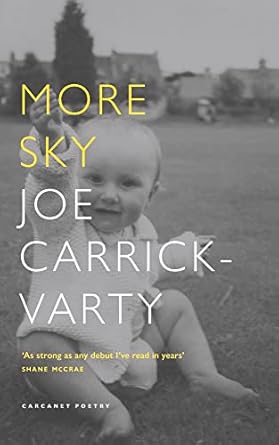
‘a thought // folded inside a thought folded inside // a thought folded inside my dad’s // breast pocket’. John Field considers the extraordinary power, both brutal and tender, in Joe Carrick-Varty’s More Sky
Be among the first to receive updates on the latest T. S. Eliot Prize news by subscribing now!
‘a thought // folded inside a thought folded inside // a thought folded inside my dad’s // breast pocket’. John Field considers the extraordinary power, both brutal and tender, in Joe Carrick-Varty’s More Sky
Perhaps I will never stand in the Rothko room in Washington’s National Gallery of Art, but I’ve been told that, gathered together like Moai, you feel the resonance, the dark obsessive energy of those canvases in that room. A gathering of Rothkos is greater than the sum of its parts.
More Sky is Joe Carrick-Varty’s first collection. Individually each poem packs a punch, but together they create a work of extraordinary power. It is both brutal and tender, a realist and a surrealist presentation of a disordered, inverted world.
An early poem, ‘Sambas for Christmas’, denies the reader the context required to read the title correctly. What are ‘sambas’? Is it a proper noun, or are we talking Strictly Come Dancing here? Either way, we know that these ‘sambas’ are for Christmas, so we might feel relatively secure in our presumption that we are dealing with festivities, or gift-giving. Carrick-Varty opens with levity, presenting the reader with a slice of pop culture mock heroic: ‘In a corner of some far-flung town / on some moon of some planet / at the edge of some pocketed galaxy’. Perhaps it’s just me, but I can hear the horns and heroic fifths of the theme from Star Wars. I’m waiting to meet a plucky youth who’s about to transition from zero to hero, but bathos quickly becomes pathos. Sambas, it turns out, are Puma trainers, and there’s already a troubling mismatch between the speaker’s father’s ‘box-fresh’ sneakers and his ‘faded black jeans’. We’re told that the Sambas ‘will squeak for a week or so’. The cute assonance makes this phrase pop, but there’s a suggestion that these trainers are newborns – chicks or babies – the speaker’s proxy, condemned to a life in pubs, chippies and bookies, condemned to neglect, to death.
Identity is elusive in ‘A week and not a word since the argument’. The speaker meets his father on the street, saying ‘I’m cycling near your block, / cycling for no reason, to nowhere’. Perhaps the reader visualises a child. After all, aimless cycling smacks of childhood recreation on street corners but, as the pair converse about work, we reimagine the speaker as an adult. Across the stanza break, his identity slips again: ‘I look at my watch: 11 a.m.— / I’m seven years old, waiting with a Coke outside / the frosted glass of The Seven Stars’. Inside the body of the man we see the wounded child. The trivia of daily life like the time of day reopens barely healed wounds. But Carrick-Varty’s not done yet. There’s a final coup-de-théâtre as ‘every time the door bangs— / then I’m you, in Dublin, your father / at the bar’, and we feel a wider cycle of abuse in which everyone concerned is, at one level, always a child.
The collection’s final sequence, ‘sky doc’, is a meditation on suicide. It integrates brilliantly with the other poems, as the speaker’s father’s death by suicide haunts them too. Initially, suicide exists in myth, buried deep, repressed: ‘Once upon a time when suicide was a thought // folded inside a thought folded inside // a thought folded inside my dad’s // breast pocket’. It feels safe, contained, fictional. The piece of paper’s troubling though. All of those folds squirrel suicide away. Is it peripheral, or is it treasured? Is it trivial, or fundamental? As we saw in ‘Sambas for Christmas’, there’s a surreal, disturbing, vertiginous change of scale and tone as this breast pocket lies ‘at the edge of the reef’: placid up top but, beneath, a razor-sharp hazard. The poem ends ‘then suicide pulls up slow as a planet’. We’re playing with time again but here the scale is so enormous it’s difficult to notice. The speaker sees his family as ‘nuclear’ – as a microsopic solar system – held together by forces far stronger than its parts… but the forces shaping the universe will pull it apart with ease.
More Sky’s a challenging read, but it repays the effort. It does a beautiful job of exploring the limits of language: the speaker is full of questions – questions for his father, and questions for the bloke who sold him the shotgun, but love’s light always shines through the cracks. In ‘sky doc’ we see the speaker, excluded from school, wondering whether he’ll receive a beating. Instead, they watch King Kong together and afterwards, ‘he knelt down / zipped up my jacket in the bright sunshine’… and I’m struggling to keep my eyes dry just to write this.
More Sky’s raw, but warm. Somehow, Joe Carrick-Varty has marshalled language to articulate a howling pain – and its enduring legacy.
If you need to talk, contact the Samaritans free on 116 123.
Joe Carrick-Varty’s More Sky (Carcanet Press, 2023) is shortlisted for the T. S. Eliot Prize 2023. John Field blogs at Poor Rude Lines.
Be among the first to receive updates on the latest T. S. Eliot Prize news by subscribing now!