
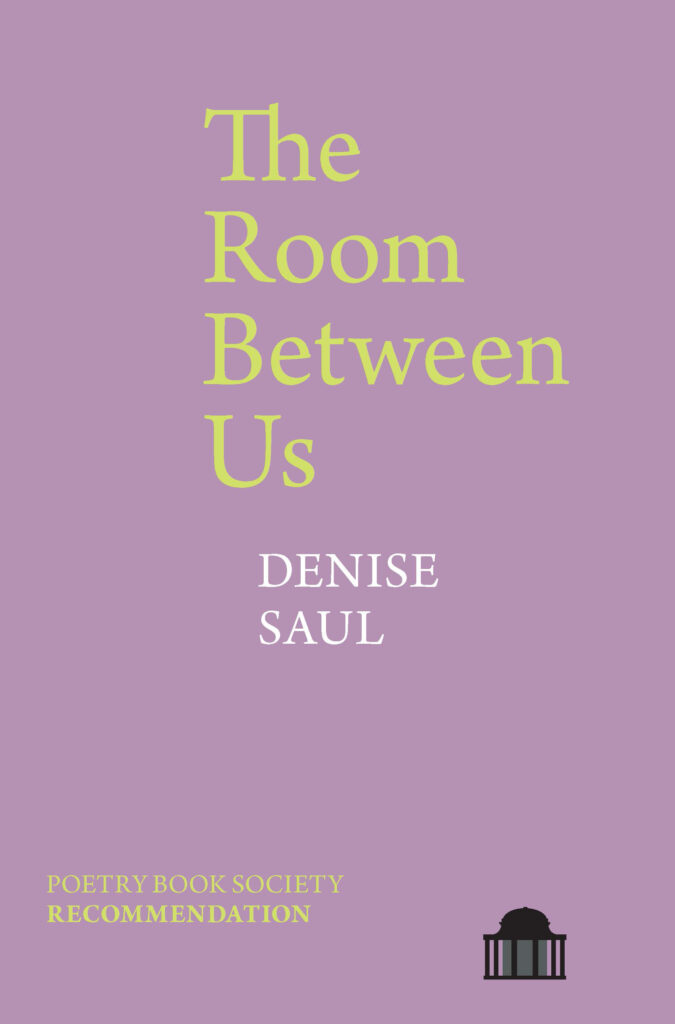

The Room Between Us

Pavilion Poetry (Liverpool University Press)
Saul-Denise-CROP-SQUARE-credit-Karolina-Heller-CROP
Denise Saul’s debut collection The Room Between Us (Pavilion / Liverpool University Press, 2022) was shortlisted for the T. S. Eliot Prize 2022, longlisted for the Jhalak Prize 2023, and was a Poetry Book Society Summer Recommendation 2022. She is the author of two pamphlets: White Narcissi (flipped eye, 2007), a Poetry Book Society Pamphlet Choice; and House of Blue (Rack Press, 2012), a PBS Pamphlet...

Review

Interview

Review

In The Room Between Us, ‘the Rubicon has been crossed and that which has happened cannot unhappen’. John Field reviews Denise Saul’s unflinching exploration of loving care

Interview

The Room Between Us, says author Denise Saul, ‘can be viewed as an interrogation of chaos and order', what happens when 'the boundaries between "life and death", "remembering and forgetting", and "gain and loss" become blurry or porous’

Read the
Reader's Notes

Videos

Denise Saul reads from The Room Between Us at the T. S. Eliot Prize Shortlist Readings
Holly Moberley reviews Denise Saul’s The Room Between Us
Denise Saul talks about her work
Denise Saul reads ‘Golden Grove’
Denise Saul reads ‘The Room Between Us’
Denise Saul reads ‘Someone Walked into a Garden’

Related News Stories

The T. S. Eliot Foundation is delighted to announce that the winner of the T. S. Eliot Prize 2022 is Anthony Joseph for his collection Sonnets for Albert published by Bloomsbury Poetry.
The T. S. Eliot Prize and The Poetry Society have now published the first set of video reviews created by participants in the new Young Critics Scheme.
Judges Jean Sprackland (Chair), Hannah Lowe and Roger Robinson have chosen the 2022 T. S. Eliot Prize shortlist from a record 201 poetry collections submitted by British and Irish publishers. The eclectic list comprises seasoned poets, including one previous winner, and five debut collections. Victoria Adukwei Bulley – Quiet (Faber &...

Review of The Room Between Us

In The Room Between Us, ‘the Rubicon has been crossed and that which has happened cannot unhappen’. John Field reviews Denise Saul’s unflinching exploration of loving care 

Saul’s first collection, The Room Between Us, lifts the veil on those caring for elderly relatives. It is a deeply moving collection in which we see loved ones through the distorting prism of new spaces, distanced from them by doors and glass.

This sense of people misplaced is suggested by Saul’s epigraph, taken from Gray’s ‘Elegy Written in a Country Churchyard’: ‘Full many a flow’r is born to blush unseen, / And waste its sweetness on the desert air.’ In her title poem, which opens the collection, Saul’s quatrains are superficially similar to Gray’s but his neat iambic pentameter and rhyme scheme are absent, indicating, perhaps, that something is wrong. Doors should provide privacy and security but here they have become the spring of a trap. The speaker recollects that ‘You point again to the Bible, door, wall / before I whisper, It’s alright, alright, / now tell me what happened before the fall.’ At this moment, Saul deploys a rhyme with a terrible sense of finality. In Christian terms, ‘before the fall’ reminds us of life in Eden before the apple, sin and death. The Rubicon has been crossed and that which has happened cannot unhappen.

The title of ‘The Viewing’ suggests that the speaker’s mother has become an object we might expect to see behind glass in a gallery or museum. It begins ‘Behind another brown door’, inevitably reminding us of the door in ‘The Room Between Us’; in both cases, the word ‘behind’ intensifies the idea of muffled confinement. The door in ‘The Viewing’ also announces its labyrinthine motif, further emphasising how trapped is its subject. There is an awkward, uncanny quality to the poem. In many ways, it invites us to imagine an undertaker’s parlour, a loved one laid-out. The title, ‘The Viewing’ encourages this idea. However, the chronological structure of the collection belies this. She lives, but this isn’t how we see her.

This powerful sense of awkwardness and uncertainty carries through the collection. In ‘Observation’, it’s unclear who is being observed, the speaker or her mother. The precision of the daughter’s gaze, noting that her mother sits on the ‘left side’ of the chair but needs her ‘right leg’ repositioned shows the level of care someone in this situation requires, while also conveying an unwelcome suggestion of the mother viewed as object. However, the poem ends with ‘She waved to me and I waved back’. When it comes down to it, it is the mother who initiates this sociable moment, not the daughter.

There’s an intensity to the unflinching truth-telling of these poems. At times, Saul changes step and a memorable moment is the visionary, ekphrastic ‘The Eternal’, a meditation on G.F. Watts’ ‘The All-Pervading’ (1887–90). Watts’ painting presents a winged deity holding the world in his hands, but Saul gives us ‘the scryer’ who ‘holds a sphere’. A scryer ‘scries’ (sees into) the future or the secrets of the past or present by looking into pieces of crystal or water. Once again, we’re reading a poem exploring observations and, once again, the speaker’s isolation from that which is observed is painful. Faces are ‘brought’ to the sphere’s ‘cold surface’, suggesting that they have not appeared voluntarily. Reflections become ‘galaxies and stars’, evoking the infinite and eternal. Likewise, we finally see ‘a wooden door that cannot shut’. However, we are snapped back to reality as the speaker acknowledges Watts’ own account of his impetus for the painting: ‘Perhaps this is what Watts meant when, / seeing the glass drop of a chandelier in / a rented house, he drew the hooded figure’. The speaker’s imagined words recede and become, once more, trapped in glass and ‘the seer gazes only / at the reflection of a woman held within the sphere’.

It can sound glib to describe poems as ‘necessary’, especially in a review, but I’m going to do it anyway. These are necessary poems and through them we understand something of the complexity and pain of the windows and doors through which we view our ageing parents.

Denise Saul’s The Room Between Us (Pavilion / Liverpool University Press, 2022) is shortlisted for the T. S. Eliot Prize 2022. John Field blogs at Poor Rude Lines.

The Room Between Us
Pavilion Poetry (Liverpool University Press)

Newsletter

Be among the first to receive updates on the latest T. S. Eliot Prize news by subscribing now!


The T. S. Eliot Prize on Social Media

Part of tseliot.com

Designed by thinking

Interview of The Room Between Us

The Room Between Us, says author Denise Saul, ‘can be viewed as an interrogation of chaos and order’, what happens when ‘the boundaries between “life and death”, “remembering and forgetting”, and “gain and loss” become blurry or porous’


T. S. Eliot Prize
: One of the first poems in the book is ‘Stroke’, which is formatted as a dictionary entry and gives multiple definitions of the word: care, sudden even violent change, writing/language, repetition, water/landscape and time. This announces your key themes, doesn’t it?

Denise Saul: Yes. From the outset, the multiple definitions of ‘stroke’ define the various traumatic spaces in which writing/language and caregiving reside. As a carer, I started to question meanings of the term ‘stroke’ and how this medical condition links to other experiences of transformation and change.

TSEP: Your book is a deeply empathetic and moving exploration of how we communicate. Would you say something about communication in the context of aphasia, perhaps with reference to the work of the linguist Roman Jakobson, who you mention in our filmed interview.

DS: Jakobson’s essay, ‘Two Aspects of Language and Two Types of Aphasic Disturbances’, suggests aphasia is a ‘language disturbance’. For one type of aphasic disturbance, he uses the term ‘similarity disorder’, which refers to a major language deficiency that lies in word selection and substitution. My mother often produced elements of similarity disorder in her speech. Instead of saying the name of an object, sometimes she would substitute another word or rename that object. Some of the poems like ‘Clopidogrel’ reflect my mother’s experience of miscommunication. For example, the word ’cabbage’ might have started off as a phonologically related substitute but was replaced by a different word.

My mother also experienced ‘expressive aphasia’. Her speech and language therapist advised me to avoid asking open questions that invited more than a yes or no response. During conversations, I had to write down key words or draw diagrams and pictures. I often watched my mother’s thoughts unfold through gesture and speech.

TSEP: Some of your poems are prose poems and many are short, terse even – but they are much more than the sum of their concision. Can you say something about the different modes of language and your use of form?

DS: In TRBU I experimented with varied forms of the prose poem – like aphoristic, monologue and object-centred – to produce elements of aphasic embodiment or the carer’s narrative. This form destabilises the idea of freedom of space for the carer. Some poems sit within a condensed poetic form to mirror the breakdown of language and limited spaces experienced by the speaker. For other poems, the lyric form shapes the carer’s internal and external view of personal and public spaces. The forms used are mimetic of the emotional trauma experienced through miscommunication and the experience of caregiving.

TSEP: You talked about the domestic world of the cared-for and carer in our filmed interview. Would you like to say more about that, about the domestic space being both enclosed and permeable, even a site of revelation?

DS: Some poems locate my caregiving experience within the confinement or spaces of our house. Repetition of words like ‘window’, ‘room’ and ‘door’ situate the bodily experiences of caregiving and brain trauma in domestic spaces of confinement. The interplay between lines and the room-like form of some poems create new openings, unanswered questions and moments of doubt. The opening up of spaces within and around poems signals the rejection of closure.

TSEP: There seem to be parallel or dream worlds in poems such as ‘One’, ‘House of Blue’ or the very beautiful ‘Someone Walked Into A Garden’, which suggest a paracosm, a detailed imaginary world. Wikipedia says ‘paracosms function as a way of processing and understanding […] early loss’. But in your poems, these alternative or historical or mythical worlds seem a natural response of both the cared-for stroke survivor and the carer – an invented place in which they are able to meet and engage. Is that how you see it?

DS: Yes, I can connect to the idea of a paracosm. I wanted to give space to the caregiving experience. Writing this collection was never a linear process. This manifestation of ‘the parallel’ signifies the outer and inner worlds, that is, what is spoken and what is not. We expect a type of closure to occur at the end of reading The Room Between Us but that does not happen.

TSEP: Your repeated meditations on colour – how colours suggestively stand in for sense in non-conventional communication – is very powerful. Would you like to say something about that?

DS: TRBU meditates on the presence and absence of colour. My mother was a keen gardener so there is a natural affinity towards the representation of colour and light in nature as portrayed in the collection. The process of bereavement can heighten the bodily experiences like sound and sight. In moments of grief and trauma, our sense of seeing and hearing become intense or more vivid. In this collection, the colour spectrum allows various forms of grief to be fully experienced and expressed.

TSEP: In her blurb for your book, Nancy Campbell talks about ‘a fundamental enigma of human experience – how words bring order to the chaos of the cosmos’. That’s your theme, isn’t it?

DS: The book can be viewed as an interrogation of chaos and order. In moments of grief, there is also the moment when the act of remembering is questioned, and our sense of polarity comes under scrutiny. The boundaries between ‘life and death’, ‘remembering and forgetting’, and ‘gain and loss’ become blurry or porous.

Denise Saul’s The Room Between Us is published by Pavilion / Liverpool University Press. Watch the T. S. Eliot Prize filmed readings and interview, and read the reviews and Readers’ Notes online to find out more.

The Room Between Us
Pavilion Poetry (Liverpool University Press)

Newsletter

Be among the first to receive updates on the latest T. S. Eliot Prize news by subscribing now!


The T. S. Eliot Prize on Social Media

Part of tseliot.com

Designed by thinking