
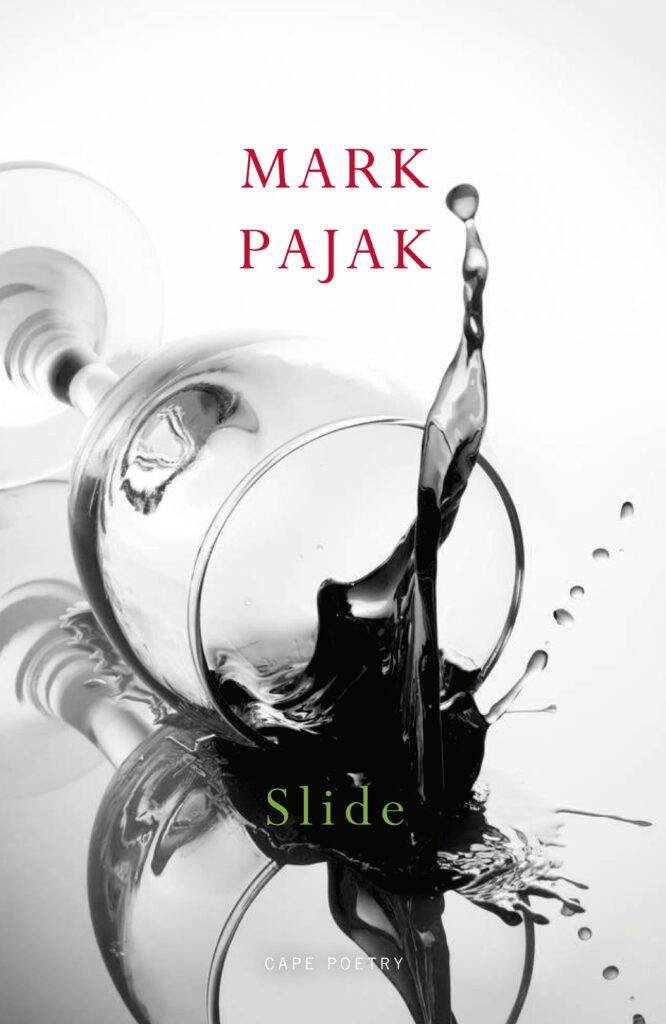
Slide

Cape Poetry
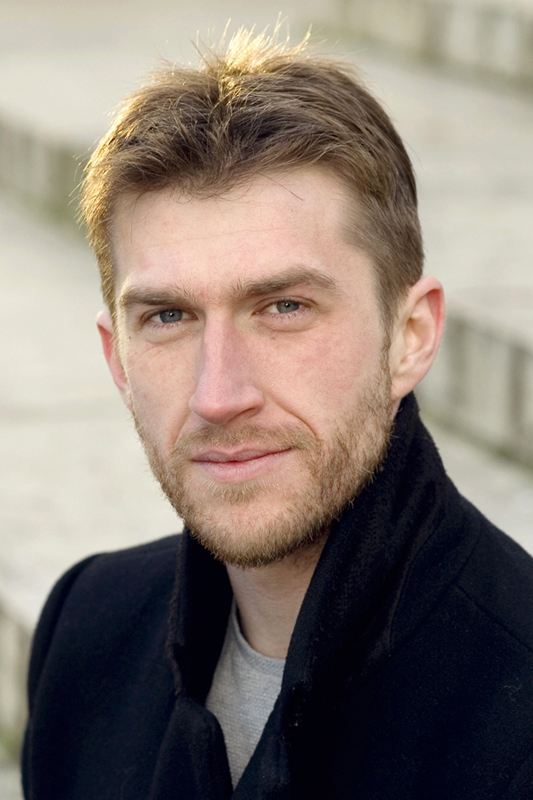
Pajak-Mark-by-Robert-Peet
Mark Pajak was born in Merseyside in 1987 and currently lives in Scotland. His work has received a Northern Writers’ Award, a Society of Authors’ Grant, an Eric Gregory Award and a UNESCO international writing residency. He is a past recipient of the Bridport Prize and has three times been included in the National Poetry Competition winners list. Slide, Mark’s...

Review

Interview

Review

There’s something disquieting about the forensic quality of Slide, but Mark Pajak knows that by focusing on the surface he can leave us to plumb our own depths, writes John Field

Interview

‘For every one poem I feel is successful, there are an inordinate amount of failures behind it […] my process is glacial – it can feel like something akin to erosion’. We spoke to Mark Pajak about the making of Slide (Cape Poetry, 2022), his Eliot Prize-shortlisted collection

Read the
Reader's Notes

Videos

Mark Pajak reads from Slide at the T. S. Eliot Prize Shortlist Readings
Eric Yip reviews Mark Pajak’s Slide
Mark Pajak talks about his work
Mark Pajak reads ‘Reset’
Mark Pajak reads ‘Crystal’
Mark Pajak reads ‘Thin’

Related News Stories

The T. S. Eliot Foundation is delighted to announce that the winner of the T. S. Eliot Prize 2022 is Anthony Joseph for his collection Sonnets for Albert published by Bloomsbury Poetry.
The T. S. Eliot Prize and The Poetry Society have now published the first set of video reviews created by participants in the new Young Critics Scheme.
Judges Jean Sprackland (Chair), Hannah Lowe and Roger Robinson have chosen the 2022 T. S. Eliot Prize shortlist from a record 201 poetry collections submitted by British and Irish publishers. The eclectic list comprises seasoned poets, including one previous winner, and five debut collections. Victoria Adukwei Bulley – Quiet (Faber &...
Review of Slide

There’s something disquieting about the forensic quality of Slide, but Mark Pajak knows that by focusing on the surface he can leave us to plumb our own depths, writes John Field  

Slide, Pajak’s debut collection, directs our gaze towards the margins – to unlit urban areas and silent shorelines. These are liminal spaces where a game can become a disaster in a heartbeat. These poems are breathtaking: they feel like the kinds of news stories that, once read, gnaw away at the mind. Liminality unsettles our sense of perspective; are we looking down and into the tragedy, or up and out of it?

The collection opens with ‘Reset’, a term associated today with an act of last resort as our work is frozen on the computer monitor, when all that’s left to do is to kill the power and to start again. In his poem, about a girl who self-harms with a cigarette lighter, Pajak develops a disturbing parallel. A previous scar is ‘a small pink socket in her forearm’ and speaks of its intentional placement and utility. Self-harming is ‘how she deletes herself’, a negation, an undoing which we generally respond to positively because mistakes can be erased, the slate is wiped clean, and a broken operating system can start anew. Her mind becomes, once again, a ‘blank page’, a tabula rasa. There’s a thrilling freshness and clarity to the poem’s precision of observation too. Eyes screwed tight become ‘walnuts’ and the lighter flame is ‘raw egg-white heat’. Even this metaphor becomes a kind of portal as, beyond it, we see the edges of another egg browning and crisping in the mind’s eye.

‘Into the Mudflats’ exists in the subjunctive as it speculates about the disappearance of a student on the river Orwell in Suffolk. The local paper ‘gave no name’, as local paper sometimes do to shield a family, but this detail adds to the sense that, in disappearing, the student has slipped from the world’s consciousness too. Little Red Riding Hood springs to mind as ‘All that’s certain is, she left the path’, and perhaps this association implies something rapacious, something lupine, about the natural world. ‘[C]old swallowed her knees’ and, again, although it’s not stated, we know what this means: peristalsis, a series of wave-like muscle contractions, as food slides down the oesophagus. Drawing the veil between planes of existence has a numinous quality: ‘And there’d have been a moment, / at that low angle of daylight, when the mudflats lit up // like quicksilver. So bright she might have stopped / screaming. It really would have been beautiful then.’ The line break (‘stopped / screaming’) is horrendous, as is the terror juxtaposed against the quicksilver beauty of the mudflats.

Towards the end of the collection, we encounter ‘Open Water’, a clever title for a poem in which a boat is pictured as a trapdoor. Two crisp tercets lend it the power and quality of an aphorism: ‘The underside of a rowboat / is the shape of a church door / to the world below’. We’re already looking up at that gothic silhouette and are reminded that the world as we know it isn’t fixed. It’s just a perspective which, in an instant, is liable to change.

We see this to horrifying effect in ‘Slaughter-House Worker at the Public Pool’ where ‘The showers / stopped him dead’. The spectre of the Holocaust also haunts this image as the ‘sterile white’ tiles and ‘the sweetness’ of the disinfectant only serve to remind us of what lurks beneath them. In the ‘guttering / of the drains’ we hear something visceral and see the nightmarish hallucination of post-traumatic stress disorder.  

One of the great strengths of this collection is its economy. With a word or phrase, Pajak reforges the world anew. Indeed, in ‘Embers’, he even writes in Haiku form. There’s something disquieting about this forensic quality, but Pajak knows that by focusing on the surface he can leave us to plumb our own depths.  

Mark Pajak’s Slide (Cape Poetry, 2022) is shortlisted for the T. S. Eliot Prize 2022. John Field blogs at Poor Rude Lines.

Slide
Cape Poetry

Newsletter

Be among the first to receive updates on the latest T. S. Eliot Prize news by subscribing now!


The T. S. Eliot Prize on Social Media

Part of tseliot.com

Designed by thinking

Interview of Slide

‘For every one poem I feel is successful, there are an inordinate amount of failures behind it […] my process is glacial – it can feel like something akin to erosion’. We spoke to Mark Pajak about the making of Slide (Cape Poetry, 2022), his Eliot Prize-shortlisted collection


T. S. Eliot Prize: Would you explain your collection’s title Slide?

Mark Pajak:
I’m awful at titles. My poor editor at Cape, Robin Robertson, was subjected to some utterly crap efforts. Mercifully, he is a master writer and mentor. He pointed out that there is always movement, often critical movement, in my poems, so we experimented with verbs that suggested a slow decline, collapse or unsteadiness: slipping, slippage, slant, inclining, subsiding, keel, The Keeling. ‘Slide’ stood out to me as I keep returning to childhood, or innocence and the loss of innocence, in many of these poems.

TSEP: People are doing dangerous, sometimes fatal, things in Slide and time stretches at the point at which these are about to happen. Can you say something about drama and storytelling in poetry? Can you say why that pivotal moment (or threshold?) interests you so much?

MP: I keep thinking about that (often comedic) cliché portrayal of a coward: someone raises a fist to hit them and they wince and scream, ‘Not the face! Not the face!’ A fear of being hit in the face is perfectly rational and, probably, inbuilt. When it happens, it’s bad: there’s that explosion of white in your vision, you’re stunned, you’re queasy, the pain is overwhelming. I wouldn’t recommend it – but by far the worst part is the anticipation. Someone raises a fist and then fear and hope exist simultaneously in that fight-or-flight moment – possible pain and possible reprieve. Threat is intensely evocative and the foundation of most suspense in storytelling. Just as slow motion in a film can hold the viewer in a moment of suspense (the inexorable approach of the Terminator comes to mind), so a poem can stretch time just before a pivotal moment, heightening the threat and allowing the reader to wallow in the complex and conflicting emotions that anticipation of danger can evoke.

TSEP: Your book works the uncomfortable border between being a bystander, a voyeur even, and being a witness. Is that the moral imperative of your work – to test the reader’s impulse, what Mary Jean Chan in her Guardian review describes as ‘our shared complicity’.

MP: In Year Eight I was waiting for the school bus when my little sister was shoved over by an older boy. My sister, tearful, looked up at me and asked for help but, for one reason or another (maybe because the other boy was much bigger or because there was a crowd), I just stood there and watched until the older boy left. I am intensely ashamed of that moment. Maybe I shouldn’t, necessarily, have hit my sister’s bully, although there’s a lot that can be said for kicking someone in the shin and running away. But at the very least I should have reflexively reached out to her in her moment of pain and embarrassment. Since then, whenever I have succeeded (consistently, mostly) in acting or speaking out instead of standing by, it is because choosing to not act when my sister needed help was a defining moment. I come back to that memory, with all its complexity, again and again.

TSEP: Does your epigraph by John Berger suggest that animals know more than humans? I see this in ‘The Knack’ – in the cow’s look, ‘her lens full of staring dark’, and in ‘Brood’, those watching ‘thousand-thousand birds’. What do animals see that we have forgotten?

MP: I wouldn’t say animals know more than humans, or vice versa. Each animal has its own depth and flavour of knowledge. However, eyes are interesting. Humans read a lot into a look. I heard recently that some paleoanthropologists have suggested that humans have such a pronounced eye-white, when compared to other great apes, because eye-contact is so vital to us and that ring of white helps us to find, then lock onto, eyes much more easily. That’s not to say that other animals don’t register or react to eye contact. However, it’s not unusual for humans to interpret human-like feeling or communication in an animal’s look. Also, how alien we consider an animal might have a lot to do with how dissimilar its eyes are to our own. Eyes are (excuse the pun) where we see ourselves in animals, it’s a place where we can attribute humanity to something non-human. So I like to draw attention to this in places where we often show the least humanity – battery hen farms, slaughterhouses etc. There is something almost accusatory in that Berger line that resonated. However, it is only accusatory depending on our own actions – it could, just as easily, be the opposite.

TSEP: You use brilliantly precise language (especially in your metaphors), and there’s a Hitchcockian inexorability in your descriptions: all those captured reflections, lines like ‘a distant train split the air along its seam’. You talked a bit about your process at the Eliot Prize filming day. It’s a carefully worked progression by the sound of it. Does something surprising happen occasionally that unlocks a poem?

MP: I often kill poems by overworking them. To produce this book, I kept a routine of early mornings and a daily quota of hours writing (three, minimum). Usually, a poem will reach a stage where it’s gone too far from whatever the original spark was and falls flat. Each draft becomes deader and deader. I save all my drafts and, when this deadening hits an inevitable wall, I look back through the iterations to see if anything is salvageable – a stanza, a line, a turn of phrase, image or concept. Then I begin again on something new (the first day on a new poem is horrendous – I start up my laptop and stare at that infamous blank screen and just… sweat). Only once in a great while does a poem actually come right and the final draft is, without fail, unrecognisable from the initial idea (‘Crystal’ began as a poem about a wasp sting). It’s always a surprise. No two ‘right’ poems progress in the same way (the poem ‘Cat on the Tracks’ took a long walk in a strange town to finally resolve, ‘Thin’ took a chanced-on news report, ‘Reset’ took the muddled thought process of a hangover).

I wouldn’t say I’m a naturally talented or intelligent person. That’s not false modesty, I have met naturally talented writers and they are not me – and that’s fine. I turn up and play the averages; if you keep writing and reading consistently, you have to produce something that resonates sooner or later. You just have to be prepared to put a lot of time and life into it. For every one poem I feel is successful, there are an inordinate amount of failures behind it with thirty or so hours spent on each. I kept my writing routine for over a period of nine-ish years and only thirty-six poems have made it into Slide. So, my process is glacial – it can feel like something akin to erosion.

You talked very entertainingly about mugging up on poetry (and the Eliot videos) lying in a bath filled with cushions. Would you say a bit more about which writers inspire you and why – what you look for?

MP: I miss that bathtub. It’s where I first read Liz Berry, Kei Miller, Sharon Olds, Tomas Tranströmer, Niall Campbell, Emily Berry and so so so many more excellent poets. I spent many a delicious morning in there feeling ‘physically as if the top of my head were taken off’ as Emily Dickinson famously said. Then I’d follow up by trying to puzzle out my own turns of phrase or staring at a YouTube video, of something like snow falling, trying to think of an interesting simile. It was a good writing desk and probably where I produced the first few poems I felt sounded more like me than my previous Armitage, Duffy and Robertson pastiches.

Which writers inspire me? So many. I could talk about any of the names I’ve mentioned above and many more: Alice Oswald, Fiona Benson, Don Paterson, John Burnside, Jean Sprackland, Michael Symmons Roberts, Kim Moore, Helen Mort, Andrew McMillan and on and on (if you are reading this and you are a poet just starting out, I could do a lot worse than recommend you read everything all the above poets have written).

However, the writer I always come back to – and anyone who’s shared a bottle of red with me has probably wished I’d shut up about – is Seamus Heaney. There are his images (that gorgeous ‘His shoulders globed like a full sail’, from ‘Follower’), his quietly earth-shattering voltas, turns and epiphanies (like the one from ‘Lightenings viii’), his economy of language (every single line in ‘Field of Vision’!). I could write reams – his sound textures, his formal control, his brutal honesty etc. Then there’s also the human being behind the poems – his stunning work ethic, how he reasoned that if poetry could be written in the trenches of the First World War, then it can be written anywhere. I particularly adore that one, it always gives me a good kick when I’m looking for an excuse not to write. He always seemed to me, in his writing and interviews, to be a deeply humble and unpretentious person – in a way I’ve never quite managed.

What touches me most, though, about Heaney’s work – especially after writing such a dark and (in places) hard to read book as Slide – are that so many of his poems feel so celebratory and life-affirming. Of course, he has written brilliantly and originally about loss, terror, violence and other more difficult subject matter. However, one day I would love to come close to such energising and powerful lines like those that round off what’s possibly my favourite poem every written, ‘Postscript’: ‘As big soft buffetings come at the car sideways / And catch the heart off guard and blow it open.’

Mark Pajak’s Slide is published by Cape Poetry. Watch the T. S. Eliot Prize filmed readings and interview, and read the reviews and Readers’ Notes online to find out more.

Slide
Cape Poetry

Newsletter

Be among the first to receive updates on the latest T. S. Eliot Prize news by subscribing now!


The T. S. Eliot Prize on Social Media

Part of tseliot.com

Designed by thinking