
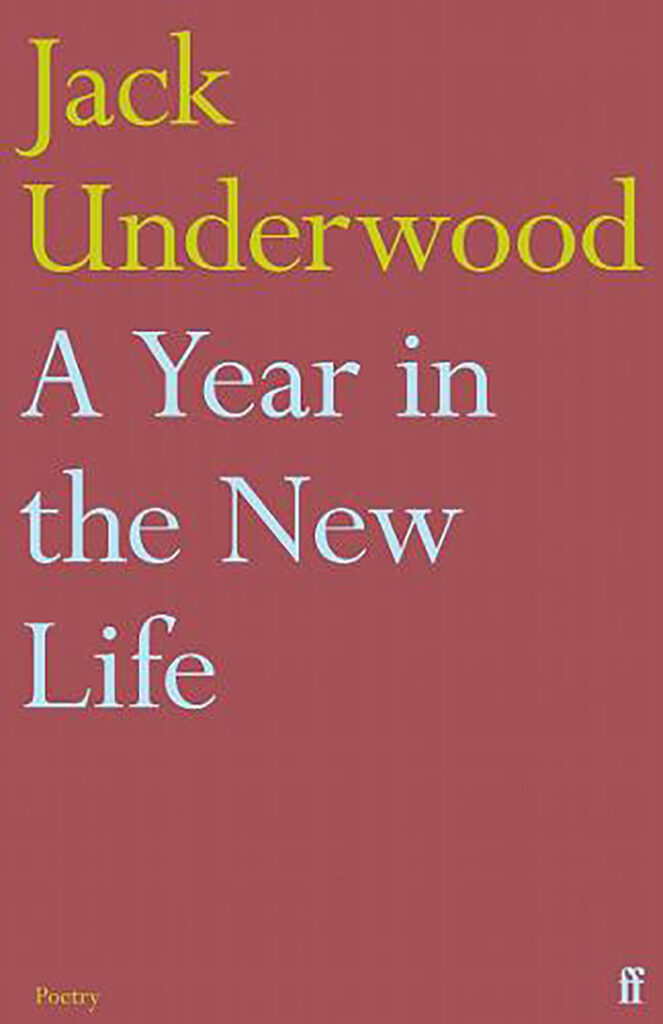
A Year in the New Life

Faber & Faber
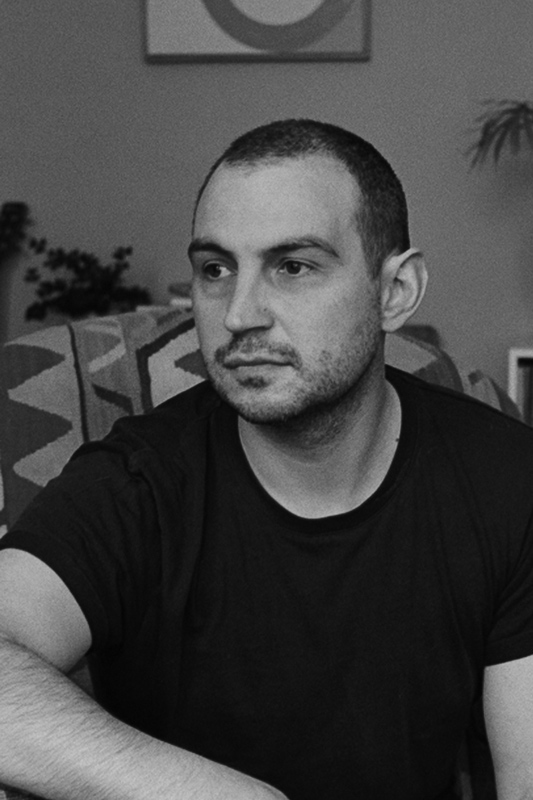
Jack-Underwood-c-Rhondda-Rhiannon_bw
Jack Underwood is a poet, writer and critic based in London. A winner of the Eric Gregory Award in 2007, his debut pamphlet was published by Faber & Faber as part of the first Faber New Poets series in 2009. His debut poetry collection, Happiness (Faber, 2015), won the Somerset Maugham Award. He was co-founder of the leading anthology series Stop...

Review

Review

Jack Underwood's A Year in the New Life 'embraces the anxieties we face. It acknowledges the cruelty and indifference of both the universe and human nature but, somehow, despite this, it smiles at us. We know that the path we will walk will be walked together', writes John Field

Read the
Reader's Notes

Videos

Jack Underwood reads from A Year in the New Life at the T. S. Eliot Prize Shortlist Readings
Jack Underwood reads ‘Behind the Face of Great White Shark’
Jack Underwood reads ‘War the War’
Jack Underwood reads ‘The Landing’
Jack Underwood talks about his work
Jack Underwood reads ‘I am become a man’

Related News Stories

The T. S. Eliot Foundation is delighted to announce that the winner of the T. S. Eliot Prize 2021 is Joelle Taylor for C+nto & Othered Poems, published by The Westbourne Press. Chair Glyn Maxwell said: Every book on the Shortlist had a strong claim on the award. We found...
  Judges Glyn Maxwell (Chair), Caroline Bird and Zaffar Kunial have chosen the T. S. Eliot Prize 2021 Shortlist from a record 177 poetry collections submitted by British and Irish publishers. The Shortlist consists of an eclectic mixture of established poets, none of whom has previously won the Prize, and...
The T. S. Eliot Foundation is delighted to announce the judges for the 2021 Prize. The panel will be chaired by Glyn Maxwell, alongside Caroline Bird and Zaffar Kunial. The 2021 judging panel will be looking for the best new poetry collection written in English and published in 2021. The...
Review of A Year in the New Life

Jack Underwood’s A Year in the New Life ’embraces the anxieties we face. It acknowledges the cruelty and indifference of both the universe and human nature but, somehow, despite this, it smiles at us. We know that the path we will walk will be walked together’, writes John Field

A Year in the New Life explores fatherhood, the challenges posed the climate emergency, and human nature more generally. With the skill of an escapologist, Underwood has a knack for burdening his reader with the heaviest of chains but, with a wink and a smile, he releases us into the light and a ripple of applause. As he struts through literary history, Sharpie in hand, he’s an iconoclastic graffiti artist too, and just because we’re asked to take life seriously doesn’t mean that we’re asked to be serious.

‘Poem Beginning with Lines by Elizabeth Barrett Browning’, the second in the collection, opens with four lines from Aurora Leigh in which Barrett Browning’s character considers the flame of her poetic inspiration in earnest terms and wonders, ‘Who had set it there?’ Underwood’s speaker replies with disarming levity: ‘Not me. I’m just a slug on the wet inner face / of the discourse’. There’s a wilful, perverse ignorance pervading the collection, and Underwood’s speaker continues, saying, ‘I’ve no idea what drags the chair, bruises / the fruit, leads a child towards a dead rabbit / and bids them not weep’. Yet Underwood’s speaker eventually reveals that his apparent confusion is a posture. He knows perfectly well how inspiration works and, commenting on the childish game of playing dead, he relates that, ‘All summer I did it, / repeating the drama, which is how a song is made; you make a phrase and turn it / over and over…’ At the last moment, just as the speaker and Barrett Browning appear to be on the same page, Underwood’s speaker is off again: ‘… like a dead rabbit, finding on the other side, o look, this rabbit, dead, too’. There’s a gleeful perversity at work here, as revelation remains one step out of reach.

Literary graffiti punctuates the collection, puncturing the balloon of the inflated ego. ‘Poem Beginning with Lines by Walter Savage Landor’ starts with the puffed-up voice of Landor’s ‘Dying Speech of an Old Philosopher,’ who claims that he ‘warm’d both hands before the fire of Life’ – spouting the empty cant of carpe diem. Underwood’s speaker’s having none of it, and retorts: ‘It doesn’t trouble me that I didn’t fuck around or win / a haunted heirloom from the panel’. Indeed, ‘What Happened Here?’ goes as far as to suggest that nothing good comes from warming one’s hands by the fire of life. The poem is structured as a dialogue, and tells us that ‘A great burning happened here’. We might hope that ‘great’ would relate to the size of the burning, but apparently not, as we’re later told that not many were burned, ‘Only a committee or so’. So, ‘great’ in this context surely means important, significant, or outstanding. Given half a chance, it seems, we’ll exploit one another any way we can, even if just to warm our hands on a cold evening. We’ll enjoy it too.

Behind the collection’s anxieties about the human nature and the condition of the planet are the sentiments of the new father. Towards the end, we read ‘There Is a Supermassive Black Hole Four Million Times the Mass of the Sun at the Centre of Our Galaxy and You Are Pregnant with Our Daughter’. The length of title is comedic, as too is the move from the sublime (Black Hole) to the ridiculous (Our Daughter). Viewing humanity along a cosmological time continuum puts our fears of survival into perspective: had we but world enough and time, we’d all see the sun extinguished. Yet, as Underwood’s speaker opens, ‘We are not unique, and we are’ and, as the speaker ends: ‘There is a supermassive black hole four million times / the mass of the sun at the centre of our galaxy / and she already responds to our voices’.

A Year in the New Life embraces the anxieties we face. It acknowledges the cruelty and indifference of both the universe and human nature but, somehow, despite this, it smiles at us. There is warmth in its embrace. We know that the path we will walk will be walked together.

Jack Underwood’s A Year in the New Life (Faber & Faber) is shortlisted for the T. S. Eliot Prize 2021. John Field blogs at Poor Rude Lines.

A Year in the New Life
Faber & Faber

Newsletter

Be among the first to receive updates on the latest T. S. Eliot Prize news by subscribing now!


The T. S. Eliot Prize on Social Media

Part of tseliot.com

Designed by thinking

Interview of A Year in the New Life

A Year in the New Life
Faber & Faber

Newsletter

Be among the first to receive updates on the latest T. S. Eliot Prize news by subscribing now!


The T. S. Eliot Prize on Social Media

Part of tseliot.com

Designed by thinking