We’re finding it hard to wait until January for the T. S. Eliot Prize Shortlist Readings at the Southbank’s Royal Festival Hall… so we thought we’d relive some of the previous events by asking those who have taken part about their experiences.
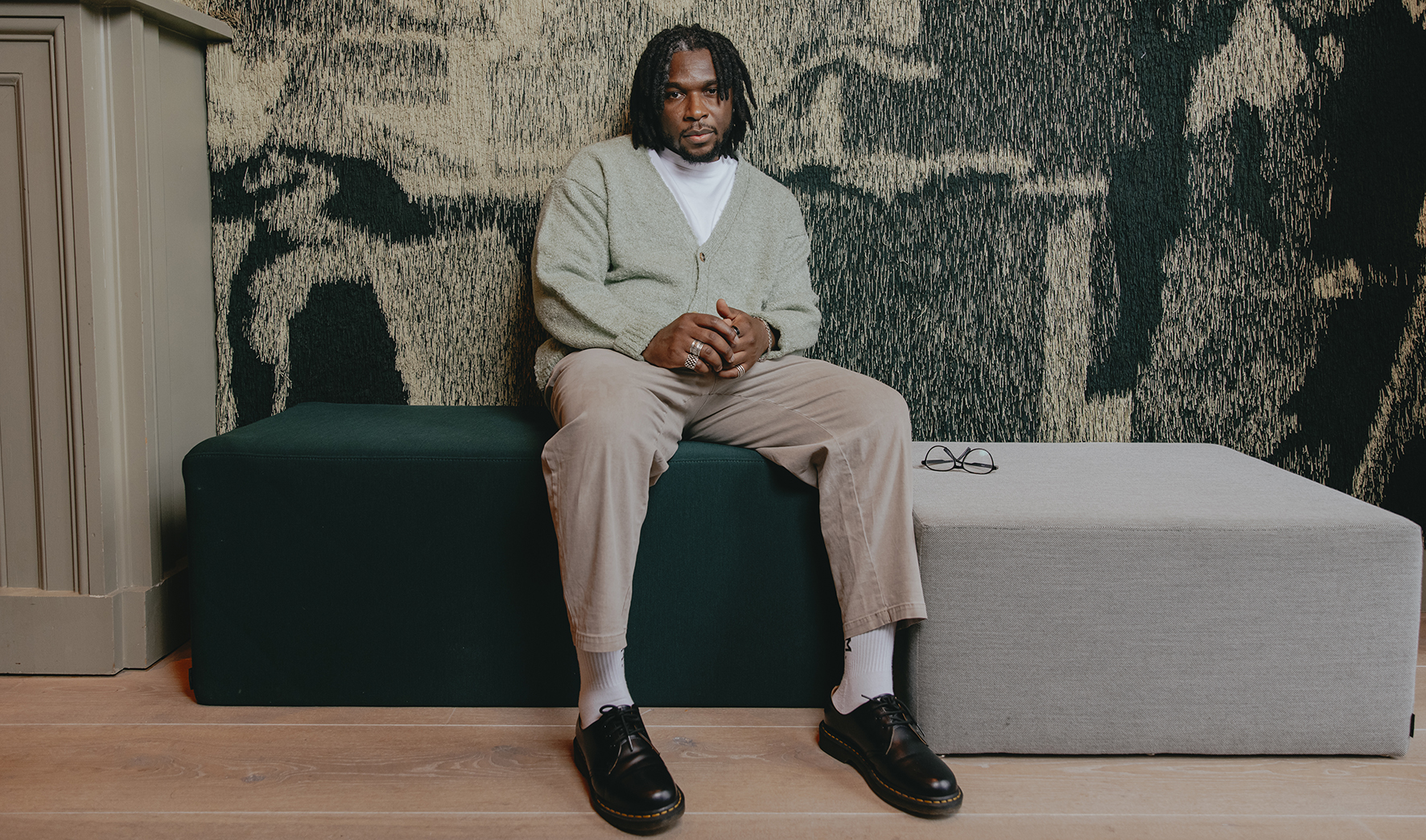
Yomi Ṣode was shortlisted for the T. S. Eliot Prize in 2022 with his debut collection Manorism (Penguin Poetry). Here he reflects on how the ‘Oscars of UK poetry had (him) fusing poems together, blurring their edges, and leaving space for the audience to lean in.’
Performance poetry can be daunting. It’s one thing to write a poem, another entirely to read it before an audience, whether thirty people in a café or two thousand in a concert hall. Both require a kind of courage. Over the years I have been praised and booed, both have taught me to carry a tougher skin each time I step into the light. Performance is its own craft, rigorous, demanding, and as thoughtful as writing.
The T. S. Eliot Prize 2022 Shortlist Readings was a moment that brought this truth home to me. For much of my career, I had been caught in the debate of page versus stage, a tired rhetoric that reduces writers to camps and draws unnecessary picket lines. Poets must choose one, never both, limiting who poets believe they can be and who audiences believe they can listen to.
I intended to prove a point that night. Win or lose, I wanted the audience to remember me, and what performance could be in that space. I felt a fire within me. Joelle Taylor’s reading for the Eliot Prize 2021 was delivered in the way that brought all of her, and, like her, I wanted to show how poems could cross these supposed lines.
I think of my poems as a set list. I map out the order, how each one might speak to and bend against each other in sound and meaning. The Royal Festival Hall is familiar ground for poets who have been shortlisted multiple times, but for me, nominated with my debut collection, Manorism, was entirely new terrain. The occasion made room to disrupt conventions, to carve out a space on my own terms.
I stepped onto that stage in my red jacket with freshly twisted hair. The boom of my voice startled but in the best way. I wanted to bring that open mic energy into a setting that usually feels formal and ‘respectfully’ quiet for the poet. The Oscars of UK poetry had me fusing poems together, blurring their edges, and leaving space for the audience to lean in. I even called on the audience to chant with me, ‘Oh… Thiago Silva…’.
At first, there was hesitation. I could hear the trepidation in their voices born not from the words themselves but from the usual formality of the setting. I wanted laughter, noise, reflection. This was, after all, the T. S. Eliot Prize Readings. On the second round, they joined me fully, and the hall reverberated with a sound rarely heard there. It was not rebellion for its own sake, but an opening to grab hold of. A reminder that poetry is participatory, alive, communal.
I had never imagined my debut would carry me here. Writing a first collection is a terrifying leap, balancing expectation, anticipation, and the ever-present hum of reviews. I carried an odd burden of feeling like an underdog. Silly, perhaps, but real. Standing amongst poets who have been loved and lauded for years, I realised that outside of all of this, I wasn’t the only one who had wrestled with the need to adjust, to fit, to soften. The act became more than performance, it was political, an insistence that poetry belongs to more than one tradition.
The response was more than I could have hoped. Friends and poets attending for the first time told me they felt seen, that they recognised themselves in my set. A raised gun finger in the air, an expression not of violence but of shared nation language.
This matters, because so often the worry is that unless you can cite a canon of names, you are an outsider in a field you’ve long inhabited.
Running through my head in the days before and during the reading was not just the anxiety of the Shortlist or the thrill of the stage, but the weight of a culture. That night was historic in itself. Five debuts on the shortlist, alongside poets who had shaped the field for decades. It was a reminder of range, of what poetry can do, of the possibilities when boundaries blur.
For me, it marked a turning point. Not a resolution of the old debate, but a rejection of it. I had stepped onto one of the grandest stages of UK poetry, and I brought with me not just my book but my whole practice, unapologetically. I realised I didn’t need to prove that performance had craft or that the page could live aloud. The poems had already done that.
I only needed to let them breathe.
See and hear the Eliot Prize experience for yourself by booking now for the T. S. Eliot Prize Shortlist Readings 2025 at 7pm on Sunday 18 January 2026. The event will be British Sign Language (BSL) interpreted and includes live captioning. Tickets are available from the Southbank Centre’s website or by calling their box office on 020 3879 9555. You can also join us from the comfort of your own home via the live stream.