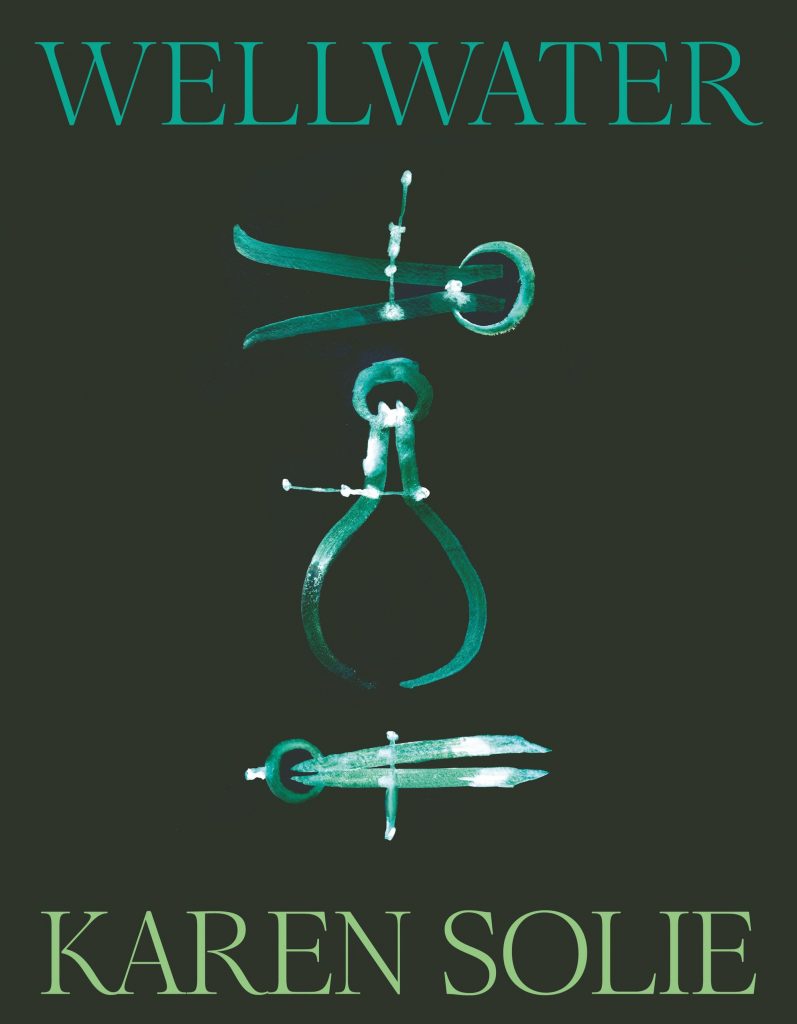

Wellwater

Picador Poetry
Solie, Karen photo © Russell-Hart
Karen Solie grew up in southwest Saskatchewan. Wellwater (Picador Poetry), her sixth collection of poetry, is the joint winner of the Forward Prize for Best Collection 2025 (with Vidyan Ravinthiran’s Avidyā). Solie’s previous collections – Short Haul Engine, Modern and Normal, Pigeon, The Road In Is Not the Same Road Out and The Caiplie Caves – have won the Dorothy...

Review

Review

In Wellwater Karen Solie celebrates beauty and creation, but doesn’t sugarcoat the hard, harsh facts, writes John Field

Read the
Reader's Notes

Videos

Karen Solie reads ‘Antelope’
Karen Solie reads ‘Holiday at the Wave Pool’
Karen Solie reads ‘Wellwater’
Karen Solie talks about her work

Related News Stories

Karen Solie, shortlisted for the T. S. Eliot Prize 2025 with her collection Wellwater (Picador Poetry), is the featured poet in this week’s Eliot Prize newsletter. The newsletter tells you about the wide range of content we have just published to help you get to know Karen and her work....
We’re delighted to announce the T. S. Eliot Prize 2025 Shortlist, which offers ‘something for everyone’ in collections of ‘great range, suggestiveness and power’. Judges Michael Hofmann (Chair), Patience Agbabi and Niall Campbell chose the Shortlist from 177 poetry collections submitted by 64 British and Irish publishers. The diverse list...
The T. S. Eliot Prize and The Poetry Society are delighted to announce the cohort for the fourth instalment of the Young Critics Scheme. Ten young writers have been selected and will each review, in video form, one of the poetry collections shortlisted for the T. S. Eliot Prize 2025....
The T. S. Eliot Foundation is delighted to announce the judges for the T. S. Eliot Prize 2025. Chair Michael Hofmann will be joined on the panel by Patience Agbabi and Niall Campbell.  Michael Hofmann said: I’m delighted to be asked to judge the T. S. Eliot Prize and look...
Review of Wellwater

In Wellwater Karen Solie celebrates beauty and creation, but doesn’t sugarcoat the hard, harsh facts, writes John Field

Karen Solie, a Saskatchewanian, can hear the shells thudding into the front line of the war for the body and soul of the planet better than most: trees cleared, landscape scarred, shale fracked and water polluted. Among other things, Wellwater is a letter home from this war zone.

‘Basement Suit’ opens the collection with a Wellsian slice of dystopia, with The Time Machine’s world of haves and have-nots, of Eloi and Morlocks. We find ourselves in a rented flat where ‘Left to our use are the fixtures and appliances’. ‘Left to’ suggests that the owners have abandoned ship. Time’s tick is barely perceptible but, as the speaker considers the weevils in the basement, they remark that there is ‘a weevil to every purpose under heaven’, a reference to Ecclesiastes: ‘To every thing there is a season, and a time to every purpose under the heaven: a time to be born, and a time to die; a time to plant, and a time to pluck up that which is planted’ and so, under the poem’s floorboards, time is writ large. The first person plural creates an unsettling dramatic monologue: we’re a huddled group of survivors taking refuge, but we’re unsure what we’re taking refuge from. Sheeplike, we follow the crowd away from ‘I’ and towards ‘we’ – perhaps a comment on our collective paralysis. It’s a topsy-turvy world where ‘The basement is a treehouse in the roots’. Where one might expect to hear water, we are told instead that ‘money flows no more freely up here’. Is this a metaphor for water, a comment on its value after the apocalypse, or do we now inhabit a world in which money is the condition essential for life?

The collection’s title poem follows. Well water issues from springs and runs deep and pure. As the speaker drinks, they ‘taste the cathedral’s rock and temperature’. At one level, we’re offered a numinous experience, but we’re also reminded that the water we drink takes on the characteristics of the surrounding rock and, as we frack for gas, what was once a cathedral will become yet another toxic dump. If it’s out of sight and out of mind then we’re incapable of attending to it. As in ‘Basement Suite’, capital’s flow is the strongest and the landscape is simply a ‘means / to and end’, with ‘means’ reminding us, once again, of the grave relationship between landscape and money, ‘fracking derricks across the country / appearing’ as the planet teeters on the brink.

In ‘Antelope’ we’re reminded of the need to experience the world on its own terms. Ted Hughes’s ‘Roe-deer’ is a useful poem to read against this, presenting an extraordinary, numinous encounter with a deer in a snowscape. Magically, ‘the curtain had been blown aside for a moment’, permitting the speaker a glimpse of the deer’s otherworld. Solie sets up a near identical scenario: her antelope ‘appear out of nowhere as if they know where all the doors are / between our dimension and where they are called / by their true name’. Her antelope are the knowledgeable ones and, although Genesis invites us to imagine that humanity named creation and holds it in dominion, Solie challenges this anthropocentric presumption. Instead of Hughes’s liminal, elemental snowstorm, we’re on a ‘great plain aligned to the god of monoculture’ and, in a moment of bathos, the speaker, musing on the antelope, comments ‘How annoying to be drawn into / another pointless encounter with me’, a rejection of Hughes’s mystical romanticism.

In one of the collection’s last poems, ‘Orion’, the speaker’s in the backyard enjoying a smoke under the constellation, considering the final cold fortnight before Christmas (less a religious festival in 2025 than an orgy of consumption). The speaker considers an experiment:

                                              In the lab a single rat
restrained on a chill plate
will exhibit robust escape behaviour later
than will several others free
to shelter together in their enclosure
when temperature is slowly but drastically lowered –

And there we are, enjoying the hygge around the family hearth, sedated by good cheer while the speaker looks ‘beyond the Horsehead Nebula, De Mairan’s Nebula, / through the hallways of the stellar nurseries’ and into the terrible beauty of a cold, indifferent universe.

In Wellwater Solie celebrates beauty and creation, but she doesn’t sugarcoat the medicine we need to take.

Karen Solie’s Wellwater (Picador Poetry) is shortlisted for the T. S. Eliot Prize 2025. John Field blogs at Poor Rude Lines.

Wellwater
Picador Poetry

Newsletter

Be among the first to receive updates on the latest T. S. Eliot Prize news by subscribing now!


The T. S. Eliot Prize on Social Media

Part of tseliot.com

Designed by thinking

Interview of Wellwater

Wellwater
Picador Poetry

Newsletter

Be among the first to receive updates on the latest T. S. Eliot Prize news by subscribing now!


The T. S. Eliot Prize on Social Media

Part of tseliot.com

Designed by thinking