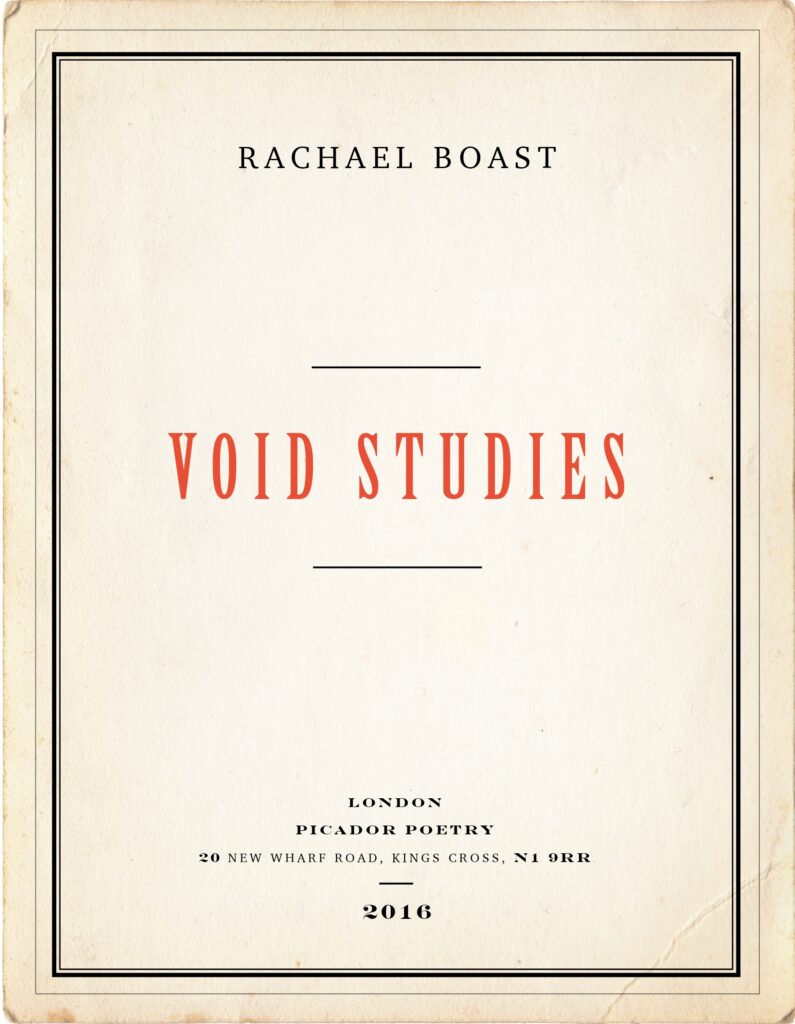
Void Studies

Picador Poetry
RachaelBoast-final-1
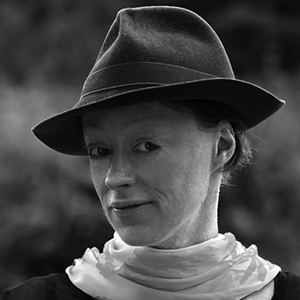
Rachael Boast was born in Suffolk in 1975. Her first collection, Sidereal, was published by Picador Poetry in 2011 and won the Forward Prize for Best First Collection and the Seamus Heaney Centre for Poetry Prize. Her second collection, Pilgrim’s Flower (Picador Poetry, 2013) was shortlisted for the Griffin Prize. Void Studies, realising a project that Arthur Rimbaud proposed but...

Review

Review

'Reading Rachael Boast’s Void Studies is a sensual, sensory joy. Like music, it has a simultaneity of effect and presents memory and desire with intoxicating immediacy and authenticity', writes John Field

Videos

Rachael Boast reads from Void Studies at the T. S. Eliot Prize Shortlist Readings
Festival of the Future City: Poets, Writers and the City
Poet Rachael Boast reads from Pilgrim’s Flower
Rachael Boast reads from Void Studies

Related News Stories

Jacob Polley’s disturbing tale of lost innocence wins world’s most prestigious poetry prize The T. S. Eliot Foundation is delighted to announce that the winner of the T. S. Eliot Prize 2016 is Jacob Polley for his remarkable new collection Jackself. After months of reading and deliberation, judges Ruth Padel...
To help readers engage fully with the T. S. Eliot Prize 2016 Shortlist, we asked poetry blogger and regular Eliot Prize reviewer John Field to explore the shortlisted titles. In his review of Rachael Boast’s Void Studies, John Field writes, ‘Reading Void Sudies is a sensual, sensory joy. Like music,...
The T. S. Eliot Prize is delighted to announce the thrilling 2016 Shortlist, featuring exciting newcomers and established names. Judges Ruth Padel (Chair), Julia Copus and Alan Gillis have chosen the Shortlist from 138 books submitted by publishers: Rachael Boast – Void Studies (Picador Poetry) Vahni Capildeo – Measures of...
Review of Void Studies

Like music, Rachael Boast’s Void Studies has a simultaneity of effect and presents memory and desire with intoxicating immediacy and authenticity, writes John Field

Reading Rachael Boast’s Void Studies is an intense, rewarding experience.  It’s best tackled in a few bursts – or even in a single reading – to best savour the restricted palette. To enjoy the connections between her archetypal images, it’s helpful to feel the musically rhythmic thrum of her images – doors, keys, moon and river – as they pulse from poem to poem.

Void Studies is divided into sections I and II, followed by ‘Poems of the Lost Poem’, a sonnet sequence coloured by the language of the previous sections. Boast’s notes point us to the late nineteenth century French poet, Arthur Rimbaud, who considered writing a collection entitled Études néantes, ‘written in the spirit of musical etudes and [which] would go beyond the temptation to convey any direct message’. Rimbaud’s name is a touchstone for the reader: in John Ashbery’s Preface to his translation of Rimbaud’s Illuminations, he writes of Rimbaud’s ‘crystalline jumble […] a disordered collection of magic lantern slides’ and this should help direct the reader down a relaxed, fruitful path. Sure, you’ll need to pay attention but you’re not missing something if you don’t ‘get’ it – you feel your way through poems like these. There’s nothing to ‘get’ as you watch sunlight playing across the surface of water – these poems are knocking on the door of the subconscious mind and the best thing to do is to relax.

Boast’s is a Protean, dreamlike, shape-shifting excess. Her form throughout these sections is the couplet – two parallel lines powering across the void of the white page – a fitting form for these meditations on the relationship between the physical and the transcendental.

‘Pleasant Thought for Morning’ opens with the sensual ‘Hiding your face in my neck’. Severed from the subject and main verb (‘I am’? or perhaps ‘You are’?) the poem feels disconnected and dreamlike. After the first two stanzas, as many of these poems do, Boast leaps into the abstract: ‘hiding in the space around / the space I have dressed you in // wings of hardened spirit.’ The perplexing double quality of space is present throughout the collection in the ‘parallel life’ of ‘The Glass-Hulled Boat’ and in the titles ‘Seeing Double’ and ‘Double Exposure’. Mirrors too reflect language through the collection. The wings of hardened spirit again evokes the French avant garde – this time Jean Cocteau’s ‘L’Ange Heurtebise’ (explicitly referenced in the section’s final poem, ‘Night of Echoes’). The poem resumes, ‘Angelot, a new day is here’. ‘Angelot’? A term of endearment, perhaps, – but again, a Protean image of instability as the Oxford English Dictionary lists it as, among other things, an instrument and a coin (both French and English, stamped with St Michael and the dragon). Boast’s is a sensual, transformational, transcendental poetry.

Section II opens with the ‘The Glass-Hulled Boat’, where the speaker is ‘Waking at lunchtime to a subdued sky / bemused by how the pivots of sleep // came loose’. The fulcrum is unstable – the dissolute hour of arousal and muted day points to a liminal world. The speaker thinks that she ‘saw you at the back / of the Tower Belle’, a physical enough instance of a pleasure cruiser operating in Bristol. However, the titular glass hull designates it a dream ship of drunkenness with its ‘splayed passengers’, where the poem’s ‘you’, its object, makes for the bar, towards ‘another vodka and tonic or any other /// see-through intoxicant’ – and again an image of transparency points to an altered reality.

The collection’s final section, ‘Poems of the Lost Poem’ reprise its themes and vocabulary, closing with the sonnet, ‘Coda: Lost Poem’. ‘Coda’ is another musical term in a decidedly musical collection. Reading Boast’s Void Studies is a sensual, sensory joy. Like music, it has a simultaneity of effect and presents memory and desire with intoxicating immediacy and authenticity.

Rachael Boast’s Void Studies (Picador Poetry) is shortlisted for the T. S. Eliot Prize 2016. John Field blogs at Poor Rude Lines.

Void Studies
Picador Poetry

Newsletter

Be among the first to receive updates on the latest T. S. Eliot Prize news by subscribing now!


The T. S. Eliot Prize on Social Media

Part of tseliot.com

Designed by thinking

Interview of Void Studies

Void Studies
Picador Poetry

Newsletter

Be among the first to receive updates on the latest T. S. Eliot Prize news by subscribing now!


The T. S. Eliot Prize on Social Media

Part of tseliot.com

Designed by thinking