In Zaffar Kunial’s debut collection, Us, 'language achieves a simultaneity that is both playful and beautiful, but also gently political as he resists and questions cultural assumptions', writes John Field
Be among the first to receive updates on the latest T. S. Eliot Prize news by subscribing now!
In Zaffar Kunial’s debut collection, Us, ‘language achieves a simultaneity that is both playful and beautiful, but also gently political as he resists and questions cultural assumptions’, writes John Field
Zaffar Kunial’s debut collection, Us, infuses culture in language, identity in history. In Kunial’s hands, language achieves a simultaneity that is both playful and beautiful, but also gently political as he resists and questions cultural assumptions.
The ‘Us’ of the collection’s title feels global and inclusive. However, reading ‘Poppy’ in November, these titles shift in meaning. A combative ‘us’ is set against ‘them’ and the poppy evokes remembrance. Kunial takes this as his starting point as we read that the poppy ‘crops up where acidic ground is neutralised – in Belgium / blasted bones and rubble added their twist of lime / turning the disturbed earth red’. An equal amount of acid and alkali would be required to neutralise the ground, highlighting the cost, the futility of Kunial’s [ex]plosive Belgian ‘blasted bones’. Language shifts before us as ‘lime’, alkaline earth, becomes its chemical opposite, the citrus fruit, loaded with acid. This casual image changes the tone of the poem as language shifts, as one idea follows another.
The earth is ‘disturbed’ – raked, hoed, but also emotionally unsettled. So far, so thrilling. However, Kunial challenges this narrow view of ‘us’ as the poem shifts a gear in stanza four and travels east: ‘Who’s there in the first script, on a Mesopotamian / tablet: Hul and Gil – ‘joy flower’ – a cuneiform / cocktail’. Rolling through Chinese, Greek, Egyptian and Hebrew, the poppy assumes a new stature as a time-honoured easement from pain and death. And so, when we revisit the shattered bodies of the trenches, the poppy has grown in potency as a symbol: ‘Mother – last word of that bleeding, wrecked soldier, / as heard by the last Tommy, the last link to living memory – / spoken for now, like the countless millions // of mouthless dead’.
The opening poem, ‘Fielder’, plays with perspective and place as some aberrant fielding takes the speaker over a quintessentially English border, the cricket pitch boundary rope, and into an uncharted world, ‘a world hidden from batsmen, the umpires and my team’. Read against the collection as a whole, this conceit assumes more significance. If fenced in, even the smallest of locales can feel like a world and, the collection asserts, open borders, intellectual curiosity and multiculturalism are essential for the health of society.
Another ‘us’ explored by Kunial’s collection is the family. ‘Prayer’ riffs on George Herbert’s sonnet of 1633 of the same name. Kunial’s poem is in close dialogue with Herbert’s Christian framework in which prayer is ‘God’s breath in man’, ‘The soul in paraphrase’ but Kunial’s speaker, facing the loss of his mum, instead made an animal noise’. Living and dying in a secular world is harder than existing in a theistic one. At his birth, the speaker’s father prays in his ear ‘Allah hu Akbar’ but the speaker offers his dying mother a secular prayer: ‘Thank you I love you thank you’ and the poem’s doubtful ending, ‘I won’t know if she heard’ operates beyond religious frameworks, suggesting that family is all that we have.
Finally, the collection maintains a close dialogue with culture and, in keeping with its aesthetic of inclusivity, it’s no surprise to see the likes of Nick Drake rubbing shoulders alongside Shakespeare and Dickens. One of the final poems, an elegy, maintains a close relationship with Old English: ‘Where are those who were before us? / Hwær becomes Uuere becomes my where.’
This human chain links one generation to the next and back into the mists of time. It celebrates our humanity and challenges the reader to look for common ground, and not for borders.
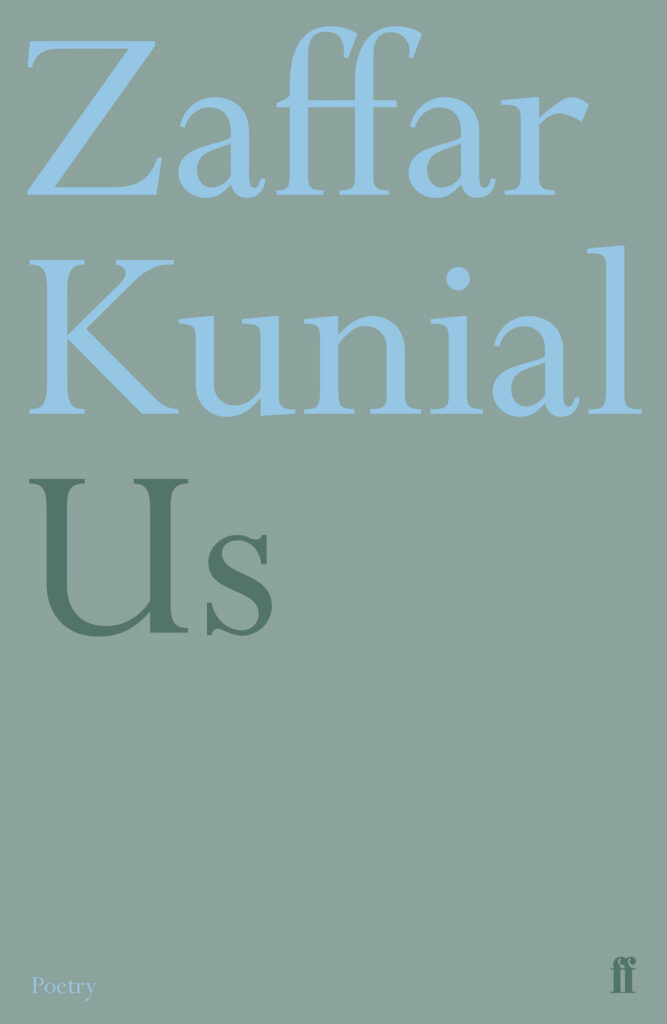
Zaffar Kunial’s Us (Faber & Faber) is shortlisted for the T. S. Eliot Prize 2018. John Field blogs at Poor Rude Lines.
Be among the first to receive updates on the latest T. S. Eliot Prize news by subscribing now!