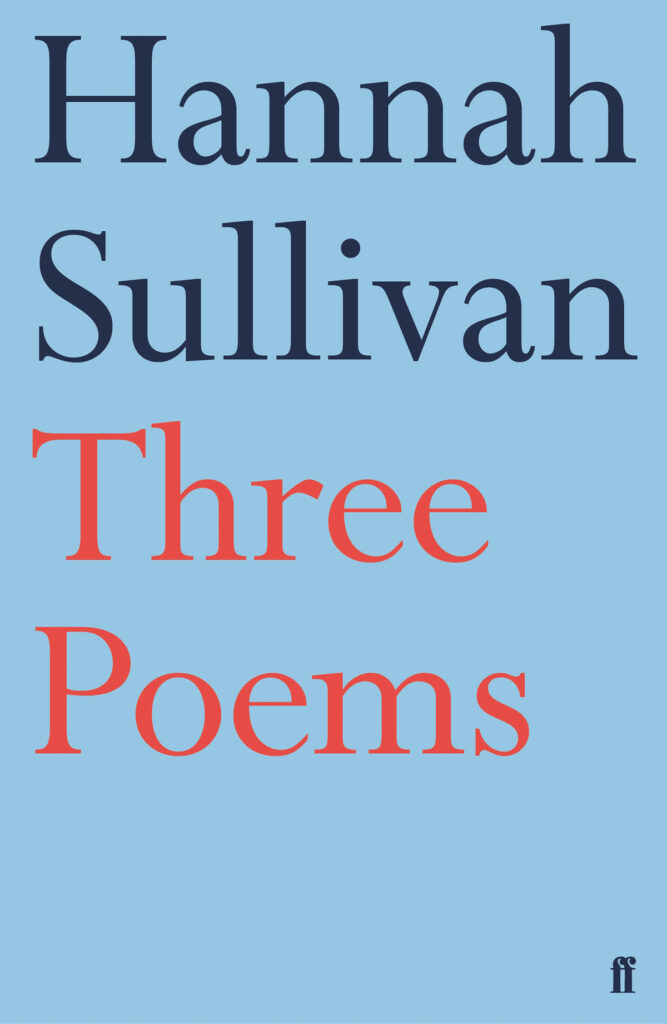

WINNER
2018

Three Poems

Faber & Faber
Hannah Sullivan crop © Teresa-Walton 1
Hannah Sullivan’s debut collection Three Poems (Faber & Faber, 2018) won the T. S. Eliot Prize and the John Pollard Foundation International Poetry Prize, and was shortlisted for the Costa Poetry Award, the Ted Hughes Award, the Seamus Heaney Poetry Prize and Michael Murphy Poetry Prize. After a degree in Classics at Cambridge, she went to Harvard University on a Kennedy Scholarship...

Review

Review

Hannah Sullivan's debut, Three Poems, 'is a sensual encounter with language', writes John Field. 'The combination of Sullivan’s disciplined couplets and riot of language create a memorable meditation on living and dying'

Read the
Reader's Notes

Videos

Rona Luo reads from Hannah Sullivan’s Three Poems
Hannah Sullivan reads from Three Poems at the T. S. Eliot Prize Shortlist Readings
Hannah Sullivan talks about her work
Hannah Sullivan reads an extract from ‘Three Poems’

Related News Stories

In 2023 the T. S. Eliot Prize celebrated its 30th anniversary. We marked the occasion by looking back at the collections which have won ‘the Prize poets most want to win’ (Sir Andrew Motion). Hannah Sullivan won the T. S. Eliot Prize 2018 with her debut collection Three Poems (Faber...
The T. S. Eliot Foundation is delighted to announce that the winner of the T. S. Eliot Prize 2018 is Hannah Sullivan for her thrilling collection Three Poems, published by Faber & Faber. After months of reading and deliberation, judges Sinéad Morrissey, Daljit Nagra and Clare Pollard unanimously chose the...
Fresh from reading a record 176 submissions, T. S. Eliot Prize 2018 judge Clare Pollard celebrates the boom in poetry By most measures, this is a good year for poetry. As life moves increasingly online, poetry suits the internet – it fits in a tweet, a blogpost, an Instagram snap,...
Judges Sinéad Morrissey (Chair), Daljit Nagra and Clare Pollard have chosen the T. S. Eliot Prize 2018 Shortlist from a record 176 poetry collections submitted by, as Sinéad Morrissey says, ‘a plethora of poetry publishers’. The Shortlist comprises five debut collections, one small press, five men, five women, and two...
Review of Three Poems

Hannah Sullivan’s debut, Three Poems, is a sensual encounter with language, writes John Field. The combination of Sullivan’s disciplined couplets and riot of language create a memorable meditation on living and dying

Hannah Sullivan’s Three Poems trains a steady gaze on the details of urban existence: its beauty, joy and pain. Like the work of Eliot and Pound before her, there’s a simultaneity to Sullivan’s presentation of time and even the medical particulars of birth and death converge into experiences which are disorienting in their similarity. The personal and the public combine in the crucible of Sullivan’s language into a disciplined, structured object of terrible beauty.

The first poem, ‘You, Very Young in New York’ stages the dizzying, numbing revolutions of the timeless city. “Rosy used to say that New York was a fairground. / ‘You will know when it’s time, when the fair is over.’ / But nothing seems to happen. You stand around // On the same street corners”. The rides repeat themselves endlessly, and the fair itself is, in essence, unchanged from season to season. But Sullivan irreverently throws entropy into the system and reminds us that no fairground ride can go on forever: “You are thinking of masturbating but the vibrator’s batteries are low / And the plasticine-pink stick rotates leisurely in your palm”. Sullivan’s presentation of time and space has a distinctly contemporary feel as the modern workplace rejects these old demarcations. Internationally, every workspace is the same anonymous “Lego-maze”: “In Chennai, meanwhile, a man is waiting for your analysis, Eating his breakfast of microwaved dal and mini-idlis, // Checking the cricket scores on his computer, reading Thoreau, / Wondering what New York looks like at night, the snow”.

The sequence ‘Repeat Until Time’ takes as its starting point an epigraph from the ancient Greek philosopher, Heraclitus: “On those who step into the same rivers, different and different waters keep on flowing…” The sequence starts conventionally enough – with a river and the predictable, Heraclitan ebb and flow of nature: “Other old women step delicately into the same floodwater” but the poem’s final, lonely, single-line stanza strikes a more uncertain note: “It is hard to say if there is progress in history” and, in the final part, we revisit the first successful nuclear detonation: “T = 0 = 5:29:45 a.m. / It is very important that the thunder comes”. Perhaps Eliot’s ‘What the Thunder Said’, the final part of The Waste Land, delivers enlightenment, perhaps it delivers oblivion, but Sullivan ends with the words of Kenneth Bainbridge, Trinity project director: “‘‘Now we’re all motherfucking sons of bitches.’’ / [And repeat.]” Language echoes through time but, like cancer cells, which “divide interminably”, the nuclear chain reaction generates itself: life and death are one and the same.

The final sequence, ‘The Sandpit After Rain’, takes a more domestic view of entropy (“jumpers bobble”) and debunks some of the more portentous aspects of high Modernist poetry. Eliot’s The Waste Land ends with the mystic mantra “Shantih shantih shantih” but Sullivan’s speaker, a pregnant woman, tries yoga and Sanskrit chanting as she prepares for birth: “Om Sahana, / Om Shanti, What faith did I have in the wisdom of the east? / In Hypnobirthing?” In a memorable image of the restaurant fish tank, Sullivan presents the saltwater eel: “Chosen and not yet chosen, neither living nor dead, / Eddying between two walls of bubbling glass” and the condemned eel is both the certainty of death and the certainty of birth. The oxytocin of birth and the morphine of the hospice are analogous to one another.

Sullivan’s Three Poems offers a sensual encounter with language. The combination of the poet’s disciplined couplets and riot of language create a memorable meditation on living and dying.

Hannah Sullivan’s Three Poems (Faber & Faber) is shortlisted for the T. S. Eliot Prize 2018. John Field blogs at Poor Rude Lines.

Three Poems
Faber & Faber

Newsletter

Be among the first to receive updates on the latest T. S. Eliot Prize news by subscribing now!


The T. S. Eliot Prize on Social Media

Part of tseliot.com

Designed by thinking

Interview of Three Poems

Three Poems
Faber & Faber

Newsletter

Be among the first to receive updates on the latest T. S. Eliot Prize news by subscribing now!


The T. S. Eliot Prize on Social Media

Part of tseliot.com

Designed by thinking