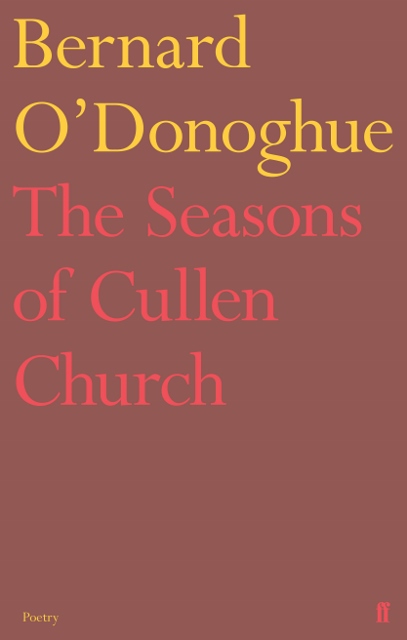
The Seasons of Cullen Church

Faber & Faber
1. Bernard O'Donoghue 3 - landscape option - PREFERRED - William Parry
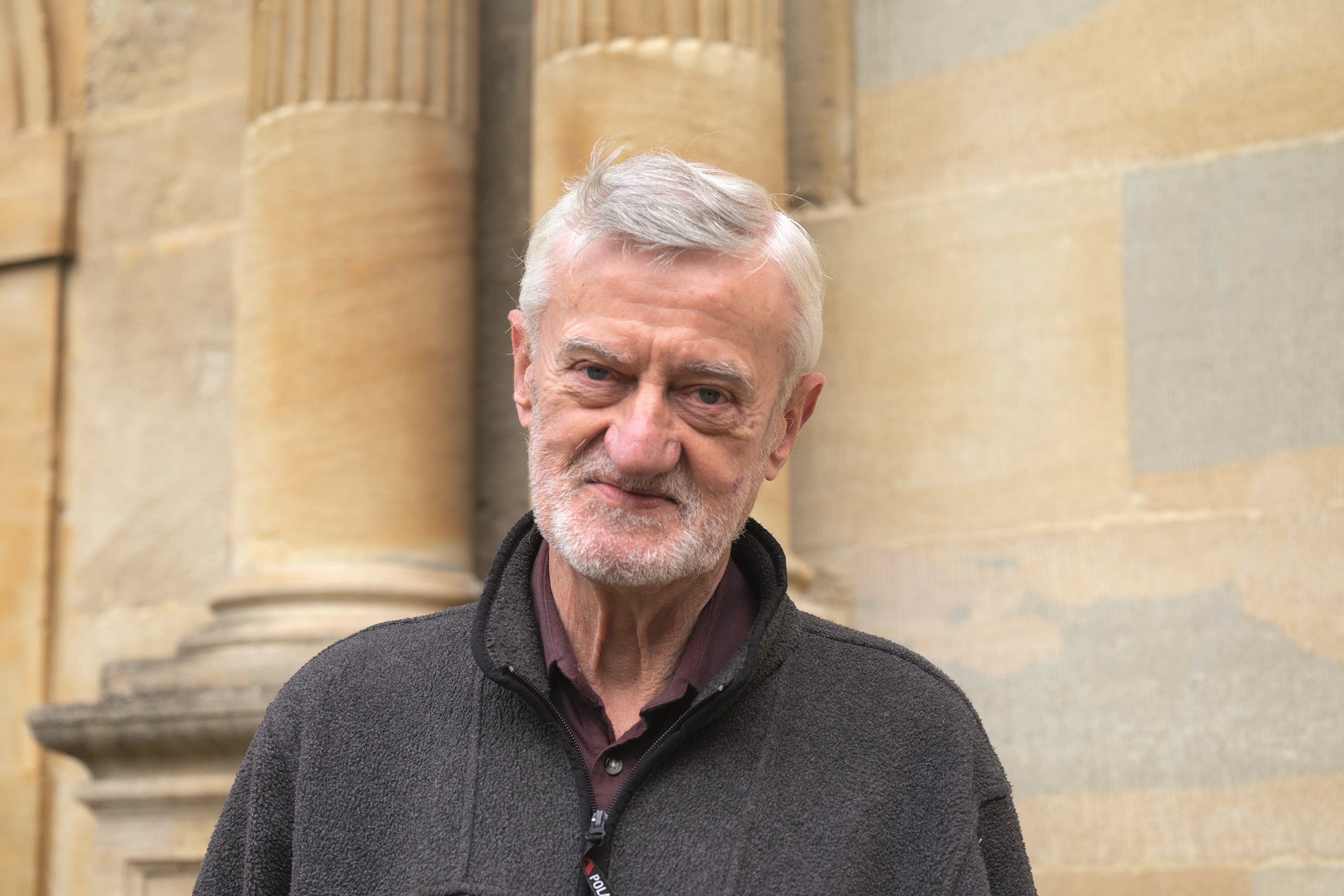
Bernard O’Donoghue was born in Cullen, Co Cork in 1945, later moving to Manchester. He is an Emeritus Fellow of Wadham College, where he taught Medieval English and Modern Irish Poetry. He has published six collections of poetry, including Gunpowder (Chatto & Windus), winner of the 1995 Whitbread Prize for Poetry, and Farmers Cross (Faber & Faber), which was shortlisted...

Review

Review

'If you enjoyed Heaney's final collection, Human Chain, then you are likely to enjoy The Seasons of Cullen Church [...] Translations of Dante, the Gawain Poet and William Langland allow these poems to resonate with the whole authority of the language – pure, beautiful and true', writes John Field

Videos

Bernard O’Donoghue reads from The Seasons of Cullen Church at the T. S. Eliot Prize Shortlist Readings
Bernard O’Donoghue reads from The Seasons of Cullen Church
Bernard O’Donoghue reads his poem ‘Munster Final’

Related News Stories

Jacob Polley’s disturbing tale of lost innocence wins world’s most prestigious poetry prize The T. S. Eliot Foundation is delighted to announce that the winner of the T. S. Eliot Prize 2016 is Jacob Polley for his remarkable new collection Jackself. After months of reading and deliberation, judges Ruth Padel...
To help readers engage fully with the T. S. Eliot Prize 2016 Shortlist, we asked poetry blogger and regular Eliot Prize reviewer John Field to explore the shortlisted titles. In his review of Rachael Boast’s Void Studies, John Field writes, ‘Reading Void Sudies is a sensual, sensory joy. Like music,...
The T. S. Eliot Prize is delighted to announce the thrilling 2016 Shortlist, featuring exciting newcomers and established names. Judges Ruth Padel (Chair), Julia Copus and Alan Gillis have chosen the Shortlist from 138 books submitted by publishers: Rachael Boast – Void Studies (Picador Poetry) Vahni Capildeo – Measures of...
Review of The Seasons of Cullen Church

Bernard O’Donoghue’s collection, The Seasons of Cullen Church, presents poems that ‘resonate with the whole authority of the language – pure, beautiful and true’, writes John Field

Open Google maps and fling your well-travelled orange ragdoll down to street level in Cullen, County Cork. Blink and you’d miss the place as, although Google feels the need to write ‘village’ on the map, all you’ll see is a ribbon of lane, peppered with houses and leading to the N72 link between Mallow and Killarney. Cullen’s church looks like any other small, parochial Irish church, yet it becomes a point of reference for the collection.

The title poem, ‘The Seasons of Cullen Church’, opens with an epigraph from Wuthering Heights: ‘I wonder how anyone could ever imagine unquiet slumbers for the sleepers in that quiet earth’ and, given the novel’s haunted wildness, we cannot take its narrator, Lockwood, at face value. And so, as we step inside the church, ODonoghue offers us an awkward prism of observation: the angels, the speaker and the unnamed ‘you’. The angels have their ‘eyes down / so as not to embarrass you as you dipped / a reverent finger, catching no one’s eye’. The seasons offered here might not be immediately apparent as the second stanza’s ‘Drop down dew, ye Heavens‘ brings with it the Rorate Coeli, a celebration of Advent and the next stanza’s ‘Was ever grief like mine?’, a reference to George Herbert’s ‘The Sacrifice’, brings with it Lenten austerity, ‘when the bell had lost its tongue and they struck / together flat wooden clappers, not to betray / the least trace of jubilation’.

And so, in an insignificant little church, the drama and mystery of the church unfolds. It’s beautiful. Every night, millions of Catholics recite the Nunc Dimittis, the Canticle of Simeon, the prayer of an old man who, having waited a lifetime to see the Messiah, knows that he can finally die in peace. ODonoghue‘s speaker asks ‘Had we, like Simeon, / lived long enough? But that night / the sky over the graveyard frosted with stars’.

Death and burial is writ large. ‘The Din Beags’, an earlier poem, presents an impoverished family losing their beloved horse: ‘But, even having so little, there was room / to have less’ and their suffering takes on a Biblical dimension, like the trials of Job. ODonoghue allows the poor to take their place in society and death levels us. In ‘At the Funeral in Oxford of Darky Finn’, ‘The rain battered on the corrugated roof / of the Simon Community’ – the pathetic fallacy here suggesting that the heavens have taken note.

If you enjoyed Heaney’s final collection, Human Chain, then you are likely to enjoy The Seasons of Cullen Church (the final poem, ‘The Boat’ is dedicated to Heaney’s memory). Translations of Dante, The Gawain Poet and William Langland allow these poems to resonate with the whole authority of the language – pure, beautiful and true.

Bernard O’Donoghue’s The Seasons of Cullen Church (Faber & Faber) is shortlisted for the T. S. Eliot Prize 2016. John Field blogs at Poor Rude Lines.

The Seasons of Cullen Church
Faber & Faber

Newsletter

Be among the first to receive updates on the latest T. S. Eliot Prize news by subscribing now!


The T. S. Eliot Prize on Social Media

Part of tseliot.com

Designed by thinking

Interview of The Seasons of Cullen Church

The Seasons of Cullen Church
Faber & Faber

Newsletter

Be among the first to receive updates on the latest T. S. Eliot Prize news by subscribing now!


The T. S. Eliot Prize on Social Media

Part of tseliot.com

Designed by thinking