
In The Million-petalled Flower of Being Here, Vidyan Ravinthiran weaves the personal and the political into a tender, honest consideration of our relationships. Despite our dividedness, Ravinthiran concludes, love will have to be enough, writes John Field
Be among the first to receive updates on the latest T. S. Eliot Prize news by subscribing now!
In The Million-petalled Flower of Being Here, Vidyan Ravinthiran weaves the personal and the political into a tender, honest consideration of our relationships. Despite our dividedness, Ravinthiran concludes that love will have to be enough, writes John Field
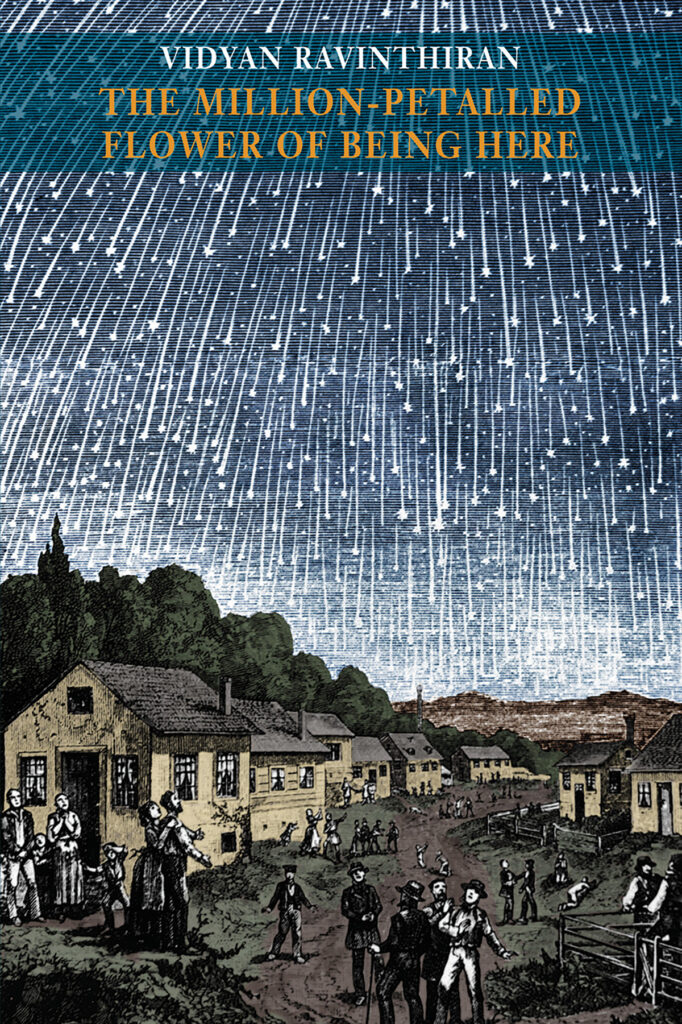
The cover of The Million-petalled Flower of Being Here shows a Leonids meteor storm in 1833, people taking a break from the humdrum to look to the heavens in wonder. Ravinthiran’s sonnets offer something similar: moments in time bloom and we’re invited to stop for a moment and look.
The collection opens with ‘Today’, the title of which lends an immediacy further enhanced by Ravinthiran’s first person address: ‘I was reading my book by the window / waiting for you’. The book, the waiting, the window, present a mind focused on elsewhere, killing time and steadfastly rejecting the offer made by the present moment. However, there’s an epiphany and the broken stem of a flower in a vase is transformed: the orange gerbera’s ‘glow’ and ‘radiant petals’ lend it a divine quality and the world around is enough.
However, Ravinthiran is quick to burst the bubble of his own numinosity. The sonnets are arranged in pairs, so ‘Today’ is paired with ‘Aubade’, inviting the reader to ponder their relationship. If anything, ‘Aubade’, a hymn to the dawn, should wax lyrical about the lover’s body, ‘completely naked’. Instead, Ravinthiran leaves us with the promise of cleaning the bathroom: ‘The sound of the curtains yanked apart / is the morning clearing its throat’.
The sonnets document an itinerant rootlessness. In ‘Our first house,’ the possessive pronoun ironically implies ownership, yet the house is ‘lost in months when the owners chose to sell’, their freedom of choice in stark contrast with the speaker’s hard necessity. The volta, that twist at the heart of a sonnet, typically placed at the beginning of line nine, is premature, jumping the gun at the beginning of line 6, perhaps suggesting the unexpected brevity of the tenancy. With a powerful turn of phrase, the speaker reflects on the neighbour ‘with whom we shared a wall and nothing else’, exposing divisions of race and class (‘We were the only renters’). Meanwhile, at the bottom of the page, in ‘A gift’, an infinitely more sociable cat annexes ‘to her domain of scents the place we lived’ in a wry, oblique condemnation of society.
The collection acknowledges the challenges of living together, whether at an intimate, domestic level, or in a wider sense. In ‘Thought experiment’ the speaker explores his presumed, friendly relationship with the reader: ‘If I love you can I love everyone, / even the stranger reading this page’. It’s an uncomfortable effect, as Ravinthiran’s first person narrator shuts us out, questioning our intentions and acknowledging the divided nature of our community before delivering the body blow: ‘Thugs in the riots sniffed the oil / in men’s hair to check, were they Tamil. / Victims were pulled close in a strange intimacy / and then embraced by a burning tyre.’
One of the joys of Ravinthiran’s poetry is his engagement with popular culture and The Million-petalled Flower works with Strictly Come Dancing, The X-Files and Super Mario Bros, showcasing the virtuosity of his magpie mind. If anything, these sonnets are among the collection’s most poignant, as the ebullience of Mario, his momentary invincibility, is contrasted with a world in which ‘Time salts all wounds’ and the ease with which the player can move Mario with a ‘quick flick of the stick’ will not be enough to help us to negotiate our own ‘wall of fire’.
In The Million-petalled Flower of Being Here, Vidyan Ravinthiran weaves the personal and the political into a tender, honest consideration of our relationships. Despite our dividedness, he concludes that love will have to be enough.
Vidyan Ravinthiran’s The Million-petalled Flower of Being There (Bloodaxe Books) is shortlisted for the T. S. Eliot Prize 2019. John Field blogs at Poor Rude Lines.
Be among the first to receive updates on the latest T. S. Eliot Prize news by subscribing now!