
We delude ourselves into thinking that endeavour is progress but J. O. Morgan's The Martian’s Regress takes a more sober view. Morgan’s Martianism offers not a fresh way of seeing but the tragedy of a species doomed to repeat its mistakes, writes John Field
Be among the first to receive updates on the latest T. S. Eliot Prize news by subscribing now!
We delude ourselves into thinking that endeavour is progress but J. O. Morgan’s The Martian’s Regress takes a more sober view. Morgan’s Martianism offers instead the tragedy of a species doomed to repeat its mistakes, writes John Field
In British poetry, ‘Martian’ is a trigger word. It harks back to the Martianism of the 1970s and 1980s, to Craig Raine’s ‘A Martian Sends a Postcard Home’, to a vision of an invigorated prosaic in which books perch on hands like birds. The Climate Emergency indicates a different response and, in Morgan’s speculative poetry, the Martians are jaded colonists who dodged extinction by fleeing a dying Earth. We might suppose that the luxury of a second chance would have altered the species for the better but ‘regress’ suggests not only their return to the mother planet, their re-entry, but also the backwardness of their thought. We delude ourselves into thinking that endeavour is progress but The Martian’s Regress takes a more sober view of our nature. Morgan’s Martianism offers not a fresh way of seeing but the tragedy of a species condemned to its nature, doomed to repeat its mistakes.
The collection does not pull its punches and opens cinematically with the body horror of the Alien franchise: ‘They found her drifting / Sleepy-headed / Barely a breath left in her’. We feel instinctively that we have been here before. The lone woman, drifting through the outer reaches of space is an analogue of Ripley, Ridley Scott’s bad-assed heroine who adopts an ethical stance in the face of corporate exploitation and greed. Morgan’s poem then turns on a dime: ‘They offered her water, she sipped / They tipped the cup, she spluttered, gagged / They jammed the bronze head of their hose / Between her teeth / And eased the pressure up’. The nightmare of extraordinary rendition pops into focus and we revisit the opening lines of the poem. We’re no longer in space; we’re drifting in the Mediterranean, praying for a safe haven but finding only exploitation.
Another way to understand regression is as a mathematical process: the application of the same formula to its own result in a futile loop of feedback. Morgan uses this twisted logic and ‘The Natural Course of Things’ presents a series of conditional clauses: ‘And if the sun had begun to burn itself ever brighter / We widened the hole, we let new dazzle in // And if the air had already started turning foul […]’ One would hope that this messy regression would afford humanity the opportunity to take stock and to learn a valuable lesson. However, Morgan’s first person plural shows that a species divided by discontent and greed is at least united in a self-destructive stupidity shrugged off as insouciance: ‘We might have stayed on for several millennia more / But there’s much to be said for a change of scenery’.
Towards the end of the collection, ‘The Body Martian’ presents a series of three sonnets and the first opens with another cinematic moment: ‘A pilgrimage for the rising of the winter solstice sun’. It points to a moment of connection with the cosmos but, instead, all we are capable of is small-minded self-interest as ‘those impatient at the rear began as one to push / And those up ahead ceased all at once to be martian / Behaving instead like a fluid under force’. It’s a brilliant conceit for the devastating impact of our herd mentality and shows us that the stiffest challenge we face is our own nature.
The Martian’s Regress reminds me of Yevgeny Zamyatin’s 1924 novel, We. ‘Lovemaking’ is permitted upon the presentation of ‘official documents’ and the species is condemned to a cloistered life in a ‘walled garden’. However, Morgan holds this dystopic mirror to our faces and we’re reminded that, sometimes, poetry functions as prophecy.
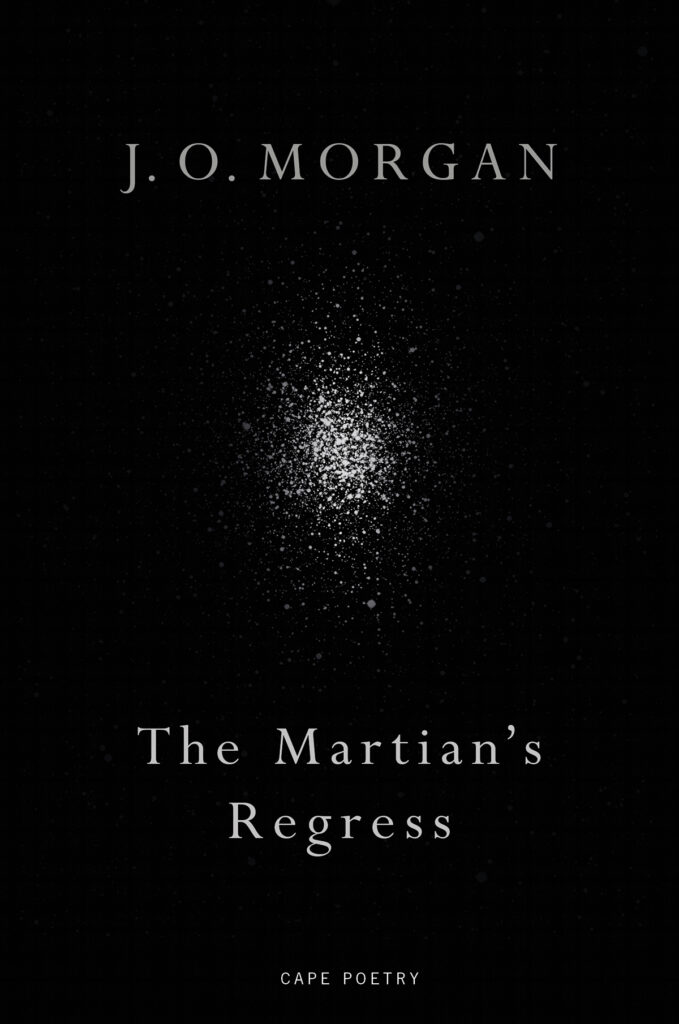
J. O. Morgan’s The Martian’s Regress (Cape Poetry) is shortlisted for the T. S. Eliot Prize 2020. John Field blogs at Poor Rude Lines.
Be among the first to receive updates on the latest T. S. Eliot Prize news by subscribing now!