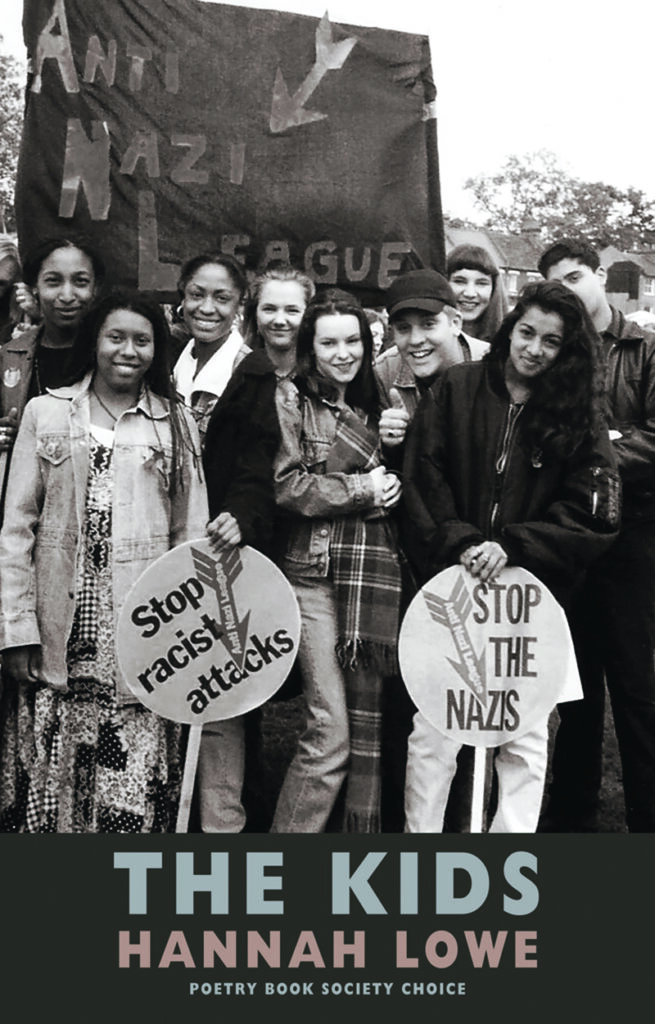
Tony Harrison once said that he ‘write[s] sonnets fairly continuously – like someone tapping a barometer’. Hannah Lowe once taught English Literature in a London Sixth Form and The Kids, written entirely in sonnet form, is her barometer, one she taps regularly through the school year, charting the kids’ highs and lows, writes John Field
Be among the first to receive updates on the latest T. S. Eliot Prize news by subscribing now!
Hannah Lowe’s The Kids, written entirely in sonnet form, asks awkward questions about institutionalised education, but retains an unshakable faith in the kids and the joy they derive from learning and from their world, writes John Field
Tony Harrison once said that he ‘write[s] sonnets fairly continuously – like someone tapping a barometer’. Hannah Lowe once taught English Literature in a London Sixth Form and The Kids is her barometer, one she taps regularly through the school year, charting the kids’ highs and lows. The final sequence, addressed to her son, rounds her collection off with intimate warmth.
Lowe’s epigraph is taken from William Blake’s ‘Nurse’s Song’, one of his Songs of Innocence, where the children beg their nurse to ‘let us play, for it is yet day’. Lowe’s ‘The Sky is Snowing’ is a Song of Innocence for the twenty-first century. The speaker’s voice is didactic, standing with her son at the window: ‘The sky is snowing, Rory’. The son is dressed in ‘burglar stripes’ but, while we usually think of the burglar breaking-in, this crime is one of breaking-out: ‘Let’s lift the window open, just a slip, / and catch this snowstorm on your fingertip’. Yes, Lowe has taught in school, but the collection asks us to consider the negative as well as the positive effects of institutional education. Sometimes education comes from parents and the world outdoors. There are no easy answers here though, as ‘Players’ presents a less wholesome side to the parent as teacher: ‘My parents taught me smoking’.
For teachers, it’s the first of September that heralds the new year but, for some students in Year Eleven, GCSE resits rain on the parade. Lowe’s first sonnet takes the register – of course! – but then it’s down to business with ‘Try, Try, Try Again’. According to legend, Robert Bruce, King of Scotland, was on the run, hiding in a cave, when he coined this phrase while watching a spider struggling to weave a web. Inspired by the spider’s stoic example, he routed the English at Bannockburn. Lowe’s poem translates Bruce’s predicament to GCSE results day, dazzling us in the spotlight of the second person to ensure that we feel suitably paralysed. The octave asks, ‘Why would anyone want to do again / the thing they’d failed?’ It unpicks the easy ‘Try, Try’ platitudes fed to the young at school assemblies and, opening the dreaded statement of results, we’re in the subjunctive, dreaming of escape as ‘you’d rather pull the sheets / above your head and flick through Instagram / with earphones in’. At least Bruce’s cave offered some respite. Through the music, ‘you can hear mum / repeat: You’ll never get a job without it!’ Lowe’s sonnet ends with a dash, a cinematic cut, mum’s diatribe in full flow and no solutions in sight. Bruce’s derring-do will surely fuel school assemblies in perpetuity, but Lowe’s sonnet, in contrast, is painfully humane.
‘The Sixth-form Theatre Trip’ offers a change of tone and reimagines a group of students finding their seats at the theatre as a pack of dogs. Perhaps we prejudge them as unruly and noisy. Lowe plays with these preconceptions, as we see ‘One badass dog in headphones mooching / up the aisle’ but, as the curtain rises, we’re at the volta, and ‘their shining dog-hearts fling wide open’. Later in the collection, in ‘Balloons’, five-year-olds are reimagined as helium balloons, ‘their small hands shooting high to give an answer, / any answer, just the chance to try’. We’re reminded of the sixth form theatre trip and feel a sense of optimism: the puppyish enthusiasm of kids is a universal constant, regardless of their age. However, we’ve encountered that word ‘try’ earlier in the collection, and we’re reminded that some of those hands will stop shooting up. Others will no longer even be in the classroom.
The Kids asks awkward questions about institutionalised education, but retains an unshakable faith in the kids and the joy they derive from learning and from their world and, because of this, it imagines a bright future.
Hannah Lowe’s The Kids (Bloodaxe Books) is shortlisted for the T. S. Eliot Prize 2021. John Field blogs at Poor Rude Lines.
Be among the first to receive updates on the latest T. S. Eliot Prize news by subscribing now!