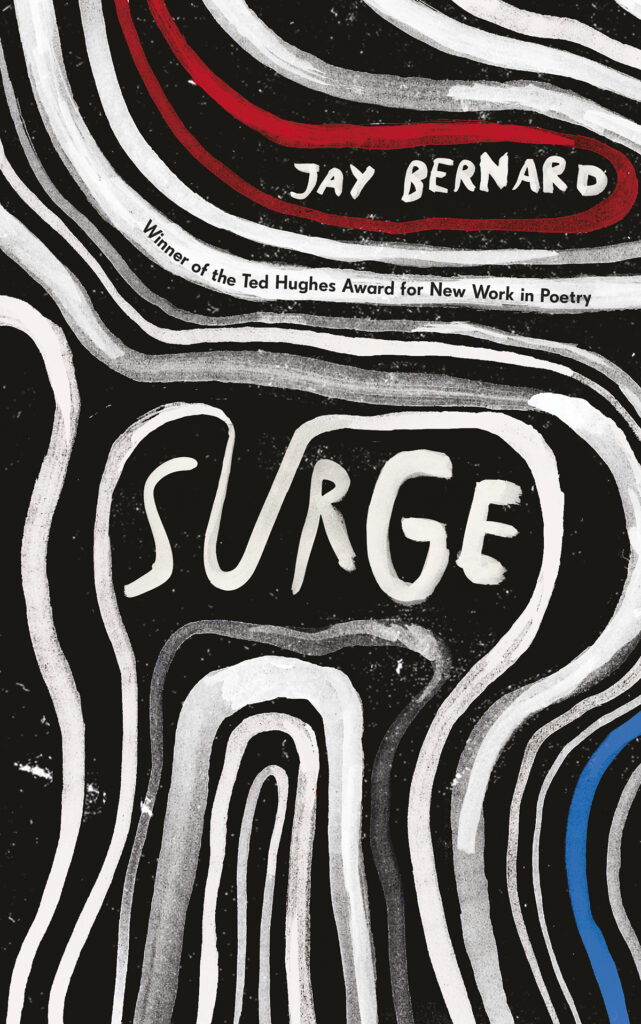

Surge

Chatto & Windus
Bernard_Jay_web
Jay Bernard is a writer and artist whose works include Surge, The Red and Yellow Nothing (Ink Sweat & Tears Press, 2016) and English Breakfast (Math Paper Press, 2013). A former film programmer at BFI Flare and an archivist at Statewatch, they participated in The Complete Works II project in 2014. Jay was a Foyle Young Poet of the Year in...

Review

Review

Jay Bernard's Surge meditates on the New Cross house fire which killed 13 young black people in 1981. It’s an enraged, erudite collection in which voices are given the space they need to resonate, that Bernard focuses into a deafening cry, writes John Field

Read the
Reader's Notes

Videos

Jay Bernard reads from Surge at the T. S. Eliot Prize Shortlist Readings
Jay Bernard talks about their work
Jay Bernard reads ‘Apple’
Jay Bernard reads ‘Clearing’
Jay Bernard reads ‘Hiss’

Related News Stories

Roger Robinson has won the T. S. Eliot Prize 2019 with his searing collection A Portable Paradise, published by Peepal Tree Press. After months of reading and deliberation, judges John Burnside, Sarah Howe and Nick Makoha unanimously chose the winner from a Shortlist which comprised five men, four women and...
This year sees the 27th T. S. Eliot Prize being awarded, and the roster of past winners includes some very well-known poets alongside some lesser known authors that demand further attention. To refresh the memory of prizes past, the T. S. Eliot Prize website contains a trove of information on...
Judges John Burnside (Chair), Sarah Howe and Nick Makoha have chosen the T. S. Eliot Prize 2019 Shortlist from 158 poetry collections submitted by British and Irish publishers. Featuring new voices and veteran poets, and covering an extraordinary range of themes, the Shortlist comprises five men, four women and one...
Review of Surge

Jay Bernard’s Surge meditates on the New Cross house fire which killed 13 young black people in 1981. It’s an enraged, erudite collection in which voices are given the space they need to resonate, that Bernard focuses into a deafening cry, writes John Field

Jay Bernard’s Surge meditates on the New Cross house fire which killed 13 young black people in 1981. It’s an enraged, elegiac, erudite collection which views London through a wide-angle lens, considering the murder of Naomi Hersi, a trans woman of colour, and the Grenfell fire as it reflects relationships between citizen and state. Despite Bernard’s presentation of London’s mean streets, they challenge the reader to step forward and to witness to the truth.

The collection opens with ‘Arrival’, where the speaker commands the reader to ‘remember we were brought here from the clear waters of our dreams.’ The first person plural is an inclusive, welcoming opening but, in the passive voice, it suggests an enslaved people as it echoes Psalm 137’s ‘By the rivers of Babylon we sat and wept when we remembered Zion.’ The poem establishes the relationship between Britain and its slaves who were ‘named, numbered and forgotten’. This, together with the ‘smoky mouths’ of the oppressed and the unsettling, unresolved ‘snap, crackle’ at the end of the poem recollects another burnt offering – another holocaust.

The prose poem ‘+’ feels like testimony: a father is rendered inarticulate by worry and broken by dashes and nervous ticks of repetition. He is treated without dignity by a police officer who said ‘oh, it’s very common for culprits to go missing – I said my son isn’t a culprit, and how dare he imply it – and one of the officers stood up by the window and looked out – he didn’t want to look us full in the eye – he made it clear, he made it clear’. The offhand ‘oh’ betrays indifference and the speaker’s repetition signals his impotent rage. Over the page, in ‘–‘, Bernard ventriloquises the dead son. Black skin and carbonised flesh are treated in the same way: ‘they were looking at me strangely, dad – like he couldn’t stand to look at me – couldn’t stand the sight of me – Police always looked at me like that’.

This collection flexes with political purpose. ‘Songbook’ doffs its cap to Linton Kwesi Johnson, whose poems, like ‘Sonny’s Letter’, seethe with anger and indignation against racist police brutality in the early 1980s. Bernard’s decision to include images of protest – signs, posters and vigils – anchor these poems to the real world.

The second half of the collection explores contemporary London, and ‘Pem-People’ (Peckham people) considers the murder of Naomi Hersi. The vigil at a pop-up shop invites the reader to make the link with the image of the New Cross vigil, suggesting that little has changed in London. However, the poem concludes by switching its focus: ‘I want to eat the bean stew alone // and watch Venus throw her serve across YouTube’. Venus Williams symbolises a changing world – a world in which black talent takes its rightful place on the podium.

Therefore, it is telling that when the collection revisits house fires in ‘Blank’, Bernard works with lines from the Manchester Weekly News campaign to save Robert Chilowa, who rescued children from a burning building, from deportation. Bernard contrasts his bravery with the evasive mandarin of government. Chilowa’s actions are instinctive and human: ‘He raced towards the ferocious blaze’ and ‘He ran to the house in his bare feet’, whereas official communications are pre-mediated and neutered as: ‘those involved have defended their actions and been given // been given / acquitted / retired with full pay / charged / acquitted’.

Surge is a work of phenomenal artistic and political power. People’s voices are given the space they need to resonate, but Bernard focuses them into a deafening cry.

Jay Bernard’s Surge (Chatto Poetry) is shortlisted for the T. S. Eliot Prize 2019. John Field blogs at Poor Rude Lines.

Surge
Chatto & Windus

Newsletter

Be among the first to receive updates on the latest T. S. Eliot Prize news by subscribing now!


The T. S. Eliot Prize on Social Media

Part of tseliot.com

Designed by thinking

Interview of Surge

Surge
Chatto & Windus

Newsletter

Be among the first to receive updates on the latest T. S. Eliot Prize news by subscribing now!


The T. S. Eliot Prize on Social Media

Part of tseliot.com

Designed by thinking