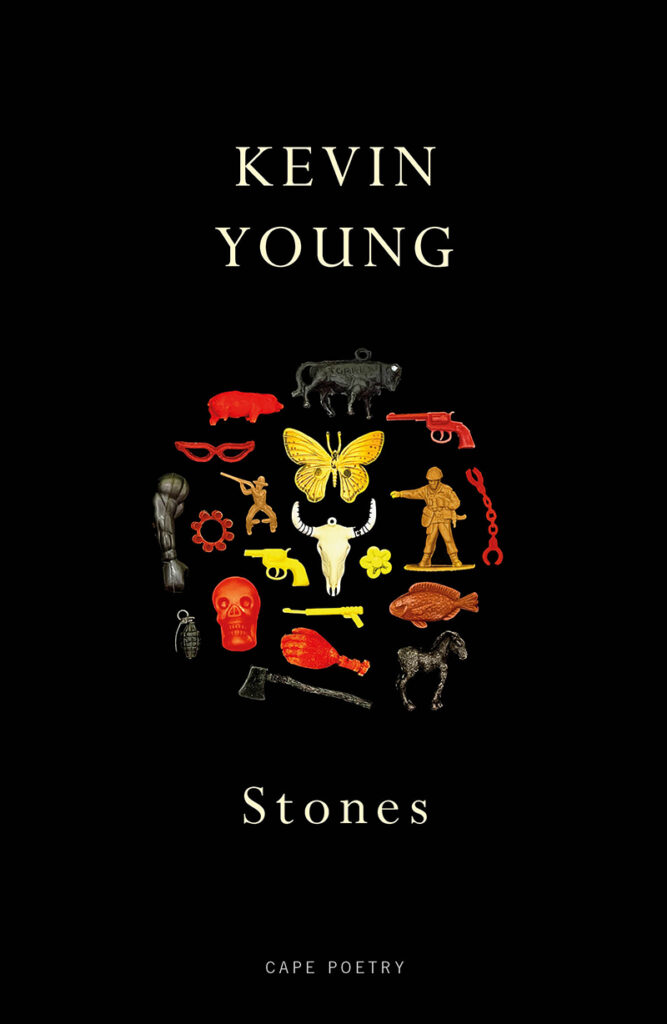

Stones

Cape Poetry
Kevin-Young-2021_C-Melanie-Dunea_bw
Kevin Young was born in Lincoln, Nebraska and now lives in New York. He is the author of fifteen books of poetry and prose, including Brown; Blue Laws: Selected & Uncollected Poems 1995-2015; Book of Hours, winner of the Lenore Marshall Prize from the Academy of American Poets; Jelly Roll: a blues, a finalist for both the National Book Award...

Review

Review

Kevin Young’s Stones is a hymn to the dearly departed. Resisting that timeless human urge to aggrandise the dead, his humble memorial creates something far more affecting, writes John Field

Read the
Reader's Notes

Videos

Kevin Young reads from Stones at the T. S. Eliot Prize Shortlist Readings
Kevin Young talks about his work
Kevin Young reads ‘Lillies’
Kevin Young reads ‘Egrets’
Kevin Young reads ‘Russet’
Kevin Young reads ‘Sandy Road’

Related News Stories

The T. S. Eliot Foundation is delighted to announce that the winner of the T. S. Eliot Prize 2021 is Joelle Taylor for C+nto & Othered Poems, published by The Westbourne Press. Chair Glyn Maxwell said: Every book on the Shortlist had a strong claim on the award. We found...
  Judges Glyn Maxwell (Chair), Caroline Bird and Zaffar Kunial have chosen the T. S. Eliot Prize 2021 Shortlist from a record 177 poetry collections submitted by British and Irish publishers. The Shortlist consists of an eclectic mixture of established poets, none of whom has previously won the Prize, and...
The T. S. Eliot Foundation is delighted to announce the judges for the 2021 Prize. The panel will be chaired by Glyn Maxwell, alongside Caroline Bird and Zaffar Kunial. The 2021 judging panel will be looking for the best new poetry collection written in English and published in 2021. The...
Review of Stones

Kevin Young’s Stones is a hymn to the dearly departed. Resisting that timeless human urge to aggrandise the dead, his humble memorial creates something far more affecting, writes John Field

Kevin Young is the poetry editor for the New Yorker and, in Stones, he explores love and and loss with a tenderness and humour that lends this collection warmth and humanity.

He opens with ‘Resume’ where the speaker is already in the past, and describes a bygone world, ‘Where the train once rained / through town / like a river’. The homophone ‘rained’ also gives us ‘reigned’ and adds to the sense of deposition: nothing lasts forever and humanity’s mightiest works lie half sunk in the soil. A verdant world is exchanged for an arid one in which ‘women speak / in burnt tongues’. Burials figure large in Stones but here, ‘someone’s daddy sinks a latrine shaft, not a grave. It’s ‘so deep / up from the dark // dank bottom springs a tree’, a reminder of the possibility of new life, even from the darkest, dirtiest places.

The world Young presents is a cruel one. The speaker in ‘Dog Tags’ presents time passing at a furious lick, as the poem opens with ‘Of us there is / always less. / The days hammer // past’. Throughout the collection, Young works with tiny lines: ‘Of us | there is’ is a line of iambic dimeter but, with ‘al-ways less’, Young subtracts a syllable from that. Line breaks create their own tensions and dramas: that neat first line appears to present a positive statement, ending as it does with ‘is’ – an assertion of being. Yes, life is fleeting, but our stone monuments to posterity sell us the idea of some kind of lasting presence. ‘Dog Tags’ chips away at this idea, as the speaker wears his father’s ‘dog tags a tin / pendulum on my chest’ and his insolvent cousin has been buried by gambling debts. She left ‘dirt a pile above her / but no stone, nothing // but the tinfoil name / from the funeral home – / the fresh plastic // flowers that still wilt / in this heat’. The present continuous ‘still wilt’ condemns the deceased to an unbiodegradable tribute of tawdry horror.  A few poems later and ’Boneyard’ also invites the reader to consider the ‘fake // flowers [that] will outlive / even doubt’. Young suggests that our memorialising instinct is futile, as even our seemingly permanent tributes will weather like Ozymandias’s great statue. In ‘Chisel’, the speaker comments that ‘Our words hope to mend / what wind / wants instead – // carved by hand, this stone / soft enough to chisel’ will not endure.

The collection’s domestic warmth lends it a tender, painful humanity. ‘Joy’ recalls the names of various bath-time unguents and opens ‘Once we bathed  / in Joy […] Sometimes accidentally // our own pee’. The brand name, ‘Joy’, becomes an abstract noun and a verb too, loading this universal memory with overwhelming emotion. Young refuses to take himself too seriously, and the bath(os) of childish pee is an essential addition to this cleansing ritual. As adults, we fear dirt. Perhaps we’re all too conscious that we are dust, and to dust we shall return but, back when we were children, ‘dirt / & each other / was all we loved’.

There’s a numinous quality to the natural world Young presents. One of the final poems in the collection, ’Evensong’, puns on the sequence of psalms and prayers typically recited in the evening. Young invites the reader to hear ‘The evensong // of frogs like monks / in the dusk / making the cedars // their abbey’ in a revelation of music, light and beauty.

The collection closes with the spectacular Last Post of ‘Trumpet’. In the Christian tradition, the trumpet is the instrument associated with Armageddon and the bodily resurrection of the dead. The poem acts as a riposte to the tawdry rituals of death. In a poem full of longing, the speaker asks ‘Let forever the flowers bloom – not like the plastic perennials / but these daylilies that repeat // out of the peat’. The reader is pointed back to the plastic bouquets of ‘Dog Tags’ and ‘Boneyard’ but this time we connect to the ground with an earthy honesty.

Kevin Young’s Stones is a hymn to the dearly departed. He resists that timeless human urge to aggrandise the dead with magnificent edifices, but his humble memorial creates something far more affecting.

Kevin Young’s Stones (Cape Poetry) is shortlisted for the T. S. Eliot Prize 2021. John Field blogs at Poor Rude Lines.

Stones
Cape Poetry

Newsletter

Be among the first to receive updates on the latest T. S. Eliot Prize news by subscribing now!


The T. S. Eliot Prize on Social Media

Part of tseliot.com

Designed by thinking

Interview of Stones

Stones
Cape Poetry

Newsletter

Be among the first to receive updates on the latest T. S. Eliot Prize news by subscribing now!


The T. S. Eliot Prize on Social Media

Part of tseliot.com

Designed by thinking