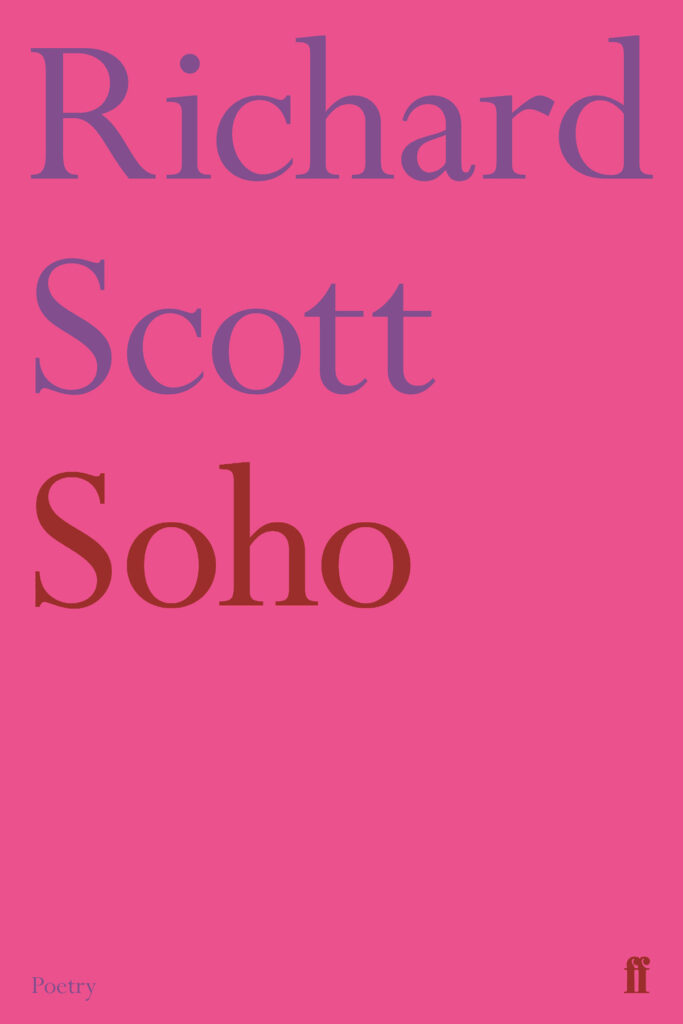

Soho

Faber & Faber
Scott_Richard_bw
Richard Scott was born in Wimbledon in 1981 and grew up in London. He studied to be an opera singer at the Royal College of Music and later at Goldsmiths College. He has been a winner of the Wasafiri New Writing Prize, a Jerwood/Arvon Poetry mentee, a member of the Aldeburgh 8 and an Open Spaces artist resident at Snape...

Review

Review

Soho, Richard Scott's extraordinary debut collection, is underpinned by a close engagement with decadent and queer culture, lending his poems a lyricism which serves as a counterpoint to their passion and pain, writes John Field

Read the
Reader's Notes

Videos

Richard Scott reads from Soho at the T. S. Eliot Prize Shortlist Readings
Richard Scott talks about his work
Richard Scott reads ‘crocodile’
Richard Scott reads ‘Oh My Soho!’
Richard Scott reads ‘love version of’

Related News Stories

The T. S. Eliot Foundation is delighted to announce that the winner of the T. S. Eliot Prize 2018 is Hannah Sullivan for her thrilling collection Three Poems, published by Faber & Faber. After months of reading and deliberation, judges Sinéad Morrissey, Daljit Nagra and Clare Pollard unanimously chose the...
Fresh from reading a record 176 submissions, T. S. Eliot Prize 2018 judge Clare Pollard celebrates the boom in poetry By most measures, this is a good year for poetry. As life moves increasingly online, poetry suits the internet – it fits in a tweet, a blogpost, an Instagram snap,...
Judges Sinéad Morrissey (Chair), Daljit Nagra and Clare Pollard have chosen the T. S. Eliot Prize 2018 Shortlist from a record 176 poetry collections submitted by, as Sinéad Morrissey says, ‘a plethora of poetry publishers’. The Shortlist comprises five debut collections, one small press, five men, five women, and two...
Review of Soho

Soho, Richard Scott’s extraordinary debut collection, is underpinned by a close engagement with decadent and queer culture, lending his poems a lyricism which serves as a counterpoint to their passion and pain, writes John Field

Richard Scott’s debut collection, Soho, measures personal experiences of gay sexuality and shame against a broader sweep of history and culture. The result is extraordinary. His poems land like punches and bloom like bruises, yet the collection is underpinned by a close engagement with decadent and queer culture, lending his poems a lyricism which serves as a counterpoint to their passion and pain.

Opening with ‘Public Library, 1998’, Scott evokes Orton’s and Halliwell’s antics defacing library books. Scott’s speaker is marginalised: ‘In the library where there is not one gay poem, / not even Cavafy eyeing his grappa-sozzled lads – I / open again the Golden Treasury of Verse and write // in the margin’. The word ‘COCK’ is written in the margin. It’s an incredible poem. The marginalia of Medieval manuscripts are a riot of misrule: Christian morality takes centre stage but, at the edges of The Macclesfield Psalter you’ll see an ape peering up a man’s asshole while another pulls his robes to his waist to spread his cheeks. The poem revels in innuendo as ‘I underline those that nature, // not the printer, had pricked out; rimming each delicate / stanza in cerulean, illuminating the readers-to-come…’ like an irreligious monk in a queer scriptorium.

The poems which follow pluck gay experience from the margins of life and place it in the centre of the page. The collection’s first part, ‘admission’, plays with ideas of initiation and guilt. Initially, there’s a tender beauty to the natural imagery of ‘le jardin secret’: ‘boys were my saplings / my whiff of green my sprouts’. His unpunctuated list and short lines are breathless and unrestrained but darken in tone as ‘boys were my / pitchers my fly-traps my / venus a petalled mouth wet / throat around a grave’. It’s a heady, fin du siècle image and evokes the violence coded in Mapplethorpe’s calla lilies. Similarly, ‘crocodile’, winner of the 2017 Poetry London Competition, is a visceral, breathless extended metaphor of abuse as Scott’s speaker was ‘held from behind / when I didn’t know sex’ and he ‘gripped my mouth like a muzzle / and unsheathed his anger / stubble grazing my neck’.

The second part, ‘Verlaine in Soho’, reworks the poetry of Paul Verlaine in enigmatic unrhymed quatrains. In ‘blue-screen’ things are not as they appear, and the brash primary colours of a Grindr profile do not necessarily mean happiness. ‘your grindr profile is an emoticon paradise / where camels and kittens go / dancing and flashing but I can tell they are :-( / beneath their primary colours’. Gay culture has ascribed its own meanings to emoticons: according to the Evening Standard, the camel represents humping. (You can guess what the aubergine means…) Codes lie beneath codes, lie beneath codes. Below the Grindr app, we reach its ‘programming and code’ ‘CC++’. Yes, C++ is a programming language but ‘CC’ also suggests sissy. Grindr becomes a kaleidoscope, abstracting the self until all grip on reality is lost.

The collection concludes with ‘Oh My Soho!’, a paean to the queer folk of London’s finest ‘Urine-lashed maze of cobble’ and takes a historical look at the oppression of gay culture, from Roman times to the present-day threat of the geneticist. Scott’s language remains resolutely playful and perverse, as the speaker submits his flesh to the ‘grindstone – my only weapon against normativity!’

Sex remains a weapon to the end but rather than being its victim, the speaker has learned to use it for the defence of the ‘homo-land’. Soho is a thrilling exploration of language and identity, delivered with terrific emotional force.

Richard Scott’s Soho (Faber & Faber) is shortlisted for the T. S. Eliot Prize 2018. John Field blogs at Poor Rude Lines.

Soho
Faber & Faber

Newsletter

Be among the first to receive updates on the latest T. S. Eliot Prize news by subscribing now!


The T. S. Eliot Prize on Social Media

Part of tseliot.com

Designed by thinking

Interview of Soho

Soho
Faber & Faber

Newsletter

Be among the first to receive updates on the latest T. S. Eliot Prize news by subscribing now!


The T. S. Eliot Prize on Social Media

Part of tseliot.com

Designed by thinking