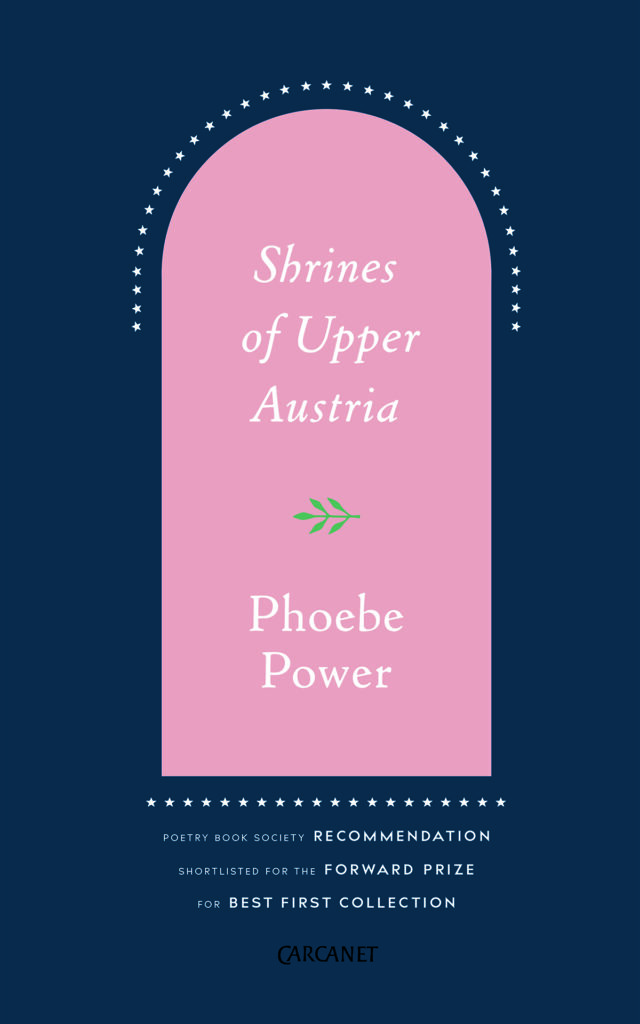

Shrines of Upper Austria

Carcanet Press
Power_Phoebe_bw
Phoebe Power was a winner of the Foyle Young Poets in 2009, received an Eric Gregory Award in 2012 and a Northern Writers’ Award in 2014. Her debut collection, Shrines of Upper Austria (Carcanet Press, 2018), was a Poetry Book Society Recommendation, shortlisted for the T. S. Eliot Prize and was awarded the 2018 Forward Prize for Best First Collection....

Review

Review

Full of voices and European colour, Phoebe Powers's Shrines of Upper Austria builds a compelling, troubling picture of a changing world, writes John Field

Read the
Reader's Notes

Videos

Phoebe Power reads from Shrines of Upper Austria at the T. S. Eliot Prize Shortlist Readings
Phoebe Power reads ‘children’
Phoebe Power reads ‘Eisblumen’
Phoebe Power reads ‘Name’
Phoebe Powers talks about her work

Related News Stories

The T. S. Eliot Foundation is delighted to announce that the winner of the T. S. Eliot Prize 2018 is Hannah Sullivan for her thrilling collection Three Poems, published by Faber & Faber. After months of reading and deliberation, judges Sinéad Morrissey, Daljit Nagra and Clare Pollard unanimously chose the...
Fresh from reading a record 176 submissions, T. S. Eliot Prize 2018 judge Clare Pollard celebrates the boom in poetry By most measures, this is a good year for poetry. As life moves increasingly online, poetry suits the internet – it fits in a tweet, a blogpost, an Instagram snap,...
Judges Sinéad Morrissey (Chair), Daljit Nagra and Clare Pollard have chosen the T. S. Eliot Prize 2018 Shortlist from a record 176 poetry collections submitted by, as Sinéad Morrissey says, ‘a plethora of poetry publishers’. The Shortlist comprises five debut collections, one small press, five men, five women, and two...
Review of Shrines of Upper Austria

John Field reviews the shortlist: Phoebe Power Shrines of Upper Austria

The Austrian Expressionist painter, Egon Schiele, is referenced early in Phoebe Power’s collection Shrines of Upper Austria, in the ekphrastic poem, ‘children’, which responds to Schiele’s 1918 painting ‘Stadtende’. A colourful town locks the viewer’s eye in the centre of the canvas but, on the margins to the left and the right, in the darker paint, children jump from open windows and run through the trees. Power’s poems question the permanence of human society and, like Schiele, acknowledge the troubling voices we hear at the margins. Power evokes a sense of place with a vibrant, spare palette and her collection’s voices reflect and refract its theme of change.

An early sequence, ‘Austrian Murder Case’, opens in a sleepy paradise like an Agatha Christie novel. The cake shop reassures us that our daily rituals tick with their reassuring regularity, ‘Close, warm, and humming with the relaxed sounds of post-midday Kaffee-Kuchen’ [coffee and cake]. Kaffee-Kuchen symbolises the bounty and dependability of the Austrian way of life. However, in ‘See (1)’ [where ‘see’ means lake], we’re reminded that this stability is an illusion. Florian, walking his dog, ‘preferred this less trodden, further side because it meant he has a good view of the town, busy and self-important on that nearer side’ and, with this change of perspective, the importance of human existence diminishes. Like Schiele’s ‘Stadtende’, we’re reminded of lawlessness that threatens to erupt in the shadows and, in ‘Hands and Feet’, a suitcase is removed from the lake with its load of ‘feet and hands’. Power’s lake is an all-seeing eye, a godlike presence. As the body parts are dumped, she closes ‘her soft, wide black eyelid’ and, in ‘See (2)’, the authorities attempt to piece the crime together ‘in their human way’, strangely diminished and displaced.

However, those dismembered cadavers, sliding into the silent waters of the lake create ripples. It is possible to read the detective novel as symbolic of a greater trauma, and not as an isolated murder. The corpse on the Edwardian croquet lawn is the violence of the Great War, dumped on the doorstep. The collection’s final section explores people’s responses to climate change. Prose fragment builds upon fragment, with a weight of experience: ‘This winter was wetter, Christmas was wrong. At the February carnival, one float was painted with unsaid words like the silent victim of a strangling – Wann wird es wieder richtiges Winter?’ [When will winter be right again?] The order of the poems accentuates this change, as the poem is followed by ‘silver white winters that melt into springs’. Statements are used to convey our former sense of certainty as ‘The winter was a thick covering of snow between late november and early march’.

‘Milk’ unpicks the predicament of the modern consumer, shopping in an ethical minefield. ‘Jessica has heard of the need to cut out dairy. Cows produce all that methane, that contributes to global warming’. The vague quality of ‘has heard’ articulates the lack of overall plan and policy and Jessica, keen to play her part, sources an alternative: a Tetra-Pak of rice milk and Power’s rhetorical questions articulate the dilemma of the modern consumer: ‘Surely here nothing can be wrong? The milk is sweet and thin; she images the delicate grains like splinters of shell poised on her tongue. But the paddies too take so much water to maintain. And all these cartons can’t be good either, with their chewy layers of cardboard, foil and plastic covering, tough to recycle’.

Full of voices and European colour, Shrines of Upper Austria is indirect, building a compelling, troubling picture of a changing world.

Phoebe Powers’s Shrines of Upper Austria (Carcanet Press) is shortlisted for the T. S. Eliot Prize 2018. John Field blogs at Poor Rude Lines.

Shrines of Upper Austria
Carcanet Press

Newsletter

Be among the first to receive updates on the latest T. S. Eliot Prize news by subscribing now!


The T. S. Eliot Prize on Social Media

Part of tseliot.com

Designed by thinking

Interview of Shrines of Upper Austria

Shrines of Upper Austria
Carcanet Press

Newsletter

Be among the first to receive updates on the latest T. S. Eliot Prize news by subscribing now!


The T. S. Eliot Prize on Social Media

Part of tseliot.com

Designed by thinking