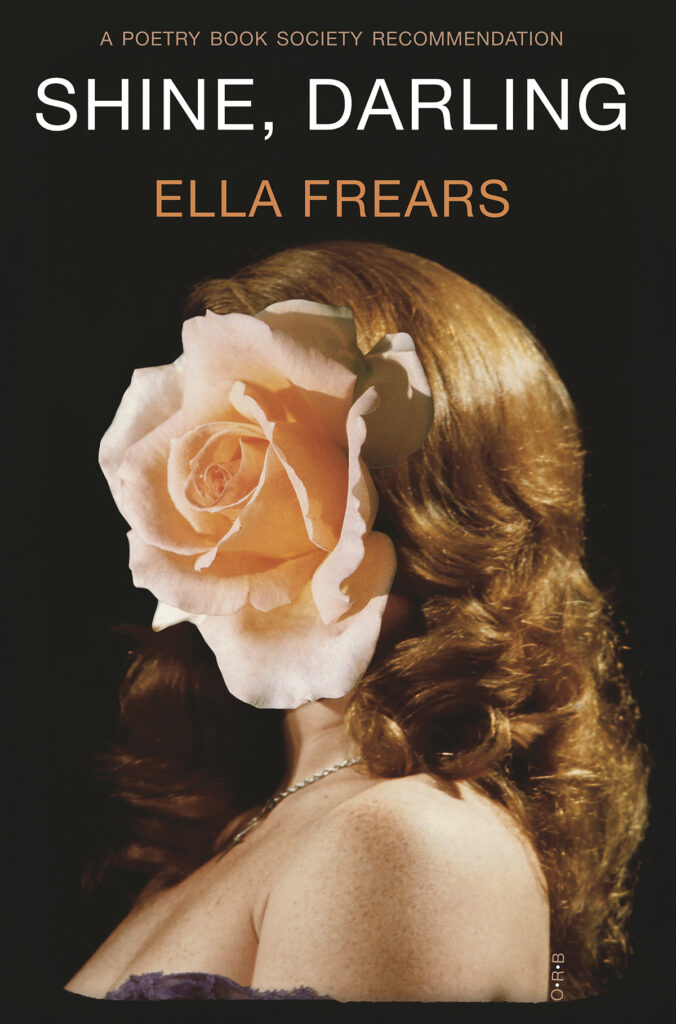

Shine, Darling, Ella Frears’s exceptional debut, contemplates the female body, the painter’s gaze, Roland Barthes’ death of the author and much else, all with a revitalising clarity and silky wit, writes John Field
Be among the first to receive updates on the latest T. S. Eliot Prize news by subscribing now!
Shine, Darling, Ella Frears’s exceptional debut, contemplates the female body, the painter’s gaze, Roland Barthes’ death of the author and much else, all with a revitalising clarity and silky wit, writes John Field
In ‘Sacred Emily’ (1913), Gertrude Stein describes a person named Rose: ‘Rose is a rose is a rose is a rose’ and, in Four in America (1947), she writes: ’I think that in that line the rose is red for the first time in English poetry for a hundred years’. Sometimes, one feels that a fatty deposit of figurative language and idiom clogs our arteries. Conversation is tired and formulaic. The world’s great riches have slipped anchor – words have lost the strength to hold them in place.
Shine, Darling, Ella Frears’s debut collection, throbs with blood and radiates a visceral heat as she explores the female body – and the world around us – with clarity and honesty. The collection concludes with Passivity, Electricity, Acclivity, a sequence about the St Ives Modernists and the painter’s gaze. Looking and reading converge and Frears’s poems perform the miracle of shackling words to the world once more and, through their lens, we see the crispest of images.
In ‘I Knew Which Direction’, Frears’s opening poem, we encounter the moon, that womanly symbol of changeability and monthly cycles. Perhaps we feel that we know the script and that it’s hardly worth reading another poem on this well-worn subject. However, like Stein, Frears reinvests language with meaning: ‘Pray now, whispered the sand and I fell to my knees thinking: / moonlight, moonlight, moonlight ———— / until it was no longer a word but a colour and then a feeling / and then the thing itself’. Frears’ spiritual imagery revitalises language as incantatory. Words are magical once more. In ‘The Overwhelming Urge’, ‘The ground is dirty with dirt. The air, dirty / with smoke’.
The collection is rich and funny too. The brilliant ‘The (Little) Death of the Author’ plays with Roland Barthes’ theory of the death of the author (reader, not writer, creates meaning). The speaker’s chatty tone belies the poem’s conceptual weight as we ponder ‘How many times, aged thirteen or so, did you send a text / saying I’m in the bath…’ and, in the reader’s mind – your mind here too – the ‘body’s hot-water blush / suddenly the only thing they could focus on’. Frears concludes with a coup de théâtre as she breaks the fourth wall with the ‘text I continue to send: Reader, I’m in the bath… / Nothing more to say than that. And if you like / you can join me. I’m blushing. Are you?’ We spin deeper into her whorl of petals, into something new, echoing Italo Calvino’s postmodernity but nodding to John Donne’s ‘To His Mistress Going to Bed’ too.
In Passivity, Electricity, Acclivity, Frears responds to the work of artists whose work is on display at Tate St Ives: Barbara Hepworth, Patrick Heron and Alfred Wallis. The touching ‘Alfred / Wallace’ revisits the ideas explored in ‘The (Little) Death of the Author’. The omniscient narrator of ‘(1942)’ inhabits the flesh and blood man, Alfred, who dreams of the sea and when he ‘wakes, fear / lights up his mind like a flare’. The poem’s counterpart, ‘(2018)’, assumes the persona of a visitor to Tate St Ives who sees Wallis’ ‘lighthouses as jaunty as sailors’. Has the viewer / reader got it wrong? Does it matter?
Shine, Darling is an exceptional collection. Frears has an arresting ability to see the world. (Here she describes the loos at a service station in ‘Midpoint’: ‘The soap dispensers dribble / silky puddles / on the faux-marble counter’). Ideas and images segue and develop satisfyingly from poem to poem but, above all, she demands that her reader makes the world new. With her, we see the world feelingly.
Ella Frears’s Shine, Darling (Offord Road Books) is shortlisted for the T. S. Eliot Prize 2020. John Field blogs at Poor Rude Lines.
Be among the first to receive updates on the latest T. S. Eliot Prize news by subscribing now!