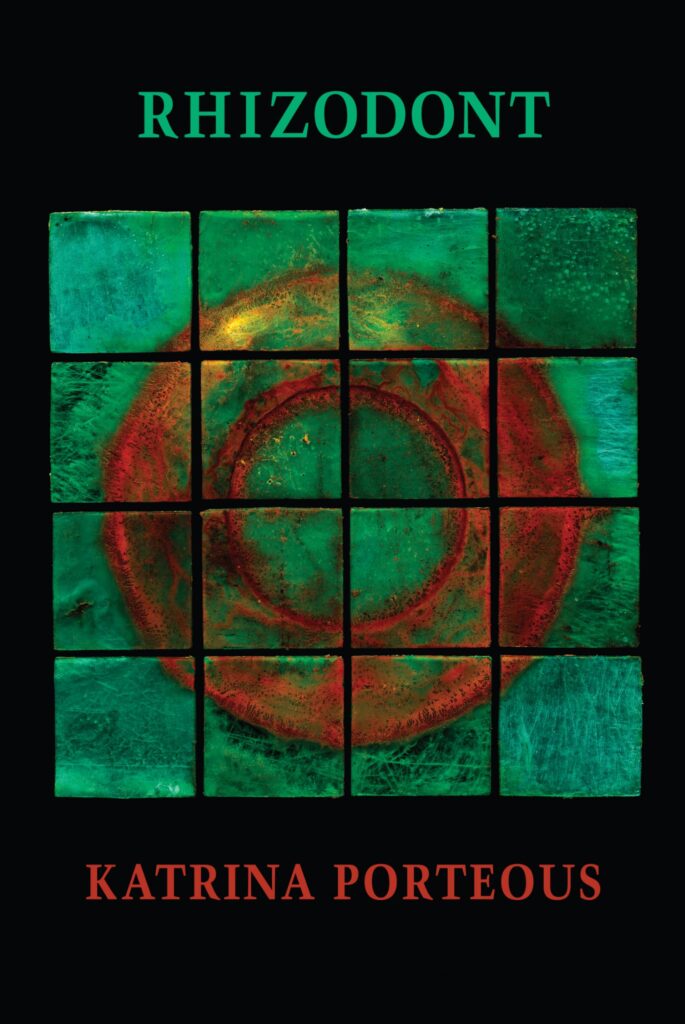
John Field finds Katrina Porteous’s Rhizodont to be ‘a thrilling meeting of ideas and language’, blurring ‘the boundary between man and machine, between planet and technology.’
Be among the first to receive updates on the latest T. S. Eliot Prize news by subscribing now!
John Field finds Katrina Porteous’s Rhizodont to be ‘a thrilling meeting of ideas and language’, blurring ‘the boundary between man and machine, between planet and technology.’
Rhizodont, Porteous’s fourth collection, is a hymn to the Earth, a love letter to the North East. The dialect of Northumberland washes it in a tide of language and, across these shifting sands of words, we step out of time and survey the planet from a geological perspective. The rhizodont of the title, a fossil fish which became extinct 310 million years ago, recalibrates our sense of time and reminds us that the Earth’s cycles of erosion, extinction and creation transcend us. The result is a thrilling meeting of ideas and language as Porteous blurs the boundary between man and machine, between planet and technology.
Porteous opens (and intersperses the collection) with ‘Susurrations of the Sea’, a sequence written for BBC Radio 4. In the second of these poems, ‘Ingredients’, we’re addressed in the second person, the speaker reaching out to us, showing us our primal urge to mark the environment, ‘When you crunch your footprint / Into sand, or splash / Among the chill pools’. In the Paleolithic period humanity’s impact on the environment was of a low order, but Porteous shows this impact changing as the collection unfolds. For example, in ‘Coastal Erosion’, a sobering nod to Philip Larkin’s ‘An Arundel Tomb’, we read ‘That what will survive of us is not love but chip forks, / Booty that Liam and Reece grab on their Pirate Litter-Pick – // Bottle tops, take-away cartons, lids, straws, nappy-liners’… the list of our detritus goes on… and on. However, it is not a scene without hope, as Liam and Reece’s good offices demonstrate.
Back in ‘Ingredients’ and Porteous imagines the Earth’s historical and future iterations as connected in space and time: ‘Every wave contains an imprint, / An echo of the last, / Of the next, a foretaste’. Porteous’s vision is not as bleak as the one we’re shown in Matthew Arnold’s ‘On Dover Beach’, the sea a melancholy long withdrawing roar. Instead, it thrums with life: ‘Can you hear its pulse / In the deep roar, its ceaseless / Boom and bass?’ There’s an energy and life in this music of time that Arnold does not account for – and then there’s the title, ‘Ingredients’ – it’s constructive, not destructive.
People and planet converge. In ‘A Short Walk from the Sea’s Edge’ we see the erosion and reconstruction of language. As mentioned in the review of Hannah Copley’s Lapwing, Robert Macfarlane has commented on our loss of the words used to describe the natural world. Porteous makes a similar observation as ‘Our Billy’s Chloe […] doesn’t know stobbie from skyemmie’ – these are North Eastern dialect words for an unfledged pigeon and a weak, sickly one. She reminds us that as language contracts in one area, so does our ability to see, to discriminate. However, as the sea erodes the coast in one location, it constructs it in another – and so Chloe has her own words, ‘Gels, Acrylics, Apps – / Incomprehensible to Billy’s ears’. Similarly, in the landscape, ‘hogweed and scrub willow are slowly erasing that hard-drive’. Running in the background, logic is operating a dynamic, responsive system and, like it or not, humanity is a component as ‘among sparty ground, green seggs, gigantic ferns / And spidery horsetails, the coal is beginning again’. Actions provoke reactions. The planet is an intelligent machine.
Poems in the collection’s second section, ‘Invisible Everywhere’, explore some of the technologies scientists use to observe and understand the planet. The final one of these, ‘Remote Sensing’, considers the ice cores drilled to see deep into the Earth’s history and, in it, human intelligence is mirrored by the planet’s self-awareness: ‘Sometimes the world understands itself from very close.’ The Earth too possesses an alphabet and its behaviour mirrors our own (or our behaviour mirrors it back): ‘Snapping its endless selfies, firing them down / In waves to disembodied listening devices’. If ‘Coastal Erosion’ showed Liam and Reece recycling, the final poem returns to this idea as the planet is asked: ‘What are you doing, so close to the Sun? Recycling, // I have forgotten its name, a planet in space’. And perhaps we wonder what it’s recycling – and whether it’s us.
Katrina Porteous’s Rhizodont (Bloodaxe Books) is shortlisted for the T. S. Eliot Prize 2024. John Field blogs at Poor Rude Lines.
Be among the first to receive updates on the latest T. S. Eliot Prize news by subscribing now!