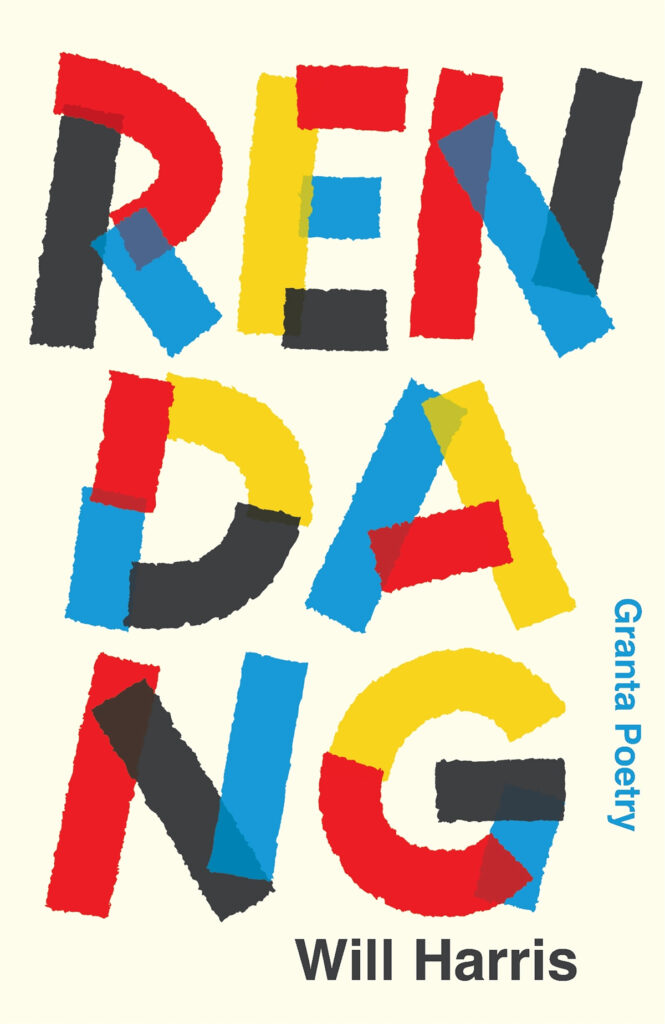

RENDANG

Granta Poetry
Will-Harris-c-Etienne-Gilfillan_web_bw
Will Harris is a writer of Chinese Indonesian and British heritage, born and based in London. His poetry pamphlet, All this is implied (HappenStance 2017), was joint winner of the London Review Bookshop Pamphlet of the Year and shortlisted for the Callum Macdonald Memorial Award. His poems and essays have been published in the TLS, Granta, the Guardian, and the London Review of Books, and...

Review

Review

In Will Harris's RENDANG, meaning is evasive and possibilities ripple through poems as Harris shows us the irresistible, distorting force of presumption and cultural heritage, writes John Field

Read the
Reader's Notes

Videos

Will Harris talks about his work
Will Harris reads ‘Scene Change’
Will Harris reads ‘The White Jumper’

Related News Stories

The T. S. Eliot Foundation is delighted to announce that the winner of the T. S. Eliot Prize 2020 is Bhanu Kapil for How to Wash a Heart, published by Pavilion Poetry (Liverpool University Press). Chair Lavinia Greenlaw said: Our Shortlist celebrated the ways in which poetry is responding to...
‘The list really began through these poets’ trust in me’ – Rachael Allen I am very inspired by a number of presses in North America, including WAVE books, Ugly Duckling Presse and Black Ocean, and the way these presses (and others like them) create space for erudite, visually innovative, essential...
Judges Lavinia Greenlaw (Chair), Mona Arshi and Andrew McMillan have chosen the 2020 T. S. Eliot Prize Shortlist from 153 poetry collections submitted by British and Irish publishers. The shortlist comprises work from five men and five women; two Americans; as well as poets of Native American, Chinese Indonesian and...
The T. S. Eliot Foundation is delighted to announce the judges for the 2020 Prize. The panel will be chaired by Lavinia Greenlaw, alongside Mona Arshi and Andrew McMillan. The 2020 judging panel will be looking for the best new poetry collection written in English and published in 2020. The...
Review of RENDANG

In Will Harris’s RENDANG, meaning is evasive and possibilities ripple through poems as Harris shows us the irresistible, distorting force of presumption and cultural heritage, writes John Field

Reading Will Harris’s debut, Rendang, is a rich, rewarding experience. Cities and interiors are evoked with deft economy and, in Harris’ hands, the kaleidoscope of context twists in a moment, fracturing and reconfiguring the world with a dreamlike surrealism. Rendang is a restless collection, flitting from explorations of identity and belonging, to a sheer joy in language.

Meaning is evasive. Even Harris’s opening dedication overwhelms the reader with etymology and regional variation. He writes from the perspectives of his Chinese, Indonesian and British heritages and rendang is a Malay spiced beef dish. ‘In West Sumatra they call rendang / randang. Neither shares a root / with rending. Rose and rose have / French and Frisian roots / you can’t hear. Context makes / the difference clear’. The rhyming of rendang, randang and rending is playful and the reader is deceived by a consonance which belies their difference. Context presents itself as a possible guide and Harris extends this invitation as he dedicates the collection to Tjandra Sari, his grandmother, writing ‘Here lies one / whose name was written in bahasa’. Readers familiar with the epigraph on Keats’s grave – ‘Here lies One Whose Name was writ in Water’ – will involuntarily translate ‘bahasa’ as ‘water’ and suppose the dedication to be a meditation on mortality and impermanence. However, Bahasa is both a form of Malay and the word for ‘language’. It anything, it ascribes a degree of permanence to Sari, now memorialised in the collection. All of these possibilities ripple through the poem’s kaleidoscopic lens as Harris shows us the irresistible, distorting force of presumption and cultural heritage.

As it plays with context, the meditative prose poem ’Holy Man’ mourns the loss of meaning in its rebuke to consumerism. Joni Mitchell’s song, ’River’, opens with the plangent ‘It’s coming on Christmas, they’re cutting down trees’. This cultural context endows Harris’s ‘Everywhere was coming down with Christmas’ with seasonal ennui and his ‘coming down’ turns the festival into an illness. The ground moves beneath us as we realise that the illness is not Christmas but the retailers’s October preparations – an act of violence in which meaning is ‘severed from the body of ritual, of belief’.

Context is also revealed to be deeply problematic. The short lines and tercets of ‘Scene Change’ evoke a pleasing simplicity as ‘A row of Georgian / houses slopes / down to a meadow’. Neoclassical symmetry is evoked by ‘row’ and Austen’s wholesomeness wafts on the meadow’s breeze. However, the title’s ‘scene’ alerts us, perhaps, to its status as a construct – it’s a deception and, with the tug of a stage rope, will disappear. The meadow reconfigures as ‘barrows’ – still an  undulating grassland, but one now concealing skeletal remains. The speaker climbs the bell tower and ‘taking in my / hands the tongue / the clapper / ring too slowly / at first aware / of my imposture’. Context still wrong-foots us as the bell tower insists that we are in a church and ought to feel uncomfortable but, in a coup de théâtre, we finally see the whole scene as we look ‘across the car- / polluted outskirts of the colony’ and wonder about the original purpose of that bell and think again about the speaker’s sense of imposture, perhaps caused by the enduring shadow of the past.

This is a rich collection and these few words fail to convey the range of Harris’s language and ideas. In ‘Half Got Out’, the speaker sees the tube ‘threading me like a / complex stitch beneath / and through the city’ in a brilliant image: he is woven into the fabric of the city… but then, perhaps, woven onto it. In a stroke, the title poem, ‘Rendang’, presents the strictures of modern living: ‘Then / she slid her hand behind the fridge. A strip light / flickered on’.

Rendang shimmers in the light. The colours of pop and high culture rebound and refract in a serious work of playful intelligence.

Will Harris’s RENDANG (Granta Poetry) is shortlisted for the T. S. Eliot Prize 2020. John Field blogs at Poor Rude Lines.

RENDANG
Granta Poetry

Newsletter

Be among the first to receive updates on the latest T. S. Eliot Prize news by subscribing now!


The T. S. Eliot Prize on Social Media

Part of tseliot.com

Designed by thinking

Interview of RENDANG

RENDANG
Granta Poetry

Newsletter

Be among the first to receive updates on the latest T. S. Eliot Prize news by subscribing now!


The T. S. Eliot Prize on Social Media

Part of tseliot.com

Designed by thinking