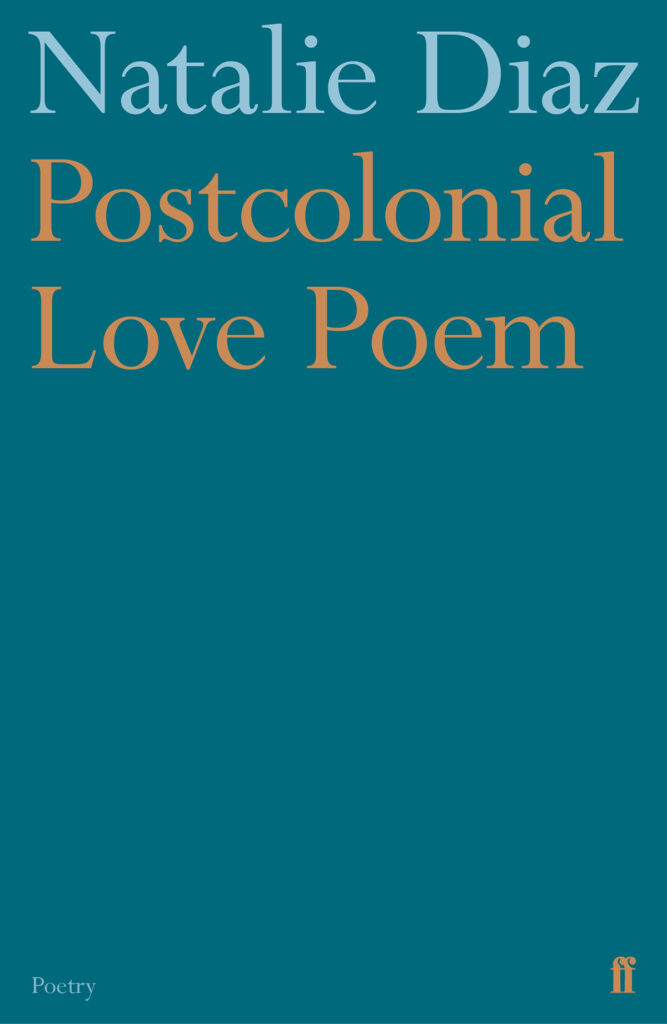

Postcolonial Love Poem

Faber & Faber
Diaz, Natalie © Deanna Dent
Natalie Diaz was born and raised in the Fort Mojave Indian Village in Needles, California. She is Mojave and an enrolled member of the Gila River Indian Tribe. Her first poetry collection, When My Brother Was an Aztec, won an American Book Award. Her second, Postcolonial Love Poem, won the 2021 Pulitzer Prize in Poetry, was shortlisted for the Forward...

Review

Review

Although the greed, guns and environmental crises of a United States riven by inequality boil on its surface, Natalie Diaz’s Postcolonial Love Poem is, above all, love poetry, and Diaz’s jewelled and honeyed language oozes with the erotic, writes John Field

Read the
Reader's Notes

Videos

Natalie Diaz reads ‘I, Minotaur’
Natalie Diaz talks about her work
Natalie Diaz reads ‘From the Desire Field’

Related News Stories

The T. S. Eliot Foundation is delighted to announce that the winner of the T. S. Eliot Prize 2020 is Bhanu Kapil for How to Wash a Heart, published by Pavilion Poetry (Liverpool University Press). Chair Lavinia Greenlaw said: Our Shortlist celebrated the ways in which poetry is responding to...
Judges Lavinia Greenlaw (Chair), Mona Arshi and Andrew McMillan have chosen the 2020 T. S. Eliot Prize Shortlist from 153 poetry collections submitted by British and Irish publishers. The shortlist comprises work from five men and five women; two Americans; as well as poets of Native American, Chinese Indonesian and...
The T. S. Eliot Foundation is delighted to announce the judges for the 2020 Prize. The panel will be chaired by Lavinia Greenlaw, alongside Mona Arshi and Andrew McMillan. The 2020 judging panel will be looking for the best new poetry collection written in English and published in 2020. The...
Review of Postcolonial Love Poem

‘Although the greed, guns and environmental crises of a United States riven by inequality boil on its surface, Natalie Diaz’s Postcolonial Love Poem is, above all, love poetry, and Diaz’s jewelled and honeyed language oozes with the erotic’, writes John Field

As a Mojave American Natalie Diaz’s Postcolonial Love Poem considers the erasure of native cultures and peoples from the American continent. However, she engages with political and environmental problems at an aesthetic and linguistic level too. Although the greed, guns and environmental crises of a United States riven by inequality boil on its surface, the collection is, above all, love poetry, and Diaz’s jewelled and honeyed language oozes with the erotic. Postcolonial Love Poem promises the reader a rich, rewarding experience.

Early in the collection, ‘Catching Copper’ engages with American gun culture. The speaker’s brothers – or close friends – keep a bullet as a pet. It’s a disconcertingly tender image and the thin line between the bullet-proof exuberance of youth and tragedy is painful. They ‘Feed their bullet / the way the bulls fed Zeus– / burning, on a pyre, their own / thigh bones wrapped in fat’. In Greek, a hecatomb is a sacrifice of a hundred oxen, a burnt offering on a grand scale. Homer’s Iliad reeks with the Greeks’ offerings to the gods and the senselessness and endlessness of their war with Troy feels here like a criticism of The Second Amendment. There is no recourse to the law as the brothers live in a state within the state. They ‘pledge / allegiance to their bullet’ in a parody of The Pledge of Allegiance which darkens with a port wine stain as they make their pledge ‘with hands over their hearts / and stomachs and throats’. Diaz’s states are not united; the government is distrusted.

The States holds the Americas in a stranglehold. In ‘exhibits from The American Water Museum’, ‘US-headquartered companies bought the rights / to water in other countries’. The murky complexity of the companies’ organizational structures is at heart-breaking odds with the desperate Natives who resort to the gathering of rain as they ‘open / their beautiful water-shaped mouths to the sky’. The poem strikes a bitter note of satire as we are presented with the redacted BIA Watermongers Congressional Records: ‘To kill xxxx.         xxx take their water’. The fig leaf drawn by the magic marker shows federal government protecting money, regardless of human cost. In ‘The First Water Is the Body’, we see the United States ‘teargassing and rubber-bulleting and kennelling Natives trying to protect their water from pollution and contamination at Standing Rock in North Dakota’. The poem is written in prose and shines a hard light on facts that don’t usually make it across the Atlantic.

‘The First Water Is the Body’ is the bedrock of the collection. Here Diaz shares a Mojave philosophy: ‘In Mojave thinking, body and land are the same.’ The good stewardship of the plant rarely looks like our priority. In fact, all too often, we demean it. In ‘Snake-Light’, even cruelty has a monetary value: ‘Americans celebrate the rattlesnake in rattlesnake rodeos— / round them up, kill them, sell them. Cash prizes / for the heaviest and longest rattlesnake’. Diaz’s ‘celebrate’ oozes scorn. The speaker’s Mojave great grandmother tells her that ‘We don’t eat snakes. They are our sisters’.

This interconnectedness is at the core of the collection’s eroticism. In ‘Ode to the Beloved’s Hips’, drinking connects the lover with the beloved: ‘Maenad tongue— / come-drunk hum-tranced honey-puller—for her hips, / I am–strummed-song and succubus’. This is language at its sweetest, the mouth crammed full of those vowels, oozing like the honeycomb, echoing Keats and Hopkins.

Despite the fractured, dysfunctional aspects of society, these poems believe in the healing power of love and, held within them, a jamboree of the world’s cultures collide with pop culture and the result is an intoxicating beauty.

Natalie Diaz’s Postcolonial Love Poem (Faber & Faber) is shortlisted for the T. S. Eliot Prize 2020. John Field blogs at Poor Rude Lines.

Postcolonial Love Poem
Faber & Faber

Newsletter

Be among the first to receive updates on the latest T. S. Eliot Prize news by subscribing now!


The T. S. Eliot Prize on Social Media

Part of tseliot.com

Designed by thinking

Interview of Postcolonial Love Poem

Postcolonial Love Poem
Faber & Faber

Newsletter

Be among the first to receive updates on the latest T. S. Eliot Prize news by subscribing now!


The T. S. Eliot Prize on Social Media

Part of tseliot.com

Designed by thinking