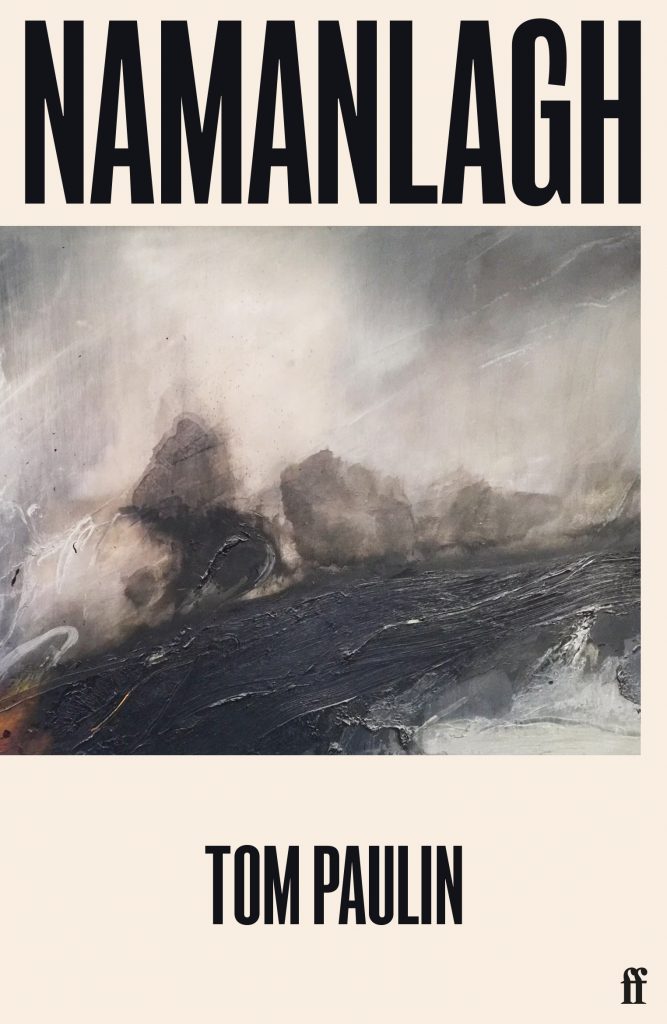

Namanlagh

Faber & Faber
Paulin, Tom_credit Bobbie Hanvey_2
Tom Paulin grew up in Belfast and now lives in Oxford, where he is Emeritus Fellow of Hertford College, University of Oxford. Namanlagh (Faber & Faber), his first collection in a decade, is his tenth book of poetry and was recently awarded the PEN Heaney Prize 2025, as well as being shortlisted for the T. S. Eliot Prize 2025. Of...

Review

Review

In Tom Paulin’s Namanlagh, the past lives on in the memory: tactile, vivid and immediate, writes John Field

Read the
Reader's Notes

Videos

Jamie McKendrick reads Tom Paulin’s poem ‘The 8th Army Cemetery, El Alamein’
Bernard O’Donoghue reads Tom Paulin’s poem ‘Quand vous serez bien vieille’
On Tom Paulin’s ‘Namanlagh’ – Jamie McKendrick & Bernard O’Donoghue
Tom Paulin reads his poem ‘Namanlagh’
Tom Paulin reads his poem ‘Folly Bridge’

Related News Stories

Tom Paulin, shortlisted for the T. S. Eliot Prize 2025 with his collection Namanlagh (Faber & Faber), is the featured poet in this week’s Eliot Prize newsletter. The newsletter tells you about the wide range of content we have just published to help you get to know Tom and his...
We’re delighted to announce the T. S. Eliot Prize 2025 Shortlist, which offers ‘something for everyone’ in collections of ‘great range, suggestiveness and power’. Judges Michael Hofmann (Chair), Patience Agbabi and Niall Campbell chose the Shortlist from 177 poetry collections submitted by 64 British and Irish publishers. The diverse list...
The T. S. Eliot Foundation is delighted to announce the judges for the T. S. Eliot Prize 2025. Chair Michael Hofmann will be joined on the panel by Patience Agbabi and Niall Campbell.  Michael Hofmann said: I’m delighted to be asked to judge the T. S. Eliot Prize and look...
Review of Namanlagh

In Tom Paulin’s Namanlagh, the past lives on in the memory: tactile, vivid and immediate, writes John Field

The title of Tom Paulin’s tenth collection, Namanlagh, sites it in the Irish Republic’s County Donegal towards the north of the island. In the titular opening poem our speaker is haunted by history even when there is no known history to haunt him as he walks beside Lough Namanlagh. He hears two stones being knocked together and, speculating about its source, he imagines a chain gang — but ‘there never was a chain gang’. It doesn’t take long before he trips into the rabbit hole of history, ‘the little chunks of red granite on the long / looping bog road tell of famine relief’. Building projects were often used by Irish landowners to keep the poor employed, and the awkward association of chain gang and famine relief asks us to think again about how philanthropic these projects really were. In fact, the knocking sound is none of these things: it’s just a stonechat. However, the imagination is its own place, a place no less haunted by history’s broad sweep than it is by birdsong. Towards the end of the collection, in ‘Waiting for an Answer’, we’re back in Namanlagh’s bogland but, this time, the landscape is haunted by personal ghosts too. The speaker has ‘just walked over the fallen lintel / that belonged to the ruined cabin or byre’. Walking over the lintel transforms the landscape into something liminal, placing the speaker on the threshold between present and past. ‘I might cross this meadow with a pail / and milk the invisible cow the bo / I whisper names to as I squeeze her teats’. The Gaelic word for cow, ‘bo’, has sprung suddenly to mind. The past lives on in the memory: tactile, vivid and immediate. To revisit a place is to shrug off those wrinkles and to travel through time.

The collection presents a tense relationship between the Irish Republic and the United Kingdom. In the monologue ‘James ‘Mick’ Magennis VC’, we meet the Belfast sailor who served in the Royal Navy during the Second World War. Upon his return home, his ‘community on the Falls Road in Belfast rejected him’. The poem is squeezed onto the page. White space pushing inwards from the margins – fitting perhaps as Magennis’s extraordinary acts of bravery were conducted in ‘a midget submarine’, or perhaps it is the uncomfortable push from both sides of the sectarian divide, a push that eventually saw Magennis upping sticks for Yorkshire.

The whiteness, the blankness, of Namanlagh also points to Paulin’s struggle writing these poems in the first place. In ‘After Depression?’ the speaker observes that ‘the power to think / has clean left me / no new essays or classes or lectures’. It evokes the Scarecrow from The Wizard of Oz. The speaker clutches his ‘two bony knees and wonder[s] / how much – stripped of flesh – [his] bones would weigh’. We’re in the territory of T. S. Eliot’s ‘Whispers of Immortality’, where we see ‘the skull beneath the skin’. Over the page, in ‘Another Bite of the Apple’, the speaker and his partner are ‘like two écorchés / rising from the dissection table’. Écorché comes from the French ‘to flay’, and was a term applied to anatomical models, stripped of their skin to expose the musculature beneath. It’s a very different kind of teaching: the university lecturer, his body left to science, still has a group of undergraduates around him, but he’s become a perishable resource.

Like revenants, these écorchés resurface return to haunt us again in ‘The Road to Lifford’ where ‘on the outskirts of Strabane / there are five six giant figures / that look like écorchés / though with the organs and the guts / cut clean away’. Lifford was a hotspot during the troubles, and this context makes it difficult for a jaunty bit of municipal art (a gaggle of musicians playing fiddle, flute and drum) to be read in a vacuum. Perhaps it’s just a tribute to the island’s great craic but alongside them ‘dances the dismantled watchtower / between a warehouse and two hypermarkets’ – whether it has been dismantled or not, it is still present in the mind’s eye.

Despite the loss of power testified to in ‘After Depression?’, Paulin’s stoic impetus to carry on has gifted us these poems. The dignity, honesty and humanity of this collection are jaw-dropping. We might want to wish history away, but this isn’t something we get to decide. Yes, it can be painful to look back. We can pretend that it’s been tidied away, that there’s nothing left to see but, as Paulin peels back the skin and shows us the écorché, he shows us a more precise, scientific, dispassionate way of looking back.

Tom Paulin’s Namanlagh (Faber & Faber) is shortlisted for the T. S. Eliot Prize 2025. John Field blogs at Poor Rude Lines.

Namanlagh
Faber & Faber

Newsletter

Be among the first to receive updates on the latest T. S. Eliot Prize news by subscribing now!


The T. S. Eliot Prize on Social Media

Part of tseliot.com

Designed by thinking

Interview of Namanlagh

Namanlagh
Faber & Faber

Newsletter

Be among the first to receive updates on the latest T. S. Eliot Prize news by subscribing now!


The T. S. Eliot Prize on Social Media

Part of tseliot.com

Designed by thinking