
Wayne Holloway-Smith's Love Minus Love is a jarring experience, the air between words squeezed out, logical divisions ignored. 'The familiar is made strange, broken, reminding us that on a domestic battlefield, danger hides in plain sight', writes John Field
Be among the first to receive updates on the latest T. S. Eliot Prize news by subscribing now!
Wayne Holloway-Smith’s Love Minus Love is a jarring experience, the air between words squeezed out. logical divisions ignored. ‘The familiar is made strange, broken, reminding us that on a domestic battlefield, danger hides in plain sight’, writes John Field
Wayne Holloway-Smith’s Love Minus Love pulls off dizzying feats with language and structure in its forensic examination of the nuclear family. Through its sound and silence, we feel the forces tearing the individual asunder as the framework of the family collapses.
The collection took me back to Glyn Maxwell’s comments on the whiteness of the page in On Poetry (Oberon Books, 2012). He writes that ‘With the best poets you can play an archeological game. Take a volume of the work, mist your eyes so you can’t read a word, flutter through the pages, get a sense of the forms the poems take. […] This is the place to begin, peering at shapes. Assess the balance of the black creature and the white silence’. As we squint at the pages of Love Minus Love, we feel the threat of a numbing nothingness pushing in. This use of space reminds me of the Abstract Impressionist, Mark Rothko. At first glance, the slabs of white suggest peace and purity, but appearances are deceptive. The poems are untitled and one opens with ‘what / is / the / least / a / person / can / reduce / themselves / to’. The lines are largely monosyllabic and, as the word ‘a’ comprises a complete line of poetry, we see language in an almost total retreat from the page. The thin, fragile column on the page suggests the tight, folded body language of someone wishing himself away.
The opening poem employs a similar technique – this time to explore a relationship. It is structured as two neat rectangles, divided in the centre by a white column, a centimetre wide. Through these rectangles and across the white barrier, a torrent of language runs: ‘Icouldbeafreegratefulguilt lessuprightsonandyoucould / beanuntroubleduntyrranic assympatheticcontentedfath / er’. The sense of the poem runs counter to the neat blocks as the speaker’s wishes for himself and his father bleed across both. On the surface all is well, but closer inspection reveals that the bonds tying us together are too tight to cut.
In Holloway-Smith’s hands, there’s an emptiness to language. One poem, ‘whenI / firstbe / ganto / speakp / ublicaly’, describes a mother who ‘thrived’ as her son enjoyed success by writing about a dysfunctional family but the narrative soon shifts and tells a different story. Or rather, although the public story remains unchanged, but we also read the fruitless attempt to conceal the seething words of the mother, who ‘wasenraged’. Love Minus Love is a jarring experience. As this poem illustrates, even the air between words has been squeezed out, creating a suffocating, stressful blackness. Perverse line breaks work to destroy language itself as the logical divisions of syllables are ignored. What we have instead feels arbitrary and violent like ‘speakp / ublicaly’. The familiar is made strange, broken, reminding us that on a domestic battlefield, danger hides in plain sight.
Holloway-Smith restricts our view. One poem opens with a breezy acknowledgement of the reader’s presence, ‘hi’, before we realise that we are not the implied reader. Distancing himself from a childhood experience, the speaker addresses himself, reliving an experience in the present. Initially, the mother is presented as a a model of duty and competence: ‘hi your mum is explaining / to you about menstrual cycles’ but, by line three, the camera zooms out enough for us to see that the room’s ‘unflushed bowl’ was the occasion of the conversation and the mother morphs into a drunkard struggling to roll with the punches of her day.
Love Minus Love radiates an austere, sculptural beauty. This playful creativity forms an exquisite counterpoint to the poems’ pain and the collection pulses with honest immediacy.
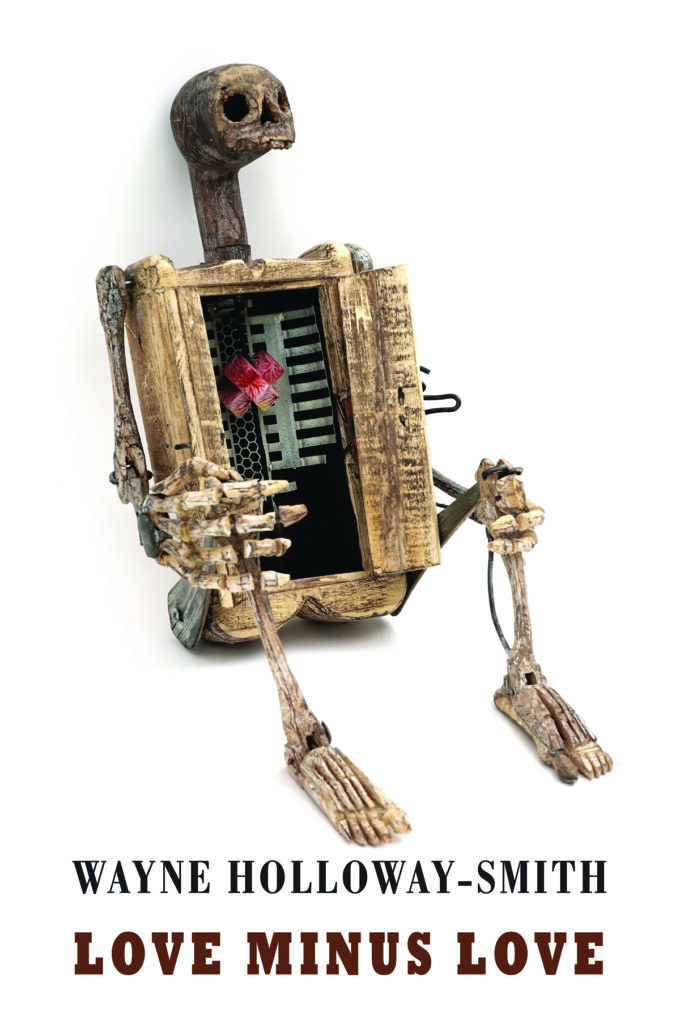
Wayne Holloway-Smith’s Love Minus Love (Bloodaxe Books) is shortlisted for the T. S. Eliot Prize 2020. John Field blogs at Poor Rude Lines.
Be among the first to receive updates on the latest T. S. Eliot Prize news by subscribing now!