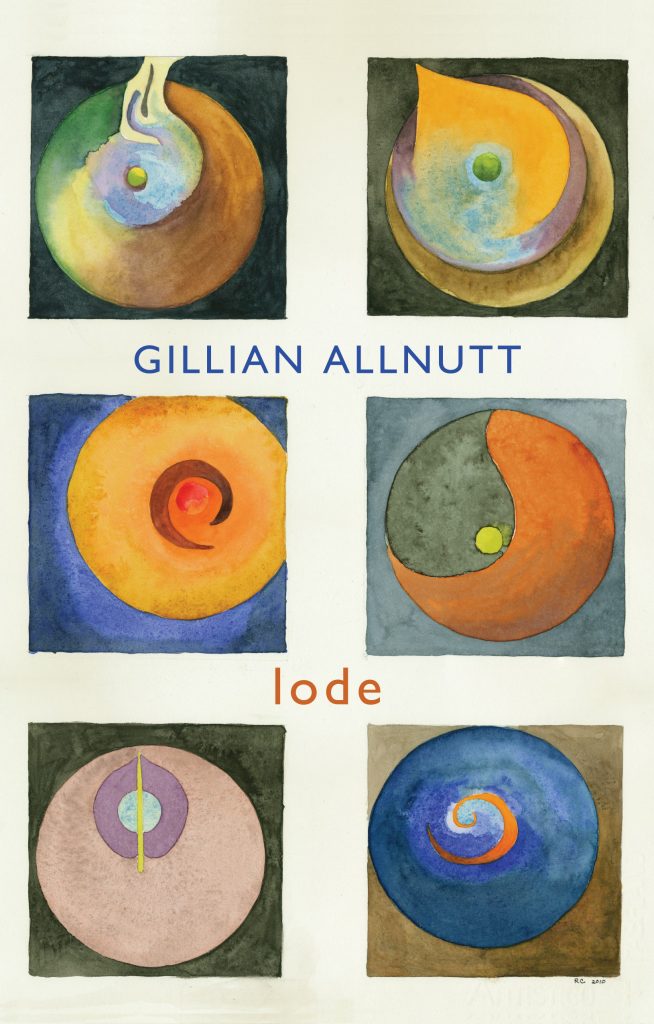
Lode

Bloodaxe Books
allnutt_phyllis_christopher_2_0
Gillian Allnutt was born in London but spent half her childhood in Newcastle upon Tyne. Nantucket and the Angel (1997) and Lintel (2001) were shortlisted for the T. S. Eliot Prize and poems from these collections are included in her Bloodaxe retrospective How the Bicycle Shone: New & Selected Poems (2007), a Poetry Book Society Special Commendation. Lode (Bloodaxe Books)...

Review

Review

In Lode Gillian Allnutt explores constraint and freedom, protection and danger and brings the full force of history to bear upon the words she weighs so carefully, writes John Field

Read the
Reader's Notes

Videos

Gillian Allnutt talks about her work
Gillian Allnutt reads ‘At 71’
Gillian Allnutt reads ‘Solitude’
Gillian Allnutt reads ‘Poem for John Clinging’

Related News Stories

Gillian Allnutt, shortlisted for the T. S. Eliot Prize 2025 with her collection Lode (Bloodaxe Books), is the featured poet in this week’s Eliot Prize newsletter. The newsletter tells you about the wide range of content we have just published to help you get to know Gillian and her work....
We’re delighted to announce the T. S. Eliot Prize 2025 Shortlist, which offers ‘something for everyone’ in collections of ‘great range, suggestiveness and power’. Judges Michael Hofmann (Chair), Patience Agbabi and Niall Campbell chose the Shortlist from 177 poetry collections submitted by 64 British and Irish publishers. The diverse list...
The T. S. Eliot Prize and The Poetry Society are delighted to announce the cohort for the fourth instalment of the Young Critics Scheme. Ten young writers have been selected and will each review, in video form, one of the poetry collections shortlisted for the T. S. Eliot Prize 2025....
The T. S. Eliot Foundation is delighted to announce the judges for the T. S. Eliot Prize 2025. Chair Michael Hofmann will be joined on the panel by Patience Agbabi and Niall Campbell.  Michael Hofmann said: I’m delighted to be asked to judge the T. S. Eliot Prize and look...
Review of Lode

In Lode Gillian Allnutt explores constraint and freedom, protection and danger and brings the full force of history to bear upon the words she weighs so carefully, writes John Field

Reading Lode aloud reveals the beauty of its assonance and consonance: the ‘poste restante address, a palimpsest’ in ‘Flame-thrower’, for example. Tethered together by sound, Gillian Allnutt’s tenth collection unites people and ideas. This is true of its title too. Lode refers to an obsolete Old English word meaning ‘way, journey, course’ and, once upon a time in Chester, it was a dialect word for ‘road’ too. Once we’re on the road, we’re in the groove. Our route is predetermined. We’re on autopilot. However, if we think of Lode as a vein of metal ore, then we’re mining lodestone, and we’re out on open waters with limitless route possibilities. Perhaps we’re overwhelmed, fearful of submerged rocks and looking to be lead, looking for guidance. The Oxford English Dictionary records this anonymous example of Suffolk dialect: ‘When a signal is made for a pilot, At Aldeburgh, the Pilots on shore draw lots, and he, who gets the lot, or as they call it the Lode, goes off to the vessel’. Constraint and freedom, protection and danger – in Lode, Allnutt brings the full force of history to bear upon the words she weighs and, under these pressures, she holds diamonds in her hands.

An early poem, ‘Corbridge’, opens with the River Tyne: ‘The river full of itself, intent, contained.’ It’s a single end-stopped line, a dramatisation of our habit of parcelling the natural world with boundaries and walls. It’s a false etymology, I know, but the river is ‘in-tent’, it has been zipped up. Containers are a neat, mess-free way to hold liquids in our hands. The cap is twisted closed. The genie is in the bottle. Perhaps this is a snug, comfortable way for the Tyne to exist but its ‘intent’ contains the Latin ‘stretching out’ and points to ‘malicious intent’ too. Writing about St Andrew’s Church, Corbridge, in England’s Thousand Best Churches, Simon Jenkins remarks that, ‘Like many towns in the far north, Corbridge has the feel of a Garrison […] In the churchyard is a priest’s dwelling built to protect him from incessant Scottish raids.’ Allnutt’s speaker shows us this church, echoing the single line stanza applied to the Tyne: ‘The tower grounded and squat as only the Anglo-Saxon.’ It’s a fragment rather than a sentence, perhaps an echo of the fact that the church’s walls are filled with Roman masonry taken from their garrison, Corstopitum.

In ‘a place beyond belief’ a father returns home from the Second World War, and perhaps the title’s idiomatic expression claims that the domestic realm is a utopia of sorts, too good to be true. A standout detail from the collection is the father’s fingers, ‘rubbing the shine once more into the grain of table and sideboard drawer’ – a kind of Paradise Regained. The poem invokes Julian of Norwich’s thirteenth revelation, translated here by Clifton Wolters: ‘It is all going to be all right; it is all going to be all right; everything is going to be all right’, but Allnutt presents the father ‘knowing all shall be mended or amended here’. There’s only a letter separating mending and amending, and perhaps an amendment might also be an improvement, but we cannot be sure. In the next stanza, Thomas Hardy’s great First World War poem, ‘In Time of “The Breaking of Nations”’ is invoked: ‘in time the breaking of nations will come to pass’, but Allnutt’s next line, ‘will pass’, echoes Mother Julian’s reassuring certainty that there are better times ahead. Thinking of Julian of Norwich, perhaps the mind wanders back to the Vicar’s Pele, the keep or tower house that stands in Corbridge churchyard, built as protection from a hostile world. By contrast, Julian was bricked into her cell next to St Julian’s Church not as retreat, but as a positive act, as a focus on contemplation and prayer.

In 2025, it is difficult to consider immurement without casting our minds back to March 2020, and the first of the UK’s COVID-19 lockdowns. Lode’s second section, ‘Lockdown’, presents poems written at that time. ‘My Garden in Esh Winning’, dated May 2020, opens ‘The sheep are loud about their lambs / and no cars come. / It’s tea-time / in the small eternity of lockdown.’ Were the sheep always so loud, or did our silence allow us, once again, to notice the natural world? Remember the photos of the Himalayas, taken from the Indian city of Jalandhar, visible for the first time in thirty years as the air pollution abated? The oxymoron ‘small eternity’ captures the weird apocalyptic-yet-prosaic qualities of that moment. Were we in heaven, or were we in hell? Did our confinement liberate us?

There is plenty of white space in Lode, but one does not have to dig too far beneath its surface to strike magnetite, and then the forces of attraction pull everything together. Lode looks small – but it’s huge.

Gillian Allnutt’s Lode (Bloodaxe Books) is shortlisted for the T. S. Eliot Prize 2025. John Field blogs at Poor Rude Lines.

Lode
Bloodaxe Books

Newsletter

Be among the first to receive updates on the latest T. S. Eliot Prize news by subscribing now!


The T. S. Eliot Prize on Social Media

Part of tseliot.com

Designed by thinking

Interview of Lode

Lode
Bloodaxe Books

Newsletter

Be among the first to receive updates on the latest T. S. Eliot Prize news by subscribing now!


The T. S. Eliot Prize on Social Media

Part of tseliot.com

Designed by thinking