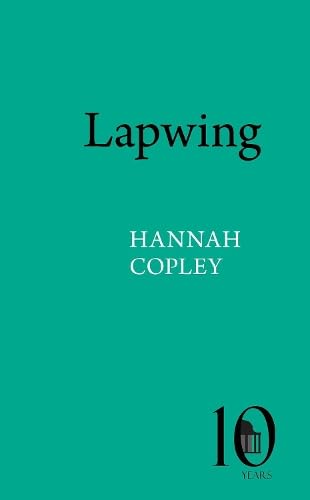
Hannah Copley’s Lapwing is a sombre skein of poems interweaving environmental threat, adversity and abandonment, writes John Field
Be among the first to receive updates on the latest T. S. Eliot Prize news by subscribing now!
Hannah Copley’s Lapwing is a sombre skein of poems interweaving environmental threat, adversity and abandonment, writes John Field
The lapwing, a once common sight, is now a Red List species which means, according to the International Union for Conservation of Nature (IUCN), that it is threatened with extinction. In her quote accompanying the announcement of this year’s Eliot Prize Shortlist, Mimi Khalvati, Chair of judges, noted the ‘strong strain of elegy’ running through the selection. Hannah Copley’s second collection, Lapwing, is a sombre skein of poems. Some of these explore the challenges of the natural world, while others present a human character struggling against life’s adversities.
Copley’s first epigram, taken from John Gower’s Confessio Amantis (c.1386), follows on from Tereus’s rape of Philomela when, in Gower’s version, he is punished by being transformed into a lapwing. The myth usually sees him transformed into the extravagantly feather-crowned hoopoe, but Gower goes for the understated English alernative: ‘on his hed ther stant upriht / A creste in tokne he was a kniht’. We’re reminded of nature’s centrality to our understanding of the world, and of ourselves. Set against this, Copley’s opening poem, ‘[Description]’, reads like a missing person’s report. We’re told that the lapwing was ‘Last seen in his winter plumage’ before being given a list of his aliases: ‘Peewit, Plover, Tew-it’. We worry about losing a single member of our flock but, here, an entire species is missing. Lapwing sightings, rendered as prose poems, are interleaved through the collection. Given that these are sightings of what is, in effect, a missing person, one might assume that they would trigger interventions by the avian equivalent of emergency services. However, these poems are forensic in tone and deed: a lapwing is spotted ‘Loitering near the military base in October […] Stalked and collected […] Archived as a study skin and partial skeleton’.
In Landmarks, Robert Macfarlane comments on Oxford University Press’s cull of words relating to the natural world from the Oxford Junior Dictionary. ‘And what is lost’, he writes, ‘along with this literacy is something precious: a kind of word magic, the power that certain terms possess to enchant our relations with nature and place’. Lapwing re-energises language. The lapwing is ‘Peewit, Plover, Tew-it, Lhapwynche, / Peet-Peet-Peet, Toppy, Kievit, Lappewincke, Pater, / Vanellus, vanellus, Phillipeen’. In a climate crisis, Copley reminds us that the relationship between word and world is political. If we can’t name it, we can’t see it. Lapwing’s language is also a language of spells, and reading it conjures the world. In ‘She thought it was just the regular carnage –’ we see ‘red kites circling the field like clock hands’ – even the speed of this image is pitch perfect.
The collection’s acknowledgements include website URLs offering help to people living with alcohol addiction, or those trying to support someone living with alcohol addiction. They’re unexpected, and pose questions about the poems presenting Peet, a daughter processing her father’s vanishing. An early one of these, ‘On the difficulty of care’, opens: ‘They once found him lulled beneath the concrete base / of the pylon, raggedy feather rucked / in leaf mould and mess.’ ‘Once’ suggests that this father is found sleeping rough regularly, the worse for drink. The next stanza jump-cuts to a lapwing lavishing care on its brood with ‘proffered crane fly, / larvae, a dozen wetland molluscs’. The chicks are served a feast. Care ought to be an instinctive rhythm, and this compounds the pain of finding one’s father ‘lulled’ asleep: a reversal of roles in which he is the infant or, like John Keats’s knight-at-arms, intoxicated, delirious and lullèd asleep ‘On the cold hill side.’
Lapwing offers little respite, and no easy answers. The collection’s final sighting of a lapwing presents it, ‘Eyes glassy in Fitzwilliam Street, standing at his full height between a swan and a European woodpecker’, reduced to a museum exhibit.
Hannah Copley’s Lapwing (Pavilion Poetry / Liverpool University Press) is shortlisted for the T. S. Eliot Prize 2024. John Field blogs at Poor Rude Lines.
Be among the first to receive updates on the latest T. S. Eliot Prize news by subscribing now!